Showing posts with label Sierra Club. Show all posts

Friday, September 12, 2014

Environmental Activism

Who would have guessed that one event, for which I have been working an entire calendar year, and another, that came about in the last couple of months, both of which are really important to me, would fall on the same day?

First, I'll tell you about the one you can be part of.  On Sunday, September 21, many environmental organizations are coming together for a People's Climate March in New York City.  Some of you know that I am very involved with the Sierra Club.  In addition to the usual 30 emails I get a day as a member of our local Sierra Club Executive Committee, and as a member of the statewide Energy Committee, I have tried to do my part in encouraging people to attend the March. Many Sierrans are making phone calls, organizing buses, and tabling, for this effort.


The timing of the People's Climate March is immediately in advance of the UN Climate Summit where leaders will lay the groundwork for a Climate Treaty.  After my experience at the march against the Keystone Pipeline in 2013 in Washington, DC, I would like to be in New York on the 21st and help take a stand for the environment and the most important issues facing the world today. If you can go or would just like more information, go to www.peoplesclimate.org    Being part of this march will be an amazing experience!


I have been working on the Adirondack Mountain Club Fall Outing sponsored by our Albany Chapter for a year, as one member of a five-person committee. I have committed to being at this event.  Hey, even my award winning photo of Lake Durant is featured on the registration page!


People often think of ADK as a "hiking club."  In fact, 70% of members join because they believe in the conservation efforts of the club.  The issues ADK tackles are more local and are easier to understand than the complex world-wide issues of the Sierra Club.  Both are worthy environmental groups.

The Fall Outing, however, will be fun.  It is three days of outings in the Keene area, including a spaghetti dinner at the firehouse and a musical event.  My part in the planning has been to communicate and help organize the 52 hikes and paddle outings for the three days.  I enjoy emailing with the leaders and working with the other members of the event committee, even though it has required many hours of communication and cooperation over the past year. If I could be in two places at once, I would surely attend both the People's Climate March and the ADK Fall Outing.

If you are able to attend the People's Climate March in Manhattan, I hope you will do so.  It will be a momentous event, and will show our world leaders how much we are concerned about the huge environmental issues we all face today.


Wednesday, February 20, 2013

Climate Rally in Washington, DC


(The U.S. Capitol in early morning)

 I had received emails from numerous environmental organizations about the upcoming February 17 Climate Rally in Washington D.C.  Billed as the biggest event of its kind, the rally was co-sponsored by the Sierra Club and 350.org, along with 160 smaller participating entities.  I bought my ticket and boarded one of three buses leaving from Albany at 12:30 a.m. on Sunday, the 17th.


( the Washington Memorial is still fenced off due to earthquake damage from 2011)
The bus let us off near the Mall at 8:20 a.m. to frigid temperatures and a strong wind.  Many people found the nearest Starbucks on their iPhones and headed in that direction.  My friend, Laura, and her co-worker Kevin, and I decided to do a little sightseeing.

(magestic sycamore trees make a canopy as we head towards The Basin)
Facing into the wind, wrapped to our eyeballs in scarves, we headed to the newest memorials.


The Martin Luther King Memorial overlooks the Basin and is dramatic in carved stone with quotes from his speeches along the wall that forms a semi-circle around the statue.


We returned to the Mall via the World War II Memorial, a dramatic series of columns with bronze wreaths.


Over 4000 stars, each representing 100 soldiers who died in World War II, glitter in the early morning sun.


Other environmentalists began arriving from states all across the country.  We were intrigued by this King Coal bus.  It would be tough to be against climate change and ride on a bus touting the coal industry.

For a brief escape from the cold, now registering about 15 degrees with the wind chill, we made a stop in the Museum of Natural History.


At 11:00, I left Laura and Kevin to return to the World War II Memorial where Sierra Club members and other New Yorkers were gathering for an anti-hydrofracking protest.  About 1000 people posed for a photo to be delivered to Governor Cuomo.


By noon, nearly 50,000 people came together near the Washington Monument to hear speeches.


I remember seeing Bill McKibben back when he was at Adirondack booksignings as a nearly unknown writer.  Now, he has been able to bring together hundreds of thousands of people of all ages through his organization, 350.org, in attempt to change the destructive path of global warming.

Michael Brune, Executive Director of the Sierra Club, spoke about the future of today's children and how Obama has the opportunity to make a difference.  Also impressive were three Canadian women who urged Americans to keep fighting the Keystone XL Pipeline and the development of the Tar Sands Oil Fields in Alberta, Canada.  The pipeline, proposed to go from Alberta through the American mid-west to the Gulf of Mexico, is considered the single most destructive proposal by the oil industry today, and was a major focus of the rally.


National Park Rangers, government helicopters, fire and ambulance crews, and police, kept watch on what was a very peaceable protest.

Here I am, nearly frozen, with Atlantic Chapter Sierra Club Executive Committee members Bob Ciesielski and Carl Arnold, holding up an anti-fracking sign.  Many people came by and took pictures of the sign which we held during the entire rally.


We folded up the sign once the march began along Constitution Avenue.  It was impossible to see the beginning or the end of the line.

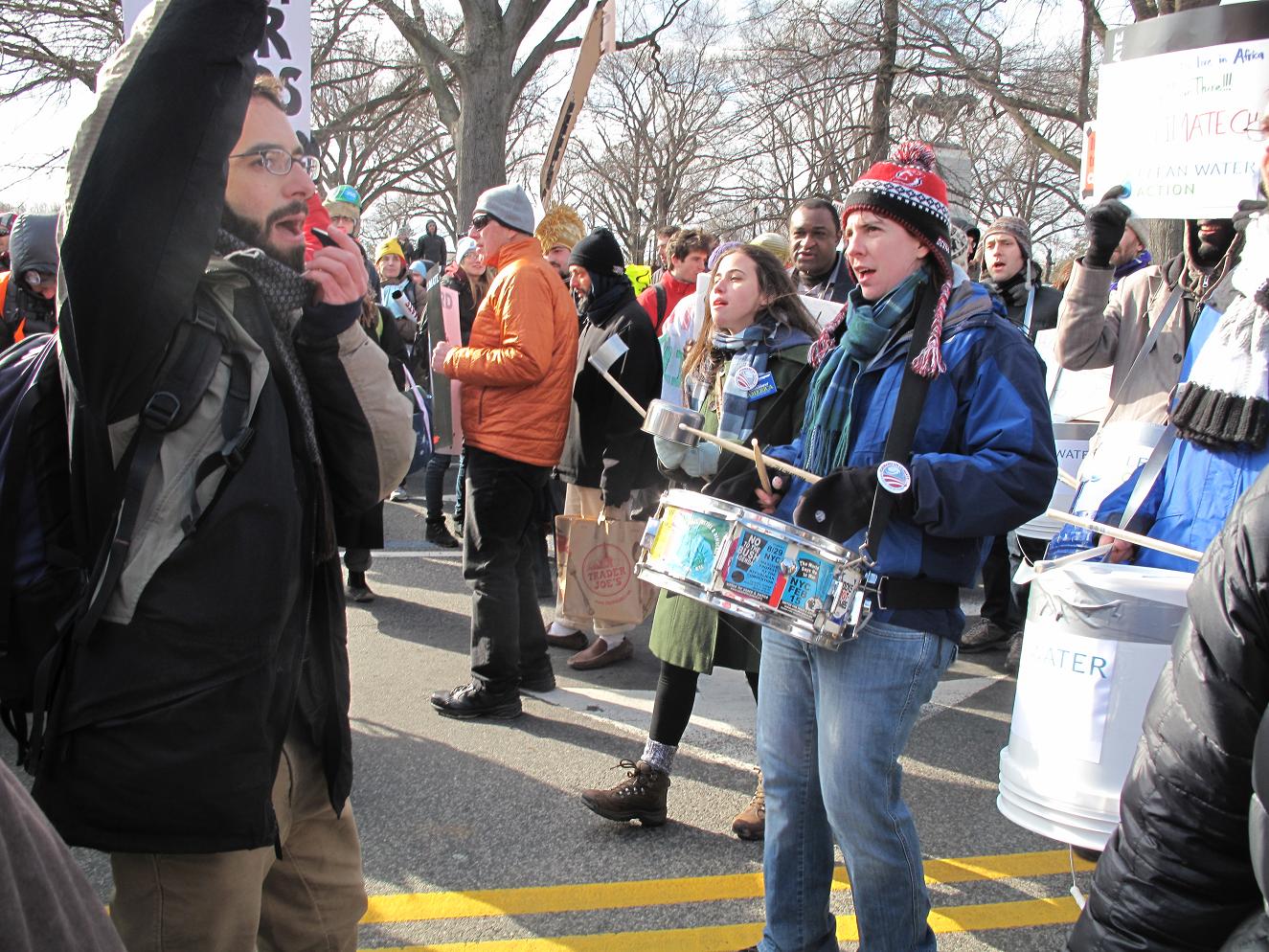
So many young people were part of the event...as it should be since their future is longer than ours and they have a powerful voice.  I stopped to take a picture of these folks drumming on homemade instruments. Within seconds, I had lost Bob and Carl in the crowd.


It didn't matter that I was on my own. Everyone was friendly, even as we stepped on or bumped into one another. And with all the people and the bright sunshine, the temperature seemed just a tad warmer.


 This young man at left actually led the makeshift band as he walked backwards.


Destination White House!  I met Jessica Helm, a Sierra Club delegate from Long Island who is on the National Board, and walked with her for a little while.  


We were encouraged not to linger in front of the White House and continued on Pennsylvania Avenue back towards the Washington Monument.  I watched people playing rhythms on this drum as they walked. The drum says, "One Earth, One People, One Heartbeat."  A young man handed me a mallet and I joined in.

When the march came to an end back at the stage near the Monument, I thought I would watch for a few minutes.  Music and dancing were promised, to warm everyone up.  I only lasted through the singer, Eve, before I decided I had had enough of the cold and wind.


Walking back towards the Air and Space Museum, I passed these hardy daffodils braving the frigid weather!  By 5 p.m., I met up with Laura and Kevin and was back on the bus heading for Albany.  We arrived home just after 1 a.m. Monday morning.

While the rally was fascinating and it certainly energized my environmental sensibilities, it is hard to know how effective we were.  Regardless, I was glad to join those who want to be able to tell their children that we are trying to leave a stable and beautiful world for them.

Saturday, October 20, 2012

At Home in Albany, NY


For a long time, I had an ambivalent relationship with Albany.  I loved the little house we bought in 1983 when Thomas was 9 months old; I had made friends, and we had good neighbors next door, but it took years for me to get used to living in the "city" (pop. 90,000).  Bill, the real country person of the two of us, immediately embraced the convenience and benefits of being in town.

(our house)

At different times over the years, we put our house on the market and looked for properties with acreage, where I envisioned our kids playing in our own stream and cutting Christmas trees on our own property.  And then, for different reasons each time, we would take our house off the market.  Each attempt at moving, and then deciding to stay, prompted a few home renovations and a new thought process, planting us just a little deeper into our community.

What fun, on a recent September weekend, when new friends, Roger and June, came for a visit and wanted to "see Albany."  As we shared downtown with them, I thought about the various aspects that had made Albany, admittedly a city with pluses and minuses, the place where we now plan to stay.
(Roger and June on the Empire State Plaza with the Egg in background)
When I told my Co-op friends that we had visitors coming to see the city, one of them said, "Be sure to show them the sculptures on the plaza!"  We intended to walk the plaza, both to see the Egg and the south side of the Capitol, but the sculpture? I hadn't given it much thought.  June especially liked this one, below.

(Plaza sculpture)
And who can resist the Egg?  I had chaperoned school field trips, and gone to concerts and special events there.  For years, Thomas had called the skyline of Albany, "the greatest city known to man."  Despite the hyperbole, the Empire State Plaza has a lot to offer.


(architectural detail on Capitol Building)
I had thought that the focus of our excursion downtown would include a tour of the Capitol. A dozen years of restoration has made the Capitol an even more fascinating destination with newly re-opened skylights and cleaned sandstone.  I was disappointed to discover that the building is closed to tourists on weekends. Filling in as tour guide for the outside, I remembered to tell June and Roger about the 17 steps on the West side of the building and the 76 steps on the East.  Symbolism abounds. 

(New York State Capitol)

I find it interesting, also, that Governor Teddy Roosevelt, over 100 years ago, had halted construction on the Capitol because it seemed never-ending and an ongoing huge expense; and just last year, Governor Cuomo had called for an end to the restoration of the Capitol for the same reasons.  Now with the cranes and scaffolding gone, our guests could better appreciate the architecture. They'll have to come another time for the inside tour.

City Hall is also striking.  Bill described the weekly carillon concerts which send music across downtown.  I remembered battles fighting for our neighborhood park, when I attended many Common Council meetings at City Hall.  A proposal had been made to develop the park in the early 2000s.  Although it created tension across the city, now I look back at how our neighbors worked together, meeting at one another's houses, pooling our skills, eventually winning and saving the little park for ourselves and for future generations.  I almost hate to admit that this battle, so negative and literally fighting "city hall," made me feel more connected to my greater community. 
(Albany City Hall)
In addition, the battle to preserve green space not only confirmed Bill's and my lifelong environmental leanings, but became a catalyst for me to become a Sierra Club member and environmental activist.  The Sierra Club had gone to bat for us when we needed it.

We headed down State Street, where Roger, who had grown up in Schenectady, recognized the SUNY Central Building, and we talked about its Belgian architecture.  From there we continued on Broadway to the Riverway, walking across the bridge to the Hudson River.  And what did we find?  Sculptures of Dutch shoes that we could sit in!  Bennington has its moose, and Saratoga has its horse sculptures--how totally fitting for Albany to celebrate its Dutch heritage with these.
(Virginia and Bill in the Dutch clog--notice the Egg in lower right)
Since the Capitol was closed, our afternoon focus was a visit to the Albany Institute of History and Art which had just that day opened an exhibit on American Impressionism.  I knew June and Roger loved art and we spent a couple of hours in the museum.  This weekend was also Larkfest, which we took in for a few blocks on Lark Street and then headed down a side street of historic row houses.
(1851 house on side street)
I came to know almost all of Albany's neighborhoods through our kids' various school friends.  Acquaintances used to raise their eyebrows when I said my kids went to the public schools.  "Middle School?" they would ask.  "High School?"  It wasn't all good, but it sure wasn't all bad.  Like anyplace, we had our great teachers, and our mediocre ones, a number of frustrations and lots of satisfaction.  Bill, who had had a rural high school graduating class of 34 students, was amazed at the variety of courses and opportunities our kids had. 

(Madison Avenue houses)
Working together with other parents and teachers to make things better took time and energy.  In the end, our kids did well and now have multiple degrees, but it wasn't always an easy path. As residents of New York City, they credit Albany High with their comfort living in a big diverse world.  

Showing off these row houses (above), that were once featured in Architectural Digest, is always a highlight for me. Our guests noticed the windows, balconies, and entryways.  The more interested the tourist, the better tour guide I become!  Only time constraints kept me from spouting off an entire dissertation.

(Cathedral of the Immaculate Conception)
I knew that Roger and June, practicing Catholics, would want to go to church, so I chose Albany's premier Catholic institution, the Cathedral of the Immaculate Conception.  Bill's sister had gotten married here in 1991 when the cathedral was a dark dreary building.  Now it is restored both inside and out (see my blog post "Cool Places for a Hot Day").


(Washington Park)
We were hungry by the time we passed through Washington Park and were thinking about dinner back at our house, three miles west.  Still, I was curious to see the fall plantings and flowers, as I regaled our guests with stories of Albany's glorious tulip display.  These autumn gardens made a nice showing. 

Do I sometimes still wish for a home in the country and a view of rolling countryside out my kitchen window?  Of course, but times have changed and so have we.  We like being able to ride our bikes to work, the library, and the food co-op, and we find plenty of excuses to make excursions out of town, as evidenced by many of my previous blog posts!  Besides, it would take a couple more decades to make another place feel like home.

When June and Roger were leaving, I waved them off saying, "there's still more to see in Albany for future visits!"  And then Bill and I went inside to read the newspaper on the porch, one of the additions we made to the house in 2005, the last time we had debated whether to move or not...and had decided to stay.

Thursday, March 24, 2011

New Orleans' Lower 9th Ward Today

When I told my friend, Rosemary, that I would be accompanying Bill to New Orleans where he would attend a conference, she asked, "Would you like Herb to introduce you to his NOLA contact?" Herb Wang, her husband and our good friend, had been taking University of Wisconsin, Madison, students down to the Lower 9th Ward every summer since Hurricane Katrina and the flooding in 2005. I was excited that I could get a morning's tour of the area with Darryl Malek-Wiley, Sierra Club Environmental Justice Organizer for New Orleans. A college student during the Vietnam War era, Darryl had stretched out his education to avoid the draft, at the same time joining in Sierra Club outings. Becoming an environmentalist has defined his life for decades. Darryl picked me up at my hotel promptly at 8:30 a.m. and said, "I have to get some students started on a project and then I'll show you around. We've got a few weeks here with lots of help over college spring breaks." My first view of the Lower 9th Ward was at the hub of Historic Green, an organization commited to sustainable design and historic preservation. Students grouped in a former warehouse received instructions for their day. Darryl would be taking a few to Bayou Bienvenue at the end of Caffin Avenue. He explained to me and the students, using a kiosk created by University of Wisconsin students a few years before, how the bayou could be restored. Before 1965 when the levees were built, natural bayous and wetlands cut the force of hurricanes and diminished the effects of flooding. Older residents of the Lower 9th could remember fishing, crabbing, and boating in the bayou. Now salt water had killed the cypress trees. The goal of Historic Green here is to restore the bayou back to its previous ecosystem. Today's project would be to work on the stairs that previous groups had begun building from the levee to the water. If residents could get to the water, they could fish for crabs, and take small boats from here. This group of six students from Minnesota would take rocks from alongside the levee and throw them into the water at the base of the steps, making a more solid area for the final steps and a beginning location for a dock. We left them throwing rocks. Back in the van, Darryl began describing the neighborhood where water had risen to the rooftops and homes had floated away, taking everything, including many people, with it. "When I first came here after Katrina," he said, "I couldn't drive down the street because it was full of debris." I remembered pictures of the wreckage of broken houses, cars, and trees. Many residents had not even been able to find where their homes had once been. Today there are no piles of debris and trash, but for every reconstructed house, there are at least three empty platforms with driveways that go nowhere. Some of the reasons that people have not returned are: the dissolution of an effective public transportation system; older residents did not qualify for new mortgages; even now there are no food markets in this area; and besides losing their homes, family, and friends, they have lost mature gardens that provided oranges, pecans, and kumquats, as well as vegetables. Some evacuees also became re-established in other towns and cities. Occasionally a charming new home has risen where an old one had been washed away. Not only are they built on concrete platforms as they had been before, but now the federal government requires that they be built a few feet off the ground on blocks, for high-water protection. Unfortunately, next door to attractive new construction, properties like this, with FEMA "x" markings still exist, continuing reminders of a painful past. Darryl seems to know everyone, calling out through the open window of the van. "What are you working on today?" a neighbor calls back. "I've got some students down at the bayou," he responds. "We're working on securing the steps so our flight of stairs won't float off into the bayou." The neighbor answers with a laugh, "Sure don't want that!" And we continue down the street. "These were not desperately poor people," Darryl tells me. "Seventy percent of them owned their own homes. They had gardens in back and flowers in front. We work with the neighborhood associations to see how they want to rebuild. Still, we have the unique opportunity here to build green, but we also have to recognize the original historic context of this area. Right now we have the greatest concentration of LEED Platinum homes in the world." Residents will live with fear for the rest of their lives, however, as evidenced by this new home (above), designed to float. I had never seen a LEED Platinum building. In Albany, we have been thrilled to watch the College of St. Rose build LEED Gold new construction. Some of the construction options that help these building qualify for platinum certification are solar panels on the roof, eco-friendly insulation, cement fiber board walls, and high energy windows. While some of the houses' non-traditional design may seem odd, they are doubtless very comfortable inside. Also, homeowners receive a reduction in their mortgage for every year that they stay in the neighborhood. In the Lower 9th, Brad Pitt has been instrumental in rebuilding part of the neighborhood to the highest environmental standards. (Note the steps going to nowhere in this yard, above. The owner lost both his sister and his mother to the flood.) Residents have a choice of different home styles, all of which aim to be carbon neutral. The Brad Pitt homes also are an entire story above ground. Homeowners have found this space handy as a car port, or for storing lawn accessories. Because some people may not be able to negotiate stairs, non-electric elevators have been installed as an additional outside entry.


Some rooftops have turf gardens (right) that absorb water and sun.


Very few trees remain, but those that are here are very dear to the people who survived the floods by hanging tight to the upper branches, inches above rising water below. The owner of this house (left) was told that he would get more direct sun for his solar panels if he took the tree down. He refused--this tree has become a member of the family.


We continued across a couple of four-lane roads to the Holy Cross Parish nearer the Mississippi, stopping at the Sierra Club headquarters here, and at the construction site of the new offices for Historic Green. Being in Darryl's company made everyone interested in meeting me. I was very glad that I could tell them that I am the Chair of the Sierra Club in upstate New York (Hudson-Mohawk Group). The Sierra Club is such a strong presence here that no other explanation is necessary; even the students we had at the bayou were Club members and had a familiarity with environmental issues in their home areas.


"Holy Cross is a historic area that the city of New Orleans has been more interested in restoring. Also the flooding here, while devastating, did not rise as high," Darryl told me. I could see that there were many shotgun houses and Creole cottages that were in the process of being restored. Still, even here a newly rebuilt house could be next door to an abandoned one.
We passed a group of students working on a rain garden. Designed with native plants, these gardens absorb water between the houses and the streets. Another group painted a nearby building. "We could not have gotten as far as we have without the help of volunteers," Darryl said. "We still have not received the help from the government that we have hoped for."
This house (above) is a "Katrina Cottage." I remembered fund drives and ad campaigns, in 2006 and 2007, for these small homes that would help replace those lost in the flood.
Eventually we returned to see how the students were doing. Darryl had brought more water for them to drink, as the sun got higher and the humidity rose. The students were pleased to show him their progress in filling the base of the stairs with rock.


Darryl looked at the sections where posts held up the stairs and cement would be poured to connect the steps to the rock. Some spots needed a few more rocks--I admit to helping throw rocks. I wasn't much help, and I came in when the hardest work had already been done, but I helped try to fill in the empty spots and enjoyed chatting with the students.


Buying cement mix was next on the project's agenda, so we left the students again. The students remained sitting on top of the levee in the breeze, eating their lunch. "You must meet a lot of great kids," I said to Darryl. "Every day," he replied, nodding.


On the way to the hardware store, Darryl dropped me off in a neighborhood where I could find my way back to places that were familiar to me and eventually to the hotel. I thanked him for giving me so much of his morning, and he said, "I want people to see what it's like here and what we are doing. Then they will go back and tell others."


To this end, I am telling you here in my blog about the Lower 9th Ward in New Orleans today. Feel free to share this blog post with people that you know. If you would like to help, there is still much work to be done. Donations can also be made to The Sierra Club Foundation, c/o Environmental Justice and Community Partnerships, 85 Second St. Suite 750, San Francisco, CA 94105, with the words New Orleans EJ on the memo line of your check. Thank you.