Sunday, March 16, 2014

Santanoni Ski

(Gateway Lodge)
Easily thirty years had passed since I had skied into Camp Santanoni in Newcomb with Bill and my father, and I was itching to go back.  The Adirondack Mountain Club (ADK) listed the trip regularly, but I never could fit it into my schedule.  This year, John Antonio, a leader of many mid-level ADK trips, offered the trip on a day that worked for me. My friend, Karen, and I signed up.

The week had been bitter cold and this mid-February day was no exception.  We arrived at the trailhead for the 4.7 mile ski to the main camp in -5 degrees with fluffy powder snow conditions, the promise of some warmth from the sun, and a clear blue sky. If any sport can beat back a chill, it is cross-country skiing. Not only that, for the first time ever, I had brought hand warmers that would fit comfortably into my mittens!
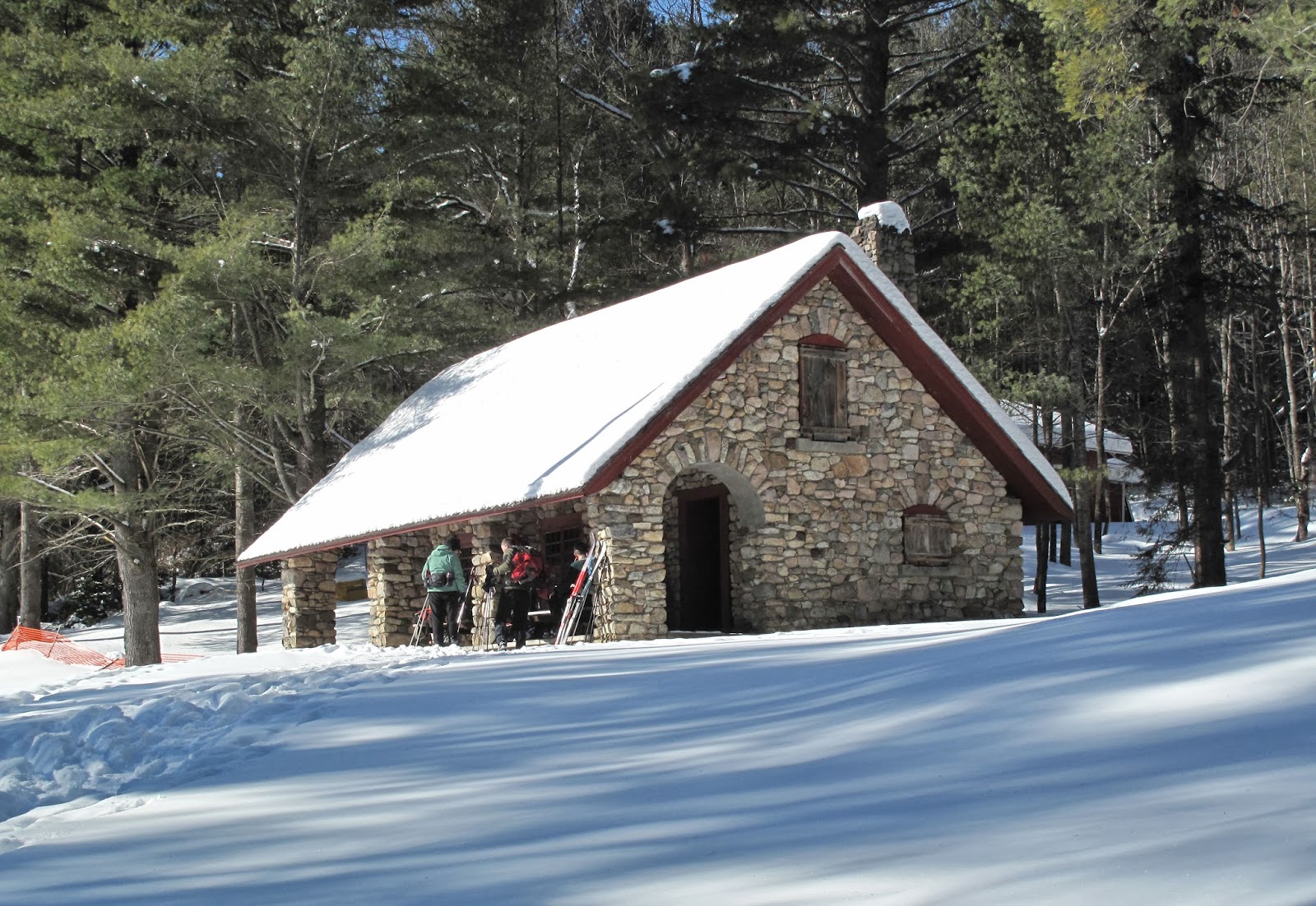


(The Creamery, part of the largest farm operation ever associated with a family estate in the Adirondacks)


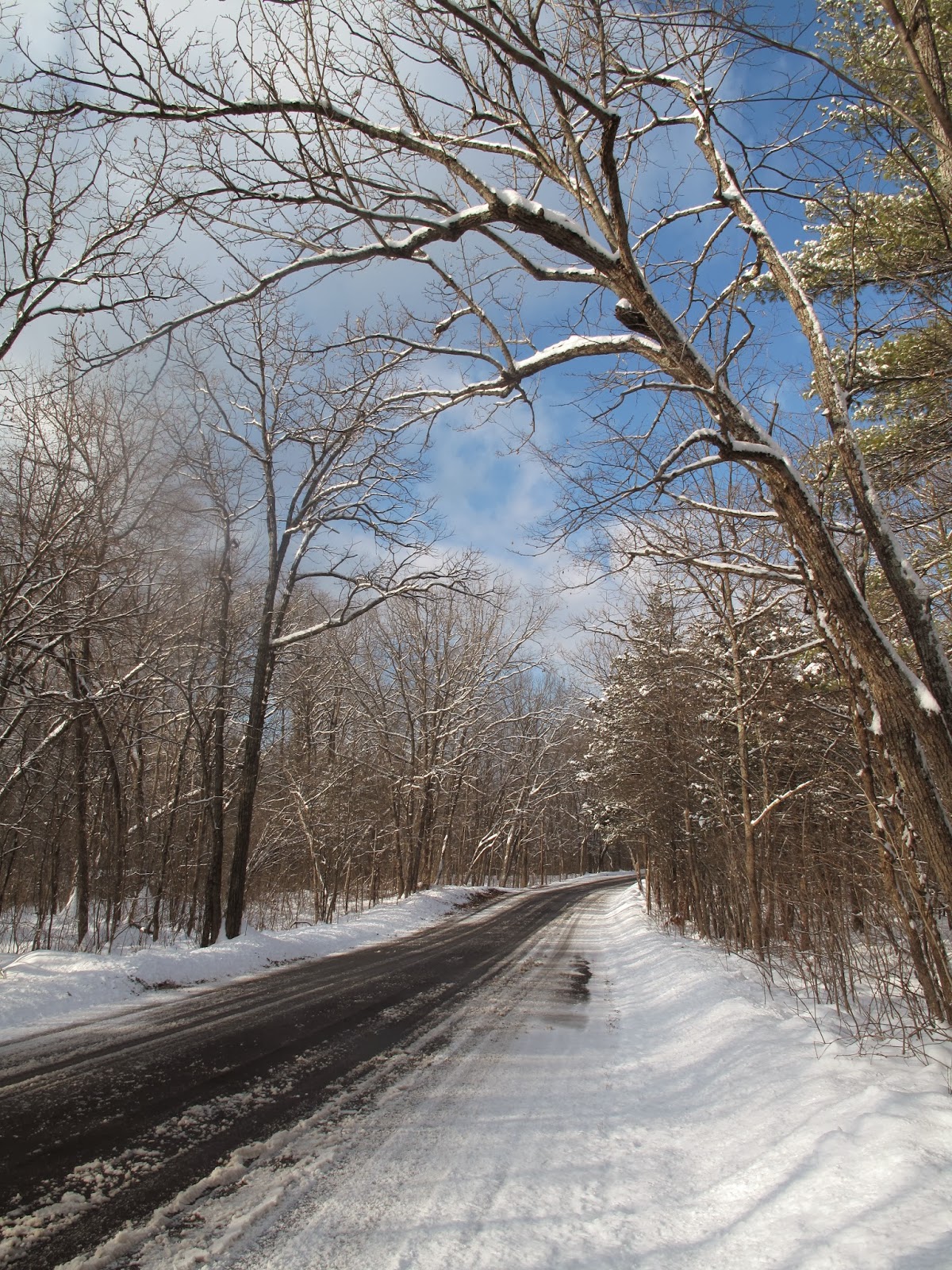
"Start out as soon as you're ready," John said, "It's too cold to stand around."  I snapped my boots into my skis, opened the hand warmer package and inserted them into my mittens. I pushed off with my poles.  Everything was in our favor; deep tracks had been made by previous skiers and the quality of the snow could not have been better. The gradual incline of the first half-mile warmed us up fast.

At The Creamery, we stopped and allowed everyone to catch up, and to take a few minutes to introduce ourselves to those we did not already know. Of the ten participants on this outing, I knew about half of them. A group trip like this is a great opportunity to meet people who enjoy playing outdoors.

 
(Karen and John ski on the carriage trail across a stone bridge.)


.

From the Creamery, we settled into a relaxing pace, our skis making barely a sound in the powder. With two tracks in the snow, side by side, conversation was easy.  I enjoyed moving ahead or behind to visit with different people.  I also liked hanging back to ski alone.  Since I stopped often to take pictures, I was often close to the back of the pack.

One woman and her son brought their canine buddies.  Often, dogs are unpredictable on the trail.  They may run into the woods, or trip up hikers and skiers.  Not these two.  They were trained to stay close to their masters, keeping a quick pace as they bounded through the snow.  And when we stopped, they got lots of attention.


We gathered again at this intersection below, making sure to have a drink of water.  Tucked into an outside pocket of my backpack, my water bottle was frosty, with a few ice chips already forming inside.  I took a few good gulps and felt refreshed.  It is easy to forget to drink water in the winter.


(ten friends, new and old, and two dogs, enjoy a perfect winter outing)


After a slow ascent for most of the trip, we began a gentle downhill glide for the final mile, heading to Newcomb Lake and the main camp.  Through the trees, we had glimpses of the high peaks beyond, cold and snowy in the distance.  I stopped often to capture Santanoni Peak, which Meredith and I had hiked a few summers ago.

The first time I took a picture, the peak was barely visible through the trees.  "You might get a better view farther on," John told me.  Another quarter-mile along, I stopped again and took another picture.  Stop and shoot, stop and shoot.  Every picture showed more of the peak than the last. Then, to my surprise, the view below appeared, clear as day, above Newcomb Lake. 

I remembered the day Meredith and I had been on Santanoni Peak's summit.  It was our second peak of three in the Santanoni range that day, and we had a good coating of Adirondack black mud on our legs.  We found a rocky overlook and took in the wide view across the Adirondacks while we ate our lunch.

Today, we would not have been able to stay on that summit long enough to have lunch. The temperature up there had to be well below zero.  After taking a final picture, I put my mittens back on.  My fingers had begun to chill, but I didn't care; my hand warmers would toast them back up in seconds!


(Santanoni Peak across Newcomb Lake)


We arrived at the camp right at noon.  Taking off our skis, we clomped across the wooden porch floors in our ski boots to a sunny spot and opened our packs.  At a balmy 10 degrees above zero, we could sit around for 20 minutes or so in comfort.  John called to me across the porch, "Virginia, did you get a picture of that last view of Santanoni Peak?  That was the best one!"


(lunch on the porch)


The Santanoni Preserve was established by Robert Pruyn, a prominent Albany banker and businessman. Originally encompassing 13,000 acres, the camp had a total of 45 buildings, included Newcomb Lake, and was considered the grandest of all Adirondack camps when it was completed around 1900.

It stayed in the Pruyn family until 1953, when it was sold to the Melvin family of Syracuse.  In 1971, tragedy struck when the Melvin's eight-year-old grandson became lost on the property.  For days, a search party combed the acreage.  I remember my father going up to Newcomb from our Saratoga home to help with the search.  No trace of the child was ever found, and the family decided to sell the property.

(Newcomb Lake at the Camp)
The Nature Conservancy bought Santanoni Preserve and then transferred to it to the State where it became part of the Forest Preserve.  For years, the buildings deteriorated with the expectation that they would be torn down, a requirement of the Forever Wild clause in the State Constitution. Eventually, in 2000, the buildings and 32 acres were reclassified from Wild Forest to Historic Area by the Adirondack Park Agency. 

(fresh paint and treated log siding are two of the many restored features)
Since 2000, restoration has been continuous.  Now, in the summers, there are tours of the buildings.  Getting to the camp is still a challenge.  Most people bike or hike in in the summer.  A horse-drawn wagon ride is available, but I've heard that it takes so long that there is little time left to enjoy the property.


Skiing to the camp is a great way to go, but no tour guide awaited us.  An unlocked padlock held the door to the great room closed.  John had been told that we were free to remove the padlock and explore the room, as long as we hooked it back over the latch when we left. 


Fifteen hundred spruce trees were used in the camp's construction. Birch bark walls and hand-hewn beams help make Camp Santanoni one of the best examples of rustic Adirondack Architecture.

It was so cold inside that I had difficulty imagining this room full of people.  Adirondack furniture with cozy upholstery and plaid wool blankets, woven carpets, and other appealing decor, seemed elusive. Still, I could appreciate the architecture and Adirondack craftsmanship.


The field stone fireplace looks like something out of a Medieval castle.  With hearths on both sides, it could house a big fire, much more than would have been necessary to ward off a late-summer evening chill.  Like many vacation homes today, a great camp such as this would not have been used in the winter.


(five buildings all connected under one roof resemble a phoenix in flight when seen from above)


Eventually, after having our lunch and exploring the buildings, we began to feel cold. It was time put our skis back on.  That mile-long descent we had had into the main camp area was a welcome uphill on the return, warming us in minutes. And later, heading back to the cars, we had some nice rolling downhills.

We stopped again at The Creamery, as we had when we first began. A thermometer registered 17 degrees, and the February sun made a few icicles drip. We snacked on whatever we had left in our packs, and visited with another skier who was on his way in to the Preserve.

(I loved this little dormer window nearly completely covered in snow)


Maybe I'll see if I can find a friend or two to bicycle in to Camp Santanoni in the summer.  We'll go on the tour and paddle one of the available canoes on the lake.  We might even find a sunny rock to sit on for lunch, under the watch of Santanoni Peak.  But for now, this crisp winter day had been perfect.


(Virginia on one of bridges crossing Newcomb Lake)

Friday, February 7, 2014

Groundhog Confusion

I have been confused about Groundhog Day for decades. I never quite get it until February 3, when I read Punxsutawney Phil's results in the Times Union. I know my newspaper will clear up many of life's mysteries--after all, my name is the same as the little girl's who learned in 1897 from the New York Sun that there really is a Santa Claus. Proof positive.

When I was little, living in Saratoga Springs, I knew that a man in a top hat holding a groundhog, or woodchuck as we called it, was really just a funny thing. And I understood that it certainly didn't tell us anything about spring, which we all knew would arrive around mid-April regardless what the woodchuck was supposed to be telling us, which I never really understood anyway.

I knew all about woodchucks, because my family spent a few fun early-summer Sunday afternoons a year woodchuckin' on farms in nearby Washington County. My father would knock on a farmhouse door and ask if the farmer would like him to hunt woodchucks in his fields. “Every farmer knows that a woodchuck hole can break a cow's leg. Farmers like to keep the woodchuck population down,” my father said, and we could see that that would definitely be true.

My mother, my sister, and I took off on cow paths up the hillsides, admiring the views and wildflowers, while my father went in another direction with his rifle. I loved running through the meadows. After a while, we would all meet back at the car and go home, refreshed from a woodchuckin' afternoon. I knew that we would never see a woodchuck in February.

The real confusion about woodchucks and their shadows came as I got a little older and learned that some people thought that spring might come in six weeks, mid-March, a very early date for spring to arrive, in my experience. And yet the story said that that would be a late spring. When I learned in school, that the weather-predicting woodchuck was Punxsutawney Phil who lived in Pennsylvania, I figured that seasons down there must just be different. End of story.

Then I read in The Saratogian, my own hometown newspaper, that the woodchuck predicted a winter ending in six weeks! I totally forgot about where Phil lived and what the significance of his shadow was; I was so surprised to think of spring coming to my neighborhood so soon...and then it didin't.  It arrived in mid-April as it always had.

From then on, I could never remember if the story told that six more weeks of winter meant an early or a late spring. Truth be told, I must have a total mental block because I still don't know from one year to the next.

Maybe it depends on what we call spring. The science of the Vernal Equinox aside, I have my own definition of what spring is. When I lift up the leaves on my garden around March 15 and see crocus shoots, that is a sign of spring, but it is not spring. Along about April 7, if I have my first blooming daffodil, that is spring. It's true, that we may have had warm days, the smell of damp mud, and even a sun burn by the end of March, but spring is when we're not likely to have much more snow. Even in these days of global warming, we sometimes get our biggest snowstorms around St. Patrick's Day.

Last Sunday, I saw on the television news that Phil had seen his shadow. That's cool, I thought, but wait, what does that mean? If it means that we have six more weeks of winter, does that make spring early or late? Didn't I figure this out last year, and the year before that? Am I, like, seriously, the only person who can't keep this straight? And should I be less concerned about woodchucks and more worried about my own cognitive inabilities?

On Monday, February 3, I opened the Times Union. My eye jumped right into the article about the groundhog story. Poor Phil “was roused from slumber at 7:28 a.m.” and “was sure of his weather forecast.”  There would be six more weeks of winter, but nothing was said about whether six weeks meant an early or late spring. Then I glanced back at the article's title which read: “Punxsutawney Phil predicts long winter.” Okay, I think I've got it...for now.

Don't even try to explain to me what happens to spring if Phil doesn't see his shadow.


Friday, January 10, 2014

Tuesdays with Pop

(my father, Irv Boyle, at the Hennig Preserve)


I have hiked with my father since childhood, but, recently, we have had a fall schedule. Fall Tuesdays are the days my mother takes a class at Skidmore.  In the past couple of years, my father's Alzheimer's has progressed to the point where she is afraid to leave him home alone for long.


When each fall season begins, I am ambivalent about  being locked into a rigid commitment, but as the weeks progress, I realize that I am getting the best of this deal.  Not only do I get quality time with my father whose lucidity increases on the trail, but I am out there, in the woods, on gorgeous fall days. I also know, more than ever, that our hiking days are limited.

I began this season with a trip to the Hennig Preserve. In the town of Providence, between Saratoga Springs and Galway, the Hennig Preserve is not far from my parents' home.  This past summer, Saratoga P.L.A.N. (Preserving Land and Nature) opened new trails on the south side of the 800-acre preserve.  I knew my father would love the variety offered by this area.                  


(trails are beautifully created and maintained by Saratoga P.L.A.N.)
We passed stone walls deep in the woods, and the remains of an old mill on the creek.

My father said, "This was a good idea, Virginia."  And in the next breath, he asked, "Does El know where we are?  When she comes home, will she know I'm out with you?"  I assured him that my mother knew where we were.


I was concerned that the trail went slightly down hill and that we would have to return on an upgrade, but my father told me that he thought it would be fine.  "Coming here was a good idea, Virginia.  What made you think of this?"  I told him that I had led an ADK (Adirondack Mountain Club) hike here a couple of months before and had checked out the trail.  I knew he would like it.  "Does El know where we are?  Does she know I'm out with you?" he asked.


Even though the south side was new to him, my father remembered having been on the north side trails.  "I skied here many times."  Then we talked about the Hennigs and how they had accumulated this acreage and had chosen to donate it as a land trust. "Coming here today was a good idea, Virginia."


(my father and I thought the tall fir trees made a nice backdrop to this autumnal scene)


It was a good idea.  With the fall foliage coming on, temperatures in the 50s, and a clear blue sky, I couldn't think of any place I'd rather be.

After about a mile and a half, we picked a "turn-around" spot across from a large beaver pond.  We sat on a fallen log under a huge pine tree.  The aroma of evergreens filled the air and the sounds of trickling water going over the beaver dam broke the silence.

"This has looked just like this for hundreds of years," my father mused.  "Think of all the people who would have seen this place just like we are...Indians, early settlers...and all the things that have happened in the world since, and this is still the same."

(beavers worked hard to make this dam and pond)


In fact, we had just passed old house and mill foundations, the remains of a cistern, and stone walls.  A hundred or more years ago, this was a very active settled area.  We talked again about the Hennigs donating the land, then turned, and headed back.

Driving slowly along the dirt road, we noticed a few vehicles parked on the opposite side.  "It's Tuesday," I said, "that's the day they work on the trails."  A petite older woman, head bent down, strolled along the roadside.

"That's, that's--," my father exclaimed, his face bright.  "Barbara Hennig," I said, finishing his sentence.  I turned the car around and pulled up near her.  This was surely the icing on the cake.  We both got out of the car and my father and Barbara had a joyful reunion, while I explained where we had just hiked. My father thanked her over and over for her part in donating this land.

According to my mother, he talked about this outing for days.

The next week was drizzly.  I needed a plan and decided to take my father out to the new Mountainman store at Stafford's Bridge on Fish Creek near Saratoga Lake.  He was in awe of all the kayaks and gear.  "What an inventory!" he exclaimed.  A young man, working in the shop, told us that this was the last day they would be open until Spring.  "Well, I'll be back in the Spring," my father said.  "I need a lighter kayak.  I'm having trouble getting my kayak on the car."

The rain stopped.  We had sandwiches with us that my mother had made, in case we were able to hike and have a "trail lunch."  I drove us to the Spa where we ate them in the parking lot.

My father has a route that he likes to walk at the Spa (Saratoga Spa State Park).  His walk usually takes him about 40 minutes along the road, down the hill to Kayaderosseras Creek and the geyser, and back up by the Roosevelt Baths to the car.  When I walk it with him, we always stop on the bridge over the creek, and have the same conversation every time.

"I've kayaked this many times," he says, and then he will tell me of all the different people he has been here with. "Those are good memories," he adds.  I have found that the more his memory leaves him, the more he tells me how important it is to remember.

This time, though, he said, "The last time I came here, I was by myself and I walked along the boundary fence on that far side for quite a ways.  I wanted to see how far the fence went.  I must have gone a mile or more and then turned around.  I began to think that if anything happened, El would never find me."

(the Kayaderosseras Creek runs through the park)


This scared me a little.  He was absolutely right.  My mother would never know where to look for him.  I tucked this location in the back of my mind, in case my mother ever calls, saying in a panic, "He went for his walk at the Spa and it's been two hours. Where do you think he might be?"  I reinforced the idea that walking by himself, bushwhacking through the trees, was not a good idea.


We took a trail away from the road.  "When I come here, and walk this trail," my father said, "I can almost imagine that I'm somewhere else, maybe up north or somewhere."  Ahh, a man after my own heart, I thought.  I often fantasize that I'm actually in the mountains or in deep woods, when I'm really close to home.


(It's easy to pretend that we are farther away from home than we actually are)


I told my father that I think water always makes a place more interesting.  "Yes," he agreed.  "We're lucky to live where we do.  And I've kayaked this many times."  He proceeded to tell me again of all the people he had been here with over the years.


One week when I left Saratoga, I took a detour to check out Woods Hollow Nature Preserve on the border of Milton and Ballston Spa. The next week, I took my father there.

Woods Hollow is a small preserve riddled with old roads, surrounding a tiny reservoir and a marsh. I had printed a trail map off the computer.  At the many intersections, I showed him where we were on the map.  I was a little concerned that he might feel insecure in a place that was unfamiliar, but he showed no apprehension, just saying, now and then, as if it were a new thought each time, "Now, does El know where we are?  Does she know I'm out with you?"  I was glad that he was certain my mother would not be concerned about his whereabouts if she knew he was with me.

We talked about skiing.  The trails were mostly flat with rolling hills.  "This would be nice place to ski, Virginia," he said.  Then we came to the big sledding hill.  We walked over to the top.  "I wouldn't ski that.  Maybe when I was younger, but not now."  I pointed out that there was also a more gradual downhill trail nearby. 


(this bench, facing a marsh, is one of many located in the Woods Hollow Nature Preserve)


We admired the little reservoir and took a narrow path along its edge. When we came to another intersection, I sat on a bench and encouraged him to do the same.  On the bench were two acorn caps on one stem.  "That's El and me," he said with a smile, as he put the acorns in his pocket.  "I'll show them to her and tell her that."

We stopped at Stewart's for ice cream on our way home, a tradition we have always had.  My father said, "That was a good hike, Virginia.  I guess I'm doing pretty well for being nearly 90."  I agreed and told him how great it was that we were still out there hiking together.

When we got back to the house, I reminded him that he had the stem of acorn caps in his pocket.  Later, when I talked to my mother on the phone, she said, "He remembered to tell me all about the acorns.  I've put them on the little kitchen shelf."

The following Tuesday began gray and chilly.  I had told my mother that I wasn't exactly sure where we would go.  Maybe we would go to the Spa again, or maybe to Moreau State Park.  Because I was vague, she did not have gear out for him.

When I decided that we would take one of the trails off Spier Falls Road at Moreau to a pond, I considered his footwear and thought his sneakers with sturdy ribbed soles looked fine.  He got out his coat, hat, and gloves, and was impressed that I knew it was hunting season and had brought blaze-orange vests for us. 


(we like to find interesting natural elements, such as this tree root that resembles a yoga pose)

The trip began with a chat with a hunter in the parking area.  As a long time hunter himself, my father regaled the man with his own tales of hunting at Indian Lake.  Our outing went down hill from there, both literally and figuratively.

Leaves were about five inches deep on the trail as we headed on a steady down grade towards the pond. "I should have brought my walking stick," my father said.  "You should have told me I would need a walking stick."  I admitted to him that I never thought of the walking stick, and that I would surely have told him to bring it, but the idea just had not crossed my mind.  A few minutes later, he said, "I should have my walking stick.  You should have told me to bring it."


(fallen foliage lies deep on the trail through a young beech forest)


Then, "You should have told me to wear hiking boots.  My balance isn't as good as it used to be, you know.  And I should have a walking stick."  The trail began a significant descent, and I suggested we turn around.  "Yes, we should," he said.

We got back to the car and drove along the road. We could see the pond, that I had wanted to hike to, through the trees.  It was covered with geese. "Look at all those geese!" he exclaimed. I knew he would have loved going to this pond that felt remote but was not far from the road. "And look at those colored leaves."  The "color season," as he calls it, is his favorite.


We decided that walking would be much better in the main area of the park on the paved campground roads. We headed out on a trail alongside a pond near the lake area. Strangely, there was not a single goose here.

(the sun shone briefly on this paved path near the camping area)


"My fingers are cold," he said.  I looked at his gloves.  He had brought the gloves he wore for yard work.  There was a hole in the tip of one finger.  "I should have brought my winter gloves," he said.  We talked about how the cold weather had come on suddenly and we just hadn't thought yet about needing warmer clothes.  I knew that my mother would have thought of it though.  If I had told her that we were going to go to Moreau, she would have had his hiking boots, hiking pole, and a knit hat and gloves laid out for him.


("No fruits, no flowers, no leaves, no birds - November!" by Thomas Hood)


Time to give this one up, I thought.  We walked back to the car.  In minutes he was warm and comfortable, and happy with the obligatory stop at Stewart's.  I reminded him of the good parts of our walk: the pond through the trees with the geese, the brilliant patch of colored leaves we had seen along the roadside, and the ice cream.

This time, my mother was at the house when we returned. I secretly told her about all the things that had gone wrong.  Later, she called me and said, "I know you were disappointed in the hike today, so I had to call to tell you that all I am hearing about are the colored leaves, and the interesting trail and ponds. In his mind, it was a success."

My father remembering the day as a success was all that mattered.  It was a good day for me then, too.


Thursday, December 19, 2013

A Walk in the Woods

(snow-covered crab apples look festive)
It is just a week before Christmas and I am "feeling low," as my mother would say.  I am thinking about my friend, Sandra, diagnosed a month ago with terminal brain cancer.  Last night I spoke to her on the phone and she told me that new tests showed cancer in her lung, and four vertebra as well. Her family is reeling, and I am sad.

I go about my tasks for the day, but I need to get outdoors. Twelve inches of gorgeous fluffy snow fell over the weekend with an additional five inches yesterday.  It beckons.  Where should I go?  I want someplace peaceful, restorative, and quiet--a woodland area, but nearby, so I don't have to drive far.  Oh, and I can't spend too much time there, so it needs to be a small place.  It is already after 1:00 p.m. and darkness comes early these days.


(the Onesquethaw Creek)

No ideas that fit the bill jump into my head, so I consult my old ECOS book on Albany County trails.  Hollyhock Hollow!  How could I forget?  It fits all the criteria.  I toss my snowshoes into the car and head out.  At first I feel a little guilty, having the luxury of being able to take off like this, but I soon put that thought behind me.

The parking area has not been plowed, so I drive farther along the road where I see a couple of safe pull-offs.  I choose one near the Creek Trail, a trail I would normally finish with, but, since I'm parked here, I will begin on this trail and go in the opposite direction from my usual walk.  I put my snowshoes on and stand by the  creek for a moment.

A former farm, Hollyhock Hollow is in Feura Bush, and is owned by the Audubon Society.  At only 138 acres, it is very small.  I can make a nice loop in just over an hour.


With numerous warning signs to watch for cars, the trail leaves the creek and crosses the road into the woods on the other side.

How odd to be going in reverse.  I enter the woods where I would normally exit.  Someone else has been here after the first big snow, but before yesterday's.  His snowshoe tracks are softened by the more recent snowfall, and I add a fresher track through the snow-laden hemlocks.


I walk slowly.  I'm not in any hurry.  My point today is not a work-out.  Instead, I absorb the quiet.  At this pace, I am easily side-tracked by natural curiosities.

A few feet off the path, I see a deep hole in the snow, surrounded by animal tracks.  I peer in, but can't see too far.  Maybe I shouldn't disturb whomever may be living there!


About six feet away is this, much smaller, exit hole.  Only a few animal tracks are visible at this end.


And what about this tiny hole?  I know mouse tracks when I see them with the fine line of a tail dragging between the paw prints. This guy went in and hasn't come out, unless he has another exit too. 


I leave the hemlocks and enter a hardwood forest.  The sun comes and goes.  When it comes out, it creates beautiful shadows.  I take a minute to enjoy them before the sun slips behind a cloud again.  Even though I'm walking slowly, I can feel my heart beat.  Maybe I'm getting a little work-out after all.


I go up this hill that we usually clamber down.  Going in reverse is fun, but a little confusing.  I had to check for trail markers a couple of times.


Big rock ledges criss-cross the hillside.  Today, the rock is barely visible under deep snow.

At the top of the hill, the land levels out into a little plateau.  I can see over the wire fence into a private field not owned by the Audubon Society.  I like the variety in the landscape.


My trail takes me back into the forest.  The sun is low in the sky, already, even though I've only been here about 45 minutes.

As I descend from the plateau, I see this crazy snake.  It's a heavy vine, making an odd curly shape.  Generally vines like this climb trees; they don't hang in mid-air off the ground.  I walk closer and see that it is actually attached to a tree, but that the tree has fallen.  I wonder if the vine will begin to climb a new tree.  I know better than to touch it, though.  I have learned that thick climbing vines like this are sometimes poison ivy!


And juxtaposed in this natural environment, is evidence of man.  This beautiful stone wall, made from Heldeberg blue stone, is actually fairly high, with this section in pretty good condition.  I'm guessing that, in this area long ago, it fenced in sheep or cows.  Now it fences in trees.


And what about this flower of birches?  They rise up as if coming out of a vase.


On closer look, I see an interloper!  See the tiny pine tree growing out of the middle that I have circled with a hexagonal line?


The snowshoe tracks that I had been following left the trail long ago, and I am breaking trail.  For being so close to Albany, Hollyhock Hollow is often left untouched. There are other places, like Five Rivers Environmental Center, that people visit first.


Whenever I come here, I like to take the Wildlife Trail which goes by this remains of a quarry.  It is believed that stone from the quarry helped build the Brooklyn Bridge.  How far away from here New York City must have seemed in the late 1800s.


I'm ready to cross the road again. I have arrived at the place where I would have expected to park, in the parking lot next to the Audubon Society headquarters.  It looks like no one has come to work here this week.


I jog down the short steep hill from the building back to the Creek Trail.  Today's snowshoes all have teeth on the bottom, so I can't slide down hills like we used to, but I like the feeling of control that I have now.


The sun is behind the ridge even though it's still only mid-afternoon.  A small flock of ducks hears me and scatters, as I walk along the creek back to my car.  I feel refreshed.  Coming here this afternoon was a good idea.


Sunday, November 10, 2013

Reading Adventures 2013

I'm sure I have read more books this year than in the previous couple of years, because, in fact, I'm not reading them, I'm listening.  A year ago, my family gave me an iPod.  I knew buying CDs was really old school, and began downloading music that I had been wanting to hear, but the iPod's real draw has been as a vehicle for audiobooks.  In the past, I enjoyed books on CD in the car for my many trips to Saratoga and Schenectady. Nowadays, the library offers a far greater selection of downloadable audiobooks.

I started out with "fluff" books like Mennonite in a Little Black Dress by Rhoda Janzen, about a modern young professional woman who had been raised Mennonite.  It was fun to read about her visits home to her parents, and her perspectives on her childhood and the Mennonite way of life.


In no time, I branched out to popular new books: Susan Cain's Quiet: the Power of Introverts in a world that can't stop talking; Anna Quindlen's, Lots of Candles, Plenty of Cake; and Maya Angelou's Mom & Me & Mom.  Being able to hear someone like Maya Angelou read her own work gives her writing even more meaning.


Those highway trips on the Northway and Thruway flew by.  I was a little disappointed to read in the newspaper, however, that listening to books is a greater driving distraction than listening to the radio, although it is still way below talking on the phone.

Fortunately, my reading is rarely high action, and I hope that I am not so distracted as to lose my driving focus. Years ago, I took out the book The Accidental Tourist on CD and the shock of hearing the sounds of squealing cars coming from the car speakers as sound effects scared me for the rest of the day. I don't expect to encounter that experience with my current books.


Since Bill has been bringing the New York Times home from work for the past few years, I find that fitting in the Albany Times Union and the daily New York Times takes all of my reading time. And then there are the environmental publications I receive and want to read: the Adirondack Explorer, magazines from the Sierra Club and The Nature Conservancy; the list goes on. Often, I would look back on a year and see that I had read very few books. 


With my new iPod, I made random choices for a few months.  Then, I began to think about what I really wanted from audiobooks.  I generally read non-fiction, but had always thought that audio would be the perfect way to read those literary classics that I had skipped over the years. As an English major and lifelong reader, I had read quite a few classics, but there were still many on my list that languished.


I chose to listen to Age of Innocence by Edith Wharton. My sister-in-law and I like to visit historic sites in our area, and had talked about going to Wharton's home, The Mount, next Spring. I should read the book, I thought.  I remembered seeing the movie years ago. The making of it had been a big deal in the Capital Region, when filming took place in the historic areas of Troy to capture the look of 19th-century New York City.

I was part way through Age of Innocence when the July heat wave struck. As I tossed and turned in front of the window fan,  my mind thought of everything but sleep. Those weeks I became addicted to my new take on bedtime stories.  In darkness, with my eyes closed, I could listen to a chapter of my book, change my thought patterns, and relax enough to fall asleep. I was swept into the late-Victorian New York social scene with its side trips to Newport. Audiobooks can be great soporifics! And later that month, after I finished the book, I watched the old 1993 movie, borrowed from the library.

Finally, I took on the big guns. For years I told myself that I should read Charles Dickens' David Copperfield. Copperfield particularly interested me because it was Dickens' favorite work, and because he considered it largely autobiographical.  I had put it off because the book is long and a major commitment.

Then I hit a snag--the Upper Hudson Library System does not have it on audio. Not to worry, though. Bill set me up with the New York Public Library.  Just about anything on my wish list is available to me now.  I downloaded all 36 hours of Copperfield.


It has taken me a couple of months to listen to David Copperfield over many trips to Saratoga and Schenectady, and on a bus ride to New York City. For weeks, I have been caught up in the huge number of characters as they weave through one another's lives in London and Falmouth.  Although wordy by today's standards, the writing style did not seem tedious at all as I cruised our local highways.

I was nearing the end of the book, when I had a symphony week with rehearsals in Schenectady every night. Would Copperfield last through the daily commute?  No problem. Those remaining chapters took me through the week and then some.

Now, I need a little break.  Copperfield was pretty consuming, and deserves some off-time to digest. Maybe I'll get the DVD of the movie from our library.  For now, I'm listening to music on my iPod when I'm on the road.

Meredith sent me a list entitled, "30 Books You Should Read Before You're Thirty."  I'm glad to see that I have read many of them, and, truth-be-told, I'm a year or two over thirty. Nevertheless, there are some books on that list that I should have read. One of these days, I'll see what's available on audio to download.  Here's to lots of great listening in 2014.