Showing posts with label Adirondack high peaks. Show all posts

Sunday, July 23, 2017

Woodswoman Then and Now

(My collection of Anne La Bastille books)


My friend, Karen, and I had plans to camp in mid-July, when I saw that the Adirondack Museum (now the Adirondack Experience) planned a day of events to celebrate the life of Anne La Bastille, the author of Woodswoman and many other books.  As fans of Anne's books and her lifestyle, Karen and I made a quick change to begin our trip one day earlier in order to go to the museum.

In preparation, I began to re-read Woodswoman, in which Anne begins a new life in her own log cabin on remote Twitchell Lake, far from roads, electricity, and running water, while she also creates a career in wildlife ecology.  I estimate that I read Woodswoman eight times in the 1980s and 90s, but had not read it in 15 or 20 years.


(My father with a heavy load going up a peak in, 1978)


With this current reading, I was initially surprised and disappointed in my sense that the book had aged along with me.  Published in 1976, Woodswoman was contemporary when I first read it.  My father and I were having many of the same experiences in the woods that Anne had.  We backpacked heavy loads over the peaks, camping on or near the summits, cooking over campfires, and drinking water from every stream, trusting its purity.  We knew that we would not see bald eagles or moose, or an abundance of alpine plants, which had been absent from the Adirondacks for many decades.

(My father drinks from a collapsible cup near Avalanche Lake, 1976)


Few people backpack over the tops of the mountains today, most doing day trips or camping at the trail's base.  Camping on high peaks' summits is illegal, as are campfires. Now, we fear giardia and purify any water we drink.  Bald eagles are common, and moose number in the hundreds.  Alpine flowers and vegetation have made the high summits even more beautiful. 

I realized that I had read the book so many times in my 20s, because I was in the Adirondacks so much less than I had been while growing up.  As a young mother, I went with Anne vicariously. I wished to see snow falling softly out of a cabin window, to swim at night under the stars, to see northern lights pulsate over an Adirondack lake, and to pitch my tent where other people were miles away.  In ensuing years, I have done all of those things, but I did not know then that I would have the opportunity later.  Did the decades since I had read Woodswoman indicate that I no longer needed Anne's words and had outgrown her landmark book?

I was half-way through my current re-reading, when Karen and I arrived at the museum before 11 a.m., the time of the first presentation on Anne's life.  Leslie Surprenant, the speaker, told us that, no matter how well we thought we knew Anne, we would learn something, and we did.


(Leslie Surprenant talks about Anne's ancestry)

Anne gives only brief mention of her parents in any of her books. Leslie told about her family over the generations and how different members contributed to who Anne became -- what she gained from them as well as what she chose to leave behind.  As a longtime friend of Anne, Leslie shared stories of Anne's devotion to breaking barriers for women in science, her eccentricities such as always wearing pink lipstick and pink toenail polish even while hiking Adirondack trails barefoot , her passion for the environment, and her love for her friends and her dogs.

The next presentation on the moving of Anne's cabin equally fascinated us.  One of the reasons for this day's celebration was the opening of a large new building at the museum, which included Anne's cabin. An Adirondack Experience spokesperson described how the cabin had been taken apart and moved piece by piece, with sleds and snowmobiles across Twitchell Lake's thick ice in subzero weather.

(The cabin now at the Adirondack Experience museum)


Photographs of the cabin, before the move, showed a place that seemed foreign to the picture I had in my mind of Anne's idyllic abode. Over the decades, Anne had added bits and pieces to the original structure to the extent that small metal roofs and sheds stuck out in every direction.  What had happened to the charming home she had originally built?  For the most part, time and a demanding career had made more space necessary, and Anne had hurriedly constructed new additions without concern for aesthetics.  As part of the presentation, we watched a video showing how the de-construction revealed the original 12x12 cabin that had been the focus of Anne's life in the woods.


(Anne's 12x12 space)

After the second presentation, Karen and I walked across the museum campus to see the cabin in its new home.  It was just as we imagined, with Anne's colorful rugs brought back from her consulting work in Guatemala, her writing desk in front of the window and rocking chair before the woodstove, her guitar,  the wooden bars she had nailed up the wall of bark-covered logs to reach her sleeping loft, and more.  We made sure to absorb the scene and to incorporate it into the visions we had carried from Anne's books over the years.

Karen and I perused other buildings and exhibits at the Adirondack Experience, and then went to nearby Lake Durant to set up our campsite and have dinner, returning to the museum for the evening presentation.


We were captivated by the information shared with us by a panel of experts, again including Leslie Surprenant, friend and executrix of Anne's estate, and also a woman from the Adirondack Park Agency, another from the Adirondack Center for Writing, someone from the Adirondack Experience museum, and a man representing the Department of Environmental Conservation.  The hour-long program explained important aspects of Anne's will and estate planning.  Panelists discussed decisions that had been made to best preserve the essence of Anne's intentions.

Anne donated a large portion of her estate to Cornell University, from which she had received her bachelor's and doctoral degrees.  In addition, Anne wanted her cabin and 32 acres to become a writer's retreat.  In her first year as executrix, Leslie tried to distill a plan for how to do this.  Restoring the cabin would be expensive, and what modern writer would want to live without electricity, running water, road access, or internet?

(The Adirondack Experience is a beautiful and interesting museum)

In a perfect-timing scenario, the Twitchell Lake Inn offered space for rent, a first in  its more than 100 year history. The Inn is a beautifully restored lodge on Twitchell Lake across from Anne's property.  The Adirondack Center for Writing secured the location for the Anne La Bastille Residency Program, in which six carefully selected writers would spend two weeks writing and sharing in creative camaraderie.

Leslie and others felt that this residency fulfilled Anne's desire to offer writers a retreat during which they would have the opportunity to focus on honing their craft. The dilemma of how to satisfy Anne's desire to protect her cabin and land remained.  The Adirondack Museum asked to have the cabin, beginning the process of disassembly.  It was determined that Anne's 32 acres should be donated to the adjacent New York State Forest Preserve.

While this all sounds cut-and-dry, establishing how to fulfill Anne's will was far from it. Each of the panelists gave us an understanding of the huge 6-year project Leslie has had to deal with.  Although a close friend of Anne's, Leslie never expected to have this task.  Now, almost completed, the results show her conscientious care over a myriad of minute details and complexity, which have created a legacy Anne would be proud of.

(Cedar River Flow)


Karen and I spent the next day paddling the Cedar River Flow and thinking about our time at the museum.  The Flow and the Cedar River are wild and beautiful, with mountains rising from every side.  We reveled in the solitude and quiet.  We thought of Anne in her canoe, as we watched a bald eagle, loons, herons, and osprey. 

In the evening, I continued my reading of Woodswoman.  I came to the chapter "Animal Visitors," and was struck by its timelessness, as Anne described the call of loons, hearing an owl from her sleeping loft, being harassed by a nesting goshawk and kept awake by mice.  Perhaps I had been premature in thinking that Woodswoman showed its age.

(Karen, the only person I see on the Flow)

I was fascinated when I re-read her conversation with a ranger who spoke about overuse and erosion of trails in the Adirondack high peaks and the need for a permit system -- in 1972!  Their conversation could occur today.  Anne worried about motor boats disturbing the nests of loons, and we fight for non-motorized ponds in 2017.  Her battles against acid rain in the Adirondacks continue and were a prelude to the changes occurring from climate change right now.

Finishing my re-reading of Woodswoman, I looked back with affection at the details I had considered historical rather than timely.  As with Anne's will, all of the specifics could no longer apply as Anne envisioned them, but the essence is loud and clear.  Woodswoman remains an important and wonderful part of Anne La Bastille's ongoing inspiration and legacy.

(Anne La Bastille, Guilderland Library, 1993)


Wednesday, January 30, 2013

Mount Marcy Revisited

(Mount Marcy, the highest peak in New York State)

As my daughter, Meredith, and I get closer to reaching the goal of having hiked the 46 Adirondack High Peaks (we're at 41), it occurred to me that I might want to make a journal of my experiences in the mountains.  I chose this winter to look back and see what I had written over the years. This blog post is an account of the time my husband, Bill, and I hiked Mount Marcy.  I had hiked a number of the peaks with my father when I was a teenager, so it was only fitting that I should take Bill to one of my favorite places.  

Readers who have been in the mountains recently will notice quite a few differences, such as being able to camp up to 5000 feet, having Colden camps all to ourselves on an August trip, dipping our drinking cups directly into the streams and, of course, visiting Marcy Dam before Hurricane Irene came and let all the water out.  May all of you enjoy this adventure.

Mount Marcy, August 1981
            There must be an alternative to the hot dog and chocolate chip cookie meals my father and I had consumed when we hiked, I thought, as I contemplated what Bill and I should take on our backpacking trip to the Adirondacks.  We had been married two years and had developed a satisfactory diet of natural foods including whole grains, vegetables, raw sugar, herbal teas, homemade breads and granola...along with occasional food runs for ice cream and white-crusted restaurant pizza.  Our first wilderness outing together would be an escape from the pressures of daily life, a time to cleanse the spirit, all enhanced by a wholesome organic diet.  

            For two and a half days we would eat a nut mixture, a dried fruit mix, rice, bulghur wheat, and peanut butter balls loaded with nutrition and calories.  Bill looked at my portioned-out menu with approval.  It would be a test that we had been eager to take.  For years we had been outward natural food enthusiasts, yet a pan of brownies had always been just a recipe away.

(the iconic view of the high peaks from Marcy Dam)
            I was excited to introduce Bill to the fabled high peaks and had mapped out a route that included lakes, forests, babbling brooks, and the highest mountain in the state.  The August sun was brilliant as we donned our packs and started along the easy jaunt to Marcy Dam, the point at which many of the more popular trails connect.  


            Marcy Dam is a great introduction to the Adirondacks' drama.  A small pond, surrounded by mountains that seem to rise straight up from the shore, makes one feel far from civilization. When we arrived at the Dam, we sat on a picnic table, the last we would see for a couple of days, and helped ourselves to our first taste of nut mix.

            My boots felt solid underfoot as we chatted about everyday events on the way to Avalanche Lake, but a few feet from our first view of the lake, I stumbled on a root.  Once off balance, the weight of my pack swayed and I fell headlong into black mud.  So much for being the fearless leader!  Together we tried to clean me up.  My face and hair were smeared with black.  I walked to the edge of the lake and made a feeble attempt at washing. I could imagine what I looked like now.
(one of the Hitch-Up Matildas at Avalanche Lake)
            Although Avalanche Lake is beautiful, it is also treacherous. We hiked over roots and rocks, up and down ladders, and across precarious wood bridges, called Hitch-Up Matildas, that hugged rugged cliffs  above a drop into twenty feet of water. By late afternoon we arrived at the Opalescent River and set up camp near Lake Colden.  We dipped our cups in the brook and took a long drink.  The cold clear water made a perfect accompaniment to a fruit and nut snack. 


            Bill decided to have a cup of tea.  Casual pawing through our packs for the sterno for our little stove became frantic. I remembered that the last time I had seen the sterno, it was on the kitchen counter of our apartment. "I thought you packed it," I said.  "No, I thought you packed it," Bill said. Without a way to heat water, we not only had no tea, but could not cook rice or bulghur wheat.  Our nutritional plan had hit a major snag.


            After Bill flung our food over a high branch to keep it away from bears, we strolled to the lake shore, deflated and concerned about our reduced food capabilities. Red squirrels ran back and forth on the branch above us, tantalized by our bag of nutty provisions. We reasoned that we had plenty of dried fruit, nuts, and peanut butter balls to last us for a couple of days.  We'd managed with a lot less in college sometimes.  A ranger stopped by; otherwise we saw no one.  Quiet and still, the surface of Lake Colden reflected the last rays of evening sun.

(Lake Colden in the evening)
            In the morning, after a peanut butter ball breakfast, we packed a day pack with a lunch of dried fruit and nuts. When I had hiked with my father, we carried our big packs over the peaks so that we would never camp two nights in the same place. Bill and I chose to leave our backpacks at the campsite.  What a treat to carry only our lunches and a cup to dip in the brook. We headed toward Mount Marcy, climbing steeply along the Opalescent and Feldspar Brooks.  The woods felt cool and the sound of rushing water drowned out conversation.  Despite the dried mud caked inside and outside of my boots from yesterday's fall, I felt strong and solid on the trail.

            At Lake Tear of the Clouds, the fabled source of the Hudson River, we read a sign that said, “No camping above 5000 feet,” but just beyond, five people had set up a tent and were out in the sun cooking up a pan of eggs.  Their breakfast smelled delicious. Moments later, the woods opened above treeline to hazy views under the hot sun.  People sat all over the summit rocks eating sandwiches.  Bill and I weren't very hungry despite our strenuous workout. We ate some dried fruit and nuts and lay down in the sun.  After a little while, we began the descent back to our camp.  Clouds rolled in.  Supper back at our tent was quick and boring as the first raindrops fell.

(a hazy summit view from Mount Marcy)

            Heading to bed early, Bill fell asleep like a rock.  I was restless.  My stomach began to churn. Rain pounded on the tent as I tried to remember where the flashlight was.  I rushed outside, cursing our food planning.  I hoped there weren't any bears.  Three times during the night I made that trip.  Why wasn't Bill suffering?  By morning, I was sure I had lost everything I had eaten.
            I gave Bill a ghastly look when he quipped, “So what do you want for breakfast?”
            “I won't ever make peanut butter balls again in my life,” I moaned.
            Our itinerary included a retracing of our steps around Lake Colden and Avalanche Lake.  We had considered taking a couple of side hikes before packing up camp, but the rain still came down in sheets. Only two of our five food containers were empty--all those uncooked grains would go back with us, along with a quantity of uneaten peanut butter balls. With the rain on our backs, we skipped breakfast and rolled up the tent, randomly stuffing all the gear into our packs. Then we stepped onto the trail, and put one foot in front of the other.

            Slogging out through black mud, we laughed about our great dietary experiment. It received a failing grade.  All morning we ate nothing and weren't hungry.  My stomach rumbled words of warning, but, after the initial couple of miles on the trail, I felt good.  The damp woods smelled of hemlock, and tree trunks stood black in the heavy atmosphere.  Avalanche Lake was pocked with pelting rain and only gray shadows of the cliffs rose out of the water. Rivulets drizzled down my face and mixed with dirt.  I sloshed through puddles and got dirtier.  It felt okay to be wet and dirty.  Still, whenever we poked our heads out of hoods of our plastic ponchos, our conversation turned to what we would eat when we hit civilization. We were hungry for white over-processed carbohydrates. 


            When we reached the car, we got a glimpse of ourselves in the rear view mirror.  After toweling off my face, I made a stab at dragging a comb through my hair.  Fresh dry clothes that we had left in the back seat felt like heaven, and we changed from our hiking shorts to long pants.  At least no one in Lake Placid would be able to see our mud-caked legs. We also hoped they wouldn't mind our three-day hiking aroma—there wasn't much we could do about that.  Finally we were ready for our debut.  Turning the heat on in the car, we drove the short distance into town, parked in the Main Street lot, threw jackets on, and ran across the street to Lums diner.


(Bill and Virginia on a cleaner day, 1979)

Tuesday, September 18, 2012

Adirondack Whirlwind


(Linda stands on a bridge rebuilt since Hurricane Irene)

When my friend, Linda, and I spent a day hiking the West River Trail to Rainbow Falls in the Ausable Club Preserve, I lamented not spending more time in the Adirondacks.  "I'm homesick for the lakes," I told Linda.  "I'm not sure what I think I need," I added, "maybe I'm just wishing for old times when I camped with the kids."

In fact, I did wonder if I was in some sentimental place where I longed for those childhood years when Thomas and Meredith could hardly sleep because it was so exciting to be in a tent at Indian Lake. 

Linda and I had a refreshingly cool sunny day in the midst of a hot humid July.  "I want to see Rainbow Falls," she had said.  "Ron went there in the winter and it looked beautiful."


We quickly discovered that, despite the summer's drought, waterfalls, both large and small, tumbled over rocks along the entire trail.  Sometimes the trail ran alongside the water, and other times we were high above and could only hear the sounds of fast-running water.  We chatted as we walked through cool hemlock forests.
(Beaver Meadow Falls)
Occasionally we saw evidence of Hurricane Irene in rock piles along the brook's edge. Tumbled-down trees lay like match sticks here and there.  Still, serene beauty and silence made the tumult of last year seem very long ago.

( Beaver Meadow)


By the time we reached Rainbow Falls, we had begun to rate the beauty of the many cascades we had passed in our three-mile hike along the river.  The crown jewel of the trail, Rainbow Falls is huge and dramatic.  We had to tilt our heads back to see the top, but we decided that it was the trail as a whole with its great variety that really drew us.

(Rainbow Falls)


Although I had spoken as if I had no plans to spend time at an Adirondack lake, in fact, a group of us had organized a women's overnight at Lake Durant for the middle of August.  Little did I know that this was just the kick-start to what I later called my two-week Adirondack whirlwind. 


(Sharing some laughs at Lake Durant)


Last summer, I had tried to organize a Women's Camping Overnight through the Adirondack Mountain Club.  My friend, Claudia, was the only respondent and she and I had a great time at Lake Durant.  This year she took on the task of gathering friends and finding a site, while the rest of us contributed gear and food.  We had lots of laughs, told the best stories, were amused by being caught in a downpour in the middle of the lake while canoeing, and shared fabulous camaraderie.


(Lake Durant at evening from the campsite)

After we dried off from our drenching, we walked around the camp area scoping out sites we might consider for next year.  In the end, we said, "the one we're on is one of the nicest," and, even though we were only camping for about 24 hours, we all agreed that this should become an annual event.


I got home to more than 50 emails, but one caught my eye. Peter, a friend of my father's described a kayak outing he had been on with the Crooked Canes, a hiking group of retired people that my father belongs to.  The group had gone to Lens Lake in Stony Creek.  He offered to be a guide, if I wanted to go there.  I had been trying to think of a nice place for my father and me that wasn't too far from my parents' Saratoga home, and decided to take Peter up on his offer.


(My father and I kayaking on Lens Lake)

As my father's Alzheimer's progresses, trips like this are more complicated and I was glad to have Peter in charge. I also knew that my father would have even more fun with his good friend along. 

What a day!  Perfect weather, a calm lake with just a touch of Fall, great company, and a pair of herons flying in graceful swoops back and forth across the water. Although I expect to have many more small hikes with my father, I was reflective and grateful here, thinking that next year a kayak outing would probably no longer be possible.

In between my comings and goings, I spent a couple of days at home doing laundry, making dinners, and mowing the lawn.  I hoped my occasional touch downs would keep the place running while I was out playing.  Fortunately, Bill was not envious of my excursions as he came home from work to camping equipment drying across the clothesline and my detritus strewn about.  He was still reveling in our earlier outing to Vermont (see my previous post).

(Late afternoon at the Flowed Lands)
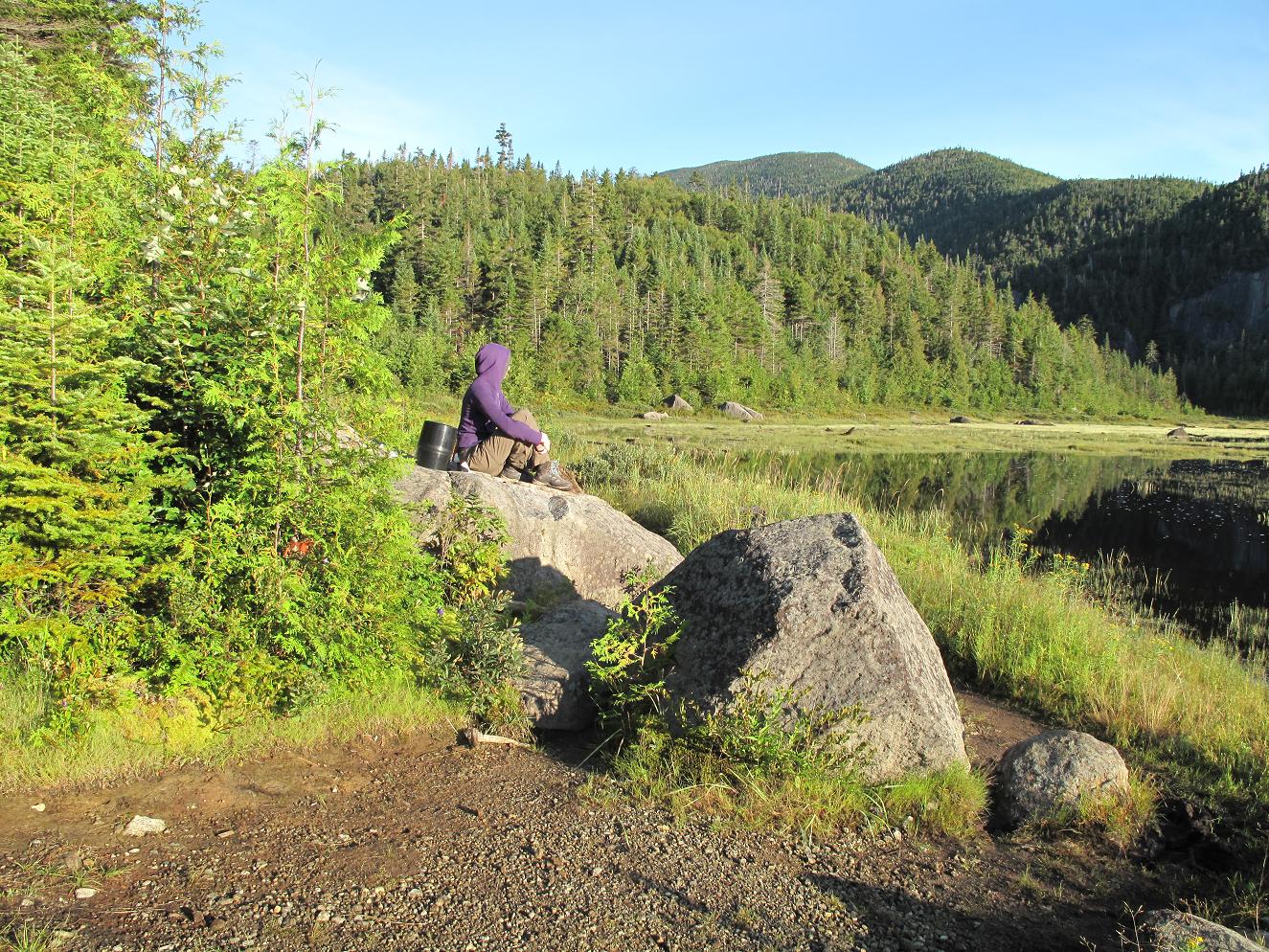
And then it was time for Meredith's and my annual High Peaks' backpacking trip.  We planned to conquer Cliff and Redfield, our 40th and 41st peaks. Since these peaks have unmarked trails and do not show up on hiking maps, I do lots of research so that I will feel safe heading into the woods.  We would backpack in 4 1/2 miles one day, hike the two mountains the second day, and backpack out the third day.  In all of my reading about trail conditions and hazards, somehow I had missed that our two-night camping spot at the Flowed Lands was a stunning location.  

(Our little tent nestled in the hemlocks at Flowed Lands)

In the evenings and mornings, we ate our meals on this rock, either watching the sun come up or go down. 
(Meredith at breakfast with our bear canister of food)
Not only had I not read about the beauty of the Flowed Lands, but I had had no idea that the summit of Redfield would offer this! Clearly, I had focused on things like finding the trailhead, or conquering the slippery bogs and treacherous rock cliffs on Cliff Mt. The advantage of my focus on the more dire aspects of the hike was that our jaws dropped when we stumbled upon gorgeous views.
(View from Redfield.  Meredith and I have walked the entire ridge in this view, one step at a time.)
 
I was surprised when, shortly after my hike with Meredith, Thomas called and asked me to join him at Indian Lake. 


(Thomas cooking marshmallows)

Unfortunately, he and Marlie had had plans for a few days there, but she could not get the time off from her new job.  Thomas said, "I still need to get away.  Would you want to go with me Saturday to Sunday?"


(early morning walk to a misty Lewey Lake)
He knew what my answer would be, although I did feel bad about Marlie missing out.

Thomas and I canoed to our favorite island in Indian Lake and swam, had a fire and s'mores, and hiked to Puffer Pond, just as we had over the nearly twenty years when Bill and I had brought the kids here for family vacations. 

I came home, put away the camping equipment, cleaned the mud off my hiking boots, and looked at all the beautiful pictures I had taken. It was time to get back into an at-home routine.  I could not play forever and responsibilities waited on the doorstep.

Just then my friend, June, called, "We're in the car on our way to Lake Placid.  Can you come up and go for a hike?  Plan to stay overnight."

June and Roger have a timeshare at Whiteface Lodge.  I had to shuffle a couple of things on my calendar but I didn't hesitate to say yes. This time, Bill would have enjoyed coming along but it was crunch time for him at The College of St. Rose.  I went up in the late afternoon.  Whiteface Lodge offers comfort and amenities antithetical to camping!  

(View of Whiteface in late-summer color, from the livingroom of our friends' timeshare)

June and I chose to hike Rooster Comb, a mountain whose trailhead is right off of route 73. Rooster Comb boasts one of the rare Adirondack Trails that was planned and laid out with switchbacks.  It is not your usual clamber-up-a-creekbed trail.  That does not mean it's easy, but very manageable with 6 miles round trip and 1700 feet of elevation gain.

 
(June dwarfed by tree roots on the trail)
We saw a few other hikers and ate our lunch on the open summit, admiring views to Giant Mt. in the east and Mt. Marcy farther away in the southwest.

(view of Giant Mt. near the summit of Rooster Comb)

Later that week, back in Albany, my friend, Linda, and I met for a walk in the neighborhood. She commented on my Adirondack whirlwind saying, "And you were feeling bad that you wouldn't have much time up north!"  Instead I had been near and far, with friends and family, every time in gorgeous weather. I had even had overnight trips with Thomas and Meredith.

Now I was ready to get some food in the house, dig up monstrous crabgrass that had invaded my garden, and talk to Bill!  I looked forward to my orchestra schedule resuming, and I knew that Sierra Club responsibilities would get more numerous with upcoming elections.  My plate would fill up, but, right now, it all looked good.


Sunday, August 29, 2010

Basin & Saddleback


If it looks like Meredith and I are at the edge of a cliff on Saddleback Mountain, it's because we are. And why are we giddy with joy? Because we survived the climb up the cliff and lived to see the top! Picture a 300' wall at a 70 degree angle, and we have to go up it with no rock climbing gear or boulder experience. I'm serious. This was the scariest, most death-defying hour of our lives. Sure, we look composed here, but our knees were still shaking.


I had read about the "ledge" on Saddleback and that some people (especially women under 5'10" according to two websites) freaked out a little,...oh, and also that one false move could mean a fall to certain death. Nobody said this ledge was a straight-up wall. And here's the real kicker--I had done this before. As a teenager, my father and I had hiked from Basin to Saddleback with full loaded backpacking gear. All I remembered was that it was really hard and that I said at the time that I would never to do it again. Now that Meredith "needed" Basin and Saddleback for her 46 peaks, I figured it couldn't be all that bad.


When I read the blogs and online advice, I rationalized: my father had taken me there--would he have jeopardized the life of his teenage daughter and "hikin' buddy?"; also, having hiked 36 of the high peaks, I decided that Meredith and I had experience enough to handle doing these; 46er friends of mine agreed that online information can be extra-cautionary because people with no knowledge or experience are reading them; and finally, wouldn't I remember if I had been scared out of my skin when I hiked this previously? Well, talk about selective memory!


Meredith and I backpacked in 3.5 miles and camped near Johns Brook Lodge on Friday. Saturday morning, I felt great beginning the day with temperatures in the 40s, a clear atmosphere and predictions of 70 degrees by mid-day. Just my kind of hiking weather. The hike up Basin was predictably difficult where we hauled on tree roots to get up innumerable rock scrambles. Views at the top were breathtaking. The entire great range and beyond stood out crisp in the late-morning sun. As we descended Basin and headed toward Saddleback, I determined that the upcoming ledge was nothing to worry about. From the Basin trail, we could see the rocks on Saddleback with a few people at the top.


Our first clue that the ledge was really a slab of straight-up rock came as we stood at its base. A woman, near tears, had only a short descent remaining, and cried out for her husband to catch her. Next a couple of very nimble 30-something men came down, saw us studying how to get started up, and offered to give us a hand for the first couple of ledges. Although grateful for their help, now we were 20 feet off the ground on precipitous footing, knowing we had to go up and unable to go back down if we had chosen to.


The man who had helped us pointed to a group of half a dozen men on their way down who, he said, would give us another hand. We turned and saw them, on all fours, faces tense, one man with his backpack on his chest to keep it from bumping him forward in a roll down the rock. One man coached the others, all of whom had fear written across their faces. They would not be helping us go up--it took all their concentration just to take care of themselves. We stood, our eyes glued to their progress. When one of the men passed us, he tried to give us tips, but we could tell that he really hoped that he wouldn't, moments later, watch us tumble from higher up into a bundle of broken bones.


All of a sudden everyone was gone. Meredith and I stood alone on a thin edge of rock. It is hard to describe how we made it to the top. Sometimes there was the smallest notch in the rock that became a hand-hold, or the slightest indentation that had to keep a boot in place as we hauled ourselves up. If the boot slipped, or the hand lost its strength, we knew we would hurl hundreds of feet. And where there was a crack in the rock, we wedged a boot and tried to find a notch for our hands.


One spot, the size of a chair seat pad, allowed me to rest a minute turned forward. Like the man before, I put my backpack on my chest and was able to go a few feet up on my bottom, but then how to turn around, and get the backpack back on my back without its weight throwing off my balance and sending me to the base, no longer visible beneath the rock? And was each step the right one? What if we made it up one section, only to come to another that was insurmountable from that location? Each decision literally held do-or-die significance. We could not lose focus for a second.


Meredith and I stayed a distance apart. At one point, I said to her, "I can't believe that I am one of the people freaking out." She agreed. My legs began to shake. I couldn't watch her. What if my precious daughter fell to her death?


Finally, somehow, I reached the final stretch, and saw rocks that began to level out. I shouted to Meredith. When I could, I turned around. She was not visible below the sheer cliff edge. I thought about watching to see her head appear, but couldn't. She might still fall. Instead I kept going. At last, she was on the level ground too. At the top, a young couple that we had met on Basin said that this was the scariest and hardest thing they had ever done. The young man took our picture and understood our giddy relief.


When they left, we went to higher more secure ground to have our lunch. We were still shaking. Meredith's hands trembled as she held her peanut butter sandwich. A few young men came up from behind us, arriving at the summit from the trail that we would descend. They looked over the edge of the cliff and decided to go back the way they had come.


The view was stupendous. We could see nearly all of the peaks we had hiked over the years. A few lakes and marshes glimmered in the valleys below. We stayed at the top for a while, regaining our composure, glad for our safety, and wondering that most people do actually summit Saddleback this way. After a while, we started down the opposite side to Johns Brook.

Meredith and I had made the wonderful decision to spend our second night at Johns Brook Lodge, rather than in our tent. Evening discussions at the lodge always center on where everyone had hiked that day. A quartet of 30-something men, all fairly tall which athletic builds had done Basin and Saddleback. There were unanimous as they said, "I have never been so afraid in my life; I love to hike, but I hated that; I don't know how I did it; One false move and I would have been dead; It's the scariest thing I have ever done; I'm mentally and physically exhausted." When we discussed hand-holds and footing, they nodded and regaled us with similar predicaments. Hearing these strong young guys admit to abject terror certainly validated our experience!


At breakfast the next morning, they were still talking about it. We all felt like we had come back from a test of survival. Sure, there are those men and women, like the two nice guys who helped us up the first rock, who are like Spiderman, or who have rock-climbing skills, but for the rest of us caught between going up and going down, the risk of dire injury is too high. I may have forgotten this from when I hiked Saddleback as a 16 year-old, (or, as one friend told me, 16 year-olds are fearless, and I trusted my very capable father), but the memory is with me this time, along with a surprisingly few scratches, bruises, and a couple of tender muscles.


Basin and Saddleback are always billed as a pair, like Algonquin and Wright, Skylight and Gray, Street and Nye. If done separately, as two different trips, hikers could avoid going directly from Basin to Saddleback, yet I know of only one person who did them this way. And he separated them based on what other trails he wanted to hike, not out of any particular knowledge of the terrain. If aspiring 46ers ask me, I will tell them how to bag Basin and Saddleback on safer trails. Meredith now has 32 peaks to my 36.