Thursday, May 8, 2014

Three New Jersey Walks

(the Palisades Park trail begins on this historic road)

Thomas called days before we were to visit him and Marlie in Jersey City, and said, "What do you want to do when you're here?"  My answer is always the same, "Take us somewhere in New Jersey that we've never been to before."  This is an easy request, because Bill and I have hardly been anywhere in New Jersey.


In the past few years, we've gone to interesting bars, delicious restaurants, bakeries, apple farms, and city parks in New Jersey.  We have also been to amazing natural areas that are filled with history and beauty.

This past March, Thomas drove us to Palisades Interstate Park for a hike.  Entering the park, high above the river, and rounding ever-descending horseshoe bends to river level, we parked at Alpine Landing. The Landing was once an active place of commerce, near a break in the cliffs, where merchants with wagons pulled by oxen could meet arriving trade ships. 


(views of the rugged Palisades and the Hudson River abound)


As soon as we started up the trail, we passed a large stone commemorating the unsuccessful attempt by British Commander Cornwallis to intercept George Washington, using this trail, on his way to Trenton, during the Revolution.

Marlie, Thomas, Bill, and I planned to make an entire loop of five miles--up to the top, across the plateau, down to the Hudson River, and along the shoreline back to the car. Although I had seen the rocky cliffs of the Palisades many times from the train on the east side of the river, hiking both above and below the cliffs was a new adventure. Once we reached  the plateau, we were rewarded with views of the Hudson north and south for miles. "With rock like this," I said, "we should see an eagle."


(Cliff Dale house foundation)


 As we traversed the flat top of the ridge, we began to notice overgrown paths, foundation remains, and plantings from cultivated gardens of long ago. I was fascinated by the paths and walkways that emerged from the forest floor. We speculated that they originated from bygone luxurious homes of the wealthy that would have dotted this high promontory.  Eventually, we stumbled upon a huge foundation. 


(a graceful stairway from long ago)

Later, at home, I read that these remains had belonged to Cliff Dale, the mansion of George Zabriskie, who made a name for himself as a representative for Pillsbury flour.  Although Palisades Interstate Park was first begun in 1900, the building of the George Washington Bridge in 1931 prompted John D. Rockefeller Jr. to buy up properties to add to the park, as assurance against development that he knew would come with easy access across the bridge to Manhattan.  When he donated the land to the park commission, Rockefeller required that all structures be razed, and Cliff Dale fell.


(Cliff Dale Manor, 1911-1939, note the foundation in front)


After hiking a couple of miles along the plateau, we made an abrupt descent on numerous switchbacks to the river.  "You would think we would see an eagle," I said.

At the river's edge, the water, at high tide, made the soothing lapping sound of waves hitting the rocks.


(Thomas begins the steep descent to the river)


(The Lower Hudson, up close and personal!)


 We walked and chatted, and then Marlie called out, "An eagle!"  "Mom! An eagle!" Thomas echoed, making sure I didn't miss it.  Above the trees, the large dark bird with white head and tail soared. As if the history, the mansion ruins, the walk in the woods with my family, and the peaceful shoreline walk along the Hudson River were not enough, the eagle made my day.  We watched it fly out toward the water and then back over the cliffs and out of sight.


(the trail continues just above and alongside the river)


A couple of years ago, Bill and I also drove south in March for a New Jersey weekend.  Visiting in late winter is appealing, because it's almost spring in New Jersey, and still winter at home in Albany.  And it's a time when our children can more easily fit us into their hectic work schedules.


That time, we visited DeKorte Park, part of the New Jersey Meadowlands in Lyndhurst.  The history here is fascinating.  This park is reclaimed from 300 years as a riverside garbage dump.  Now it's a showplace with an observatory and a center for Environmental Studies.  It is also an important bird watching area as part of the Atlantic flyway.


(Meredith and Marlie enjoy this "please touch" turtle exhibit!)

Trails over one-lane dirt roads and board walks crisscross the waterways and park perimeters.  Signage tells us what we might observe at various locations.


(DeKorte museum and environmental center on stilts over the water)
(the Jersey Turnpike and Manhattan beyond)

As we walked farther out on the trails, we could hear traffic noise from the New Jersey turnpike.  Rather than taking away from our experience, the sound only heightened our awareness of how the urban and the natural can co-exist if given a chance.


(the area is restored with native plantings)


When we returned to the parking area, we saw trailheads edged by daffodils, leading to the hill nearby. As extraordinary as reclaiming the marsh had been, this garden that covered part of a modern-day landfill, today's garbage solution, also completely intrigued us.  We were fascinated by the ecological success of a once-destroyed tidal mud flat.


(Trail up the landfill garden.  The landfill's liner is made from 400,000 recycled soda bottles.)


Last year, I drove down to New Jersey in March by myself. When I arrived, Thomas said, "I thought we'd go to Paterson.  There's a waterfall there."  With Marlie at work, just Thomas and I headed out for the day.

We parked within feet of a huge statue of Alexander Hamilton, a good sign that early history was made here.  A walkway led us above the 77-foot high Great Falls of the Passaic River, part of the Paterson Great Falls National Historic Park.

In 1792, Hamilton set up an investment group to fund the creation of America's first planned industrial city. While many different mills were built, silk manufacture dominated, and Paterson became known as the "silk city." We could imagine that anyone coming upon the power of this waterfall would see great potential for industry.


(the walkway made it possible for us to look down on the waterfalls)
We walked across to the far side, observing the falls from every angle, and then went back to the car.  There was little else to do in the neighborhood, after we had explored the historic park, and, anyway, Thomas had researched another park for us to visit in Paterson.

Up and up on residential streets, we drove, until we reached roads that wound through the woods of  expansive Garret Mountain Reservation. We parked near a castle and observation tower once owned by a wealthy silk manufacturer.  Since we had just seen the Great Falls, we knew all about local silk manufacturing!  Trails headed in two directions; we picked one that led out across the ridge.


(Thomas sits on the ridge overlooking Paterson, with the Manhattan skyline beyond)

A pervasive quiet was only broken by bird calls. How amazing to be able to look down on such urban views from this point of solitude.


At times the path became rubbly with black volcanic basalt, which could be treacherous underfoot. Eventually, we came to an equestrian center, still within the reservation, and then we turned back, retracing our steps past all the peaceful bluffs we had seen on the way in.  I thought that, if I lived in densely populated Paterson, I would try to come to this oasis as often as possible.


(volcanic basalt lies under the grass on this ridge)


It's fun to explore new places, and, at the end of the day when we're back at their apartment, Thomas always prepares a delicious dinner for us, and Marlie, creates a gourmet dessert. This is one great getaway package deal!

Sunday, April 6, 2014

St. Patrick's Day, NYC!

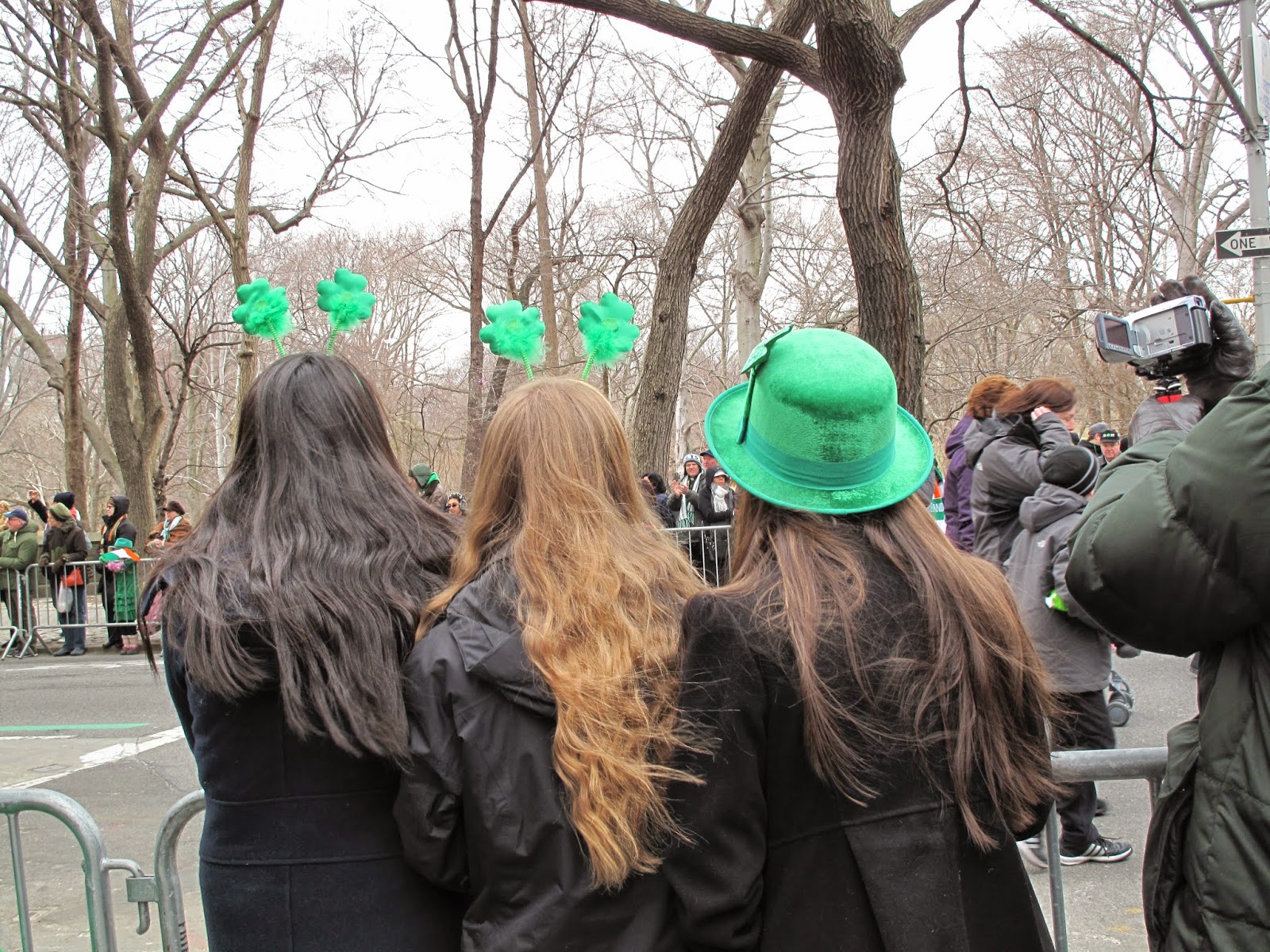
(Virginia and Meredith decked out with festive shamrock antennae, earrings, hair pieces, beads and scarves)

Meredith said, "If you're ever going to go to the St. Patrick's Day parade, this is the year.  I'm taking the day off, and everybody else is working.  You should come down."

Ever since Thomas, Marlie, and Meredith, moved to New York, I have talked about going to the parade.  It either didn't fit my schedule, or it didn't really seem like the place for me.  If the parade was on or near the weekend, both Thomas and Meredith knew that I wouldn't enjoy the huge weekend crowds and all the bar-hopping.  With the parade on Monday this year, I couldn't refuse.

On a recent trip to Albany, Meredith had suggested we go to a party store and peruse the St. Patrick's Day supplies.  She picked out colored hair pieces, and I spotted large shamrock earrings for $2.49.  I fingered a head band that had sparkly shamrocks on antennae.  "If you want anything," Meredith said, "you should buy it here.  It will cost a lot more if you buy anything in New York."  I figured I could swing the 99 cents for the head band!


Our first stop after my arrival at Port Authority, was for coffee and a bun in a nearby shop.  The cashier, who had green fingernails, looked at us both and asked, "what are you dressed up for?"  At first we thought she was kidding, but then realized that she really wanted to know.  Meredith said, "It's St. Patrick's Day.  There's going to be a big parade today."  "That's cool," the young woman responded.


We took a seat in the little cafe.  A middle-aged woman came up to me.  My green accessories, along with a shamrock scarf that I had from years of playing St. Patrick's Day concerts, made me kind of obvious.
"Are you Irish?" the woman asked me.
"Well," I stammered. "I'm not from Ireland."
"I mean are you of Irish heritage?"
"Yes, but a ways back," I said.
"So am I.  Where are you from?"
"Albany," I answered.
"No, I mean where are you from in Ireland?"
I was coming off pretty clueless so far, and it wasn't getting better.  I thought of my father's family from Northern Ireland, and my mother's ancestors from the Republic of Ireland.
Meredith jumped in, "Just say Tipperary," she said.  "It's nice there."
"Well," the woman said, "I'm from Dublin."

I laughed--one woman with green nail polish knew nothing about St. Patrick's Day, and another, who came off as 100% New York, considered herself practically right off the boat from the Emerald Isle.

We left the cafe and headed into the crowds near mid-town. Young people, laughing and shouting, jostled in bunched-up groups at the street corners.  "How are you doing?" Meredith called to me above the din.  "I'm fine, as long as no one spills beer on me," I said.

We made our way towards St. Patrick's Cathedral, where the parade groups gave special performances just as they do in front of Macy's during the Thanksgiving Day parade.  I wanted to experience the parade at mid-town, but, before long, we decided to move on.  "Let's get on the subway and go to the Upper East Side," Meredith suggested.  "It won't be crowded there." 


(delicious green beverages)

As a former Upper East Side resident, she knew from experience where to go.  We found a spot near 77th Street.  The crowd thinned out and we could stand at the curb.  There was lots of room.  "This will be a good place to spot Eddie, too," she said, "because we're almost where the parade ends."  Eddie, a member of our extended family and an Emergency Medical Technician with the Fire Department of New York, was marching in the parade. It would be a while before he got this far north.  After all, we had seen the beginning of the parade in mid-town, and it was just now arriving at 77th Street--deja vu!

Meredith reached into her hand bag.  "I brought green snacks," she said, pulling out drinks and zip lock bags. I am always amazed at what the young women I know carry with them.  Often, besides water bottles and snacks, there are the usual things like a wallet, phone, but also maps, or a book, even shoes.  And whenever I am with Meredith, and I am awkwardly carrying something like a water bottle, she will say, "Put it in my bag. I can carry it," and it disappears.

I couldn't believe how tasty the juice was, made from kiwi, spinach, pineapple, apple, and broccoli. How festive!  Then when she opened a bag of snap pea crisps, I could have eaten them all; they were that good.


(yummy snap pea crisps)

It was fun to be able to see all the bands and marching up close, and also in the distance for many blocks down Fifth Avenue.  I was surprised at how often there were large breaks between sections of the parade.  There could easily be a couple of blocks between one group and another.  "It's like that at Thanksgiving, too," Meredith told me.  "You just can't tell when you see it on television."

Meredith communicated regularly with Jocelin about Eddie's progress.  Jocelin was still at her apartment and not planning to brave the cold and wind until Eddie was near the end of the route.  Then she would arrive at our location, in time to see him pass by.  Eddie had told Jocelin that everyone walks faster when the weather is cold, so, once he started moving, it wouldn't take that long to go thirty blocks on Fifth Avenue.


It was cold, and with a strong wind. My toes began to go numb and I hopped up and down to stay warm.

After a while, I left Meredith to take some pictures of people watching the parade.  "I want babies and old men," I told her.  I had visions of wealthy babies all dressed in green here on the Upper East Side, and old white-haired men in plaid caps smoking pipes--stereotypes for sure.  I walked a few blocks north and south and found that babies and old men knew better than to stand out here and freeze.  I did see some hardy girls and women, though.


(This Irish lass looks familiar!  Maybe she's from Tipperary....)


St. Patrick's Day parades have engendered considerable controversy in recent years, especially in New York and Boston.  We found it ironic that parade leaders, who would not allow gay people to march in the parade, apparently had no problem including the British army!


(the Red Coats!?)


It was fun to see other ethnic groups, too, in native garb.  A Spanish contingent wore beautiful bright wool clothing.  Their red dresses looked cheerful and warm on this cold gray day.


(marching Spanish girls)


A text came from Jocelin that Eddie was coming along, and that she and a friend were getting on the subway to meet us.  A sea of American flags showed bright in the distance as the FDNY approached. 

Sadly, there was one group of FDNY marchers carrying a banner that read, "Families of Fallen Firefighters."  Children and adults carried pictures of their loved ones.  It is good to remember that these men and women often risk their lives for the city's residents.

(FDNY flag brigade)


Jocelin and her friend ran up to us.  "Eddie should be here in a minute," she said. "He was right; they did walk faster than other years!"  We did not see Eddie marching.  Instead, when his group arrived, Eddie and his friend, Bruce, dashed out of formation, just two blocks before the end of the parade, hopped the curb fence, gave Jocelin a kiss, and were ready to relax.


(Bruce, Jocelin, and Eddie)

We headed over to Johnny Foxes, a bar a few blocks away.  Uniformed members of the NYPD and the FDNY were everywhere, walking, chatting with friends, laughing with one another, and on the lookout for good food and drink.


(Meredith and Virginia at Johnny Foxes bar)


Jocelin and Eddie, and their friends, were going back to mid-town where Bruce was hosting a house party.  Although he invited us to join them, Meredith and I chose to spend our remaining time on the Upper East Side.  A work colleague had offered Meredith use of her apartment on this day, so that we could warm up, sit down, and have the lunch Meredith had prepared (and was carrying in her hand bag). 

It is always fun to see different apartments. This two-bedroom place had a highly desirable location and ample space.  When we arrived at the front desk to get the key, the doorman teased us, saying that he would go out drinking with us after his shift. We still looked like revelers with my antennae and Meredith's colorful hair.

In the apartment, it felt great to sit down on the couch and eat a green lunch of pitas with spinach leaves, sliced Granny Smith apples, and cheese.


(view from Meredith's friend's apartment, Upper East Side)


Time was passing, and we needed to get the subway, so that I could go back to Port Authority for the bus home.  There was just enough time to stop at Crumbs for a cupcake, not far from the 96th Street station.


(oreo cookie cupcake with my scarf)


 Once on the bus, I texted with Meredith.  After leaving me at Port Authority, she had gone to Bruce's apartment for the party.  Eventually, Thomas and Marlie would also arrive at Bruce's from work, and then they would all go to see the Irish rock band Black 47.

I tucked my antennae into a plastic bag.  I had gotten more than my 99 cents worth out of them!  I would put away the shamrock earrings to wear on future St. Patrick's Days in Albany.  This had been the year for a New York adventure!

Sunday, March 16, 2014

Santanoni Ski

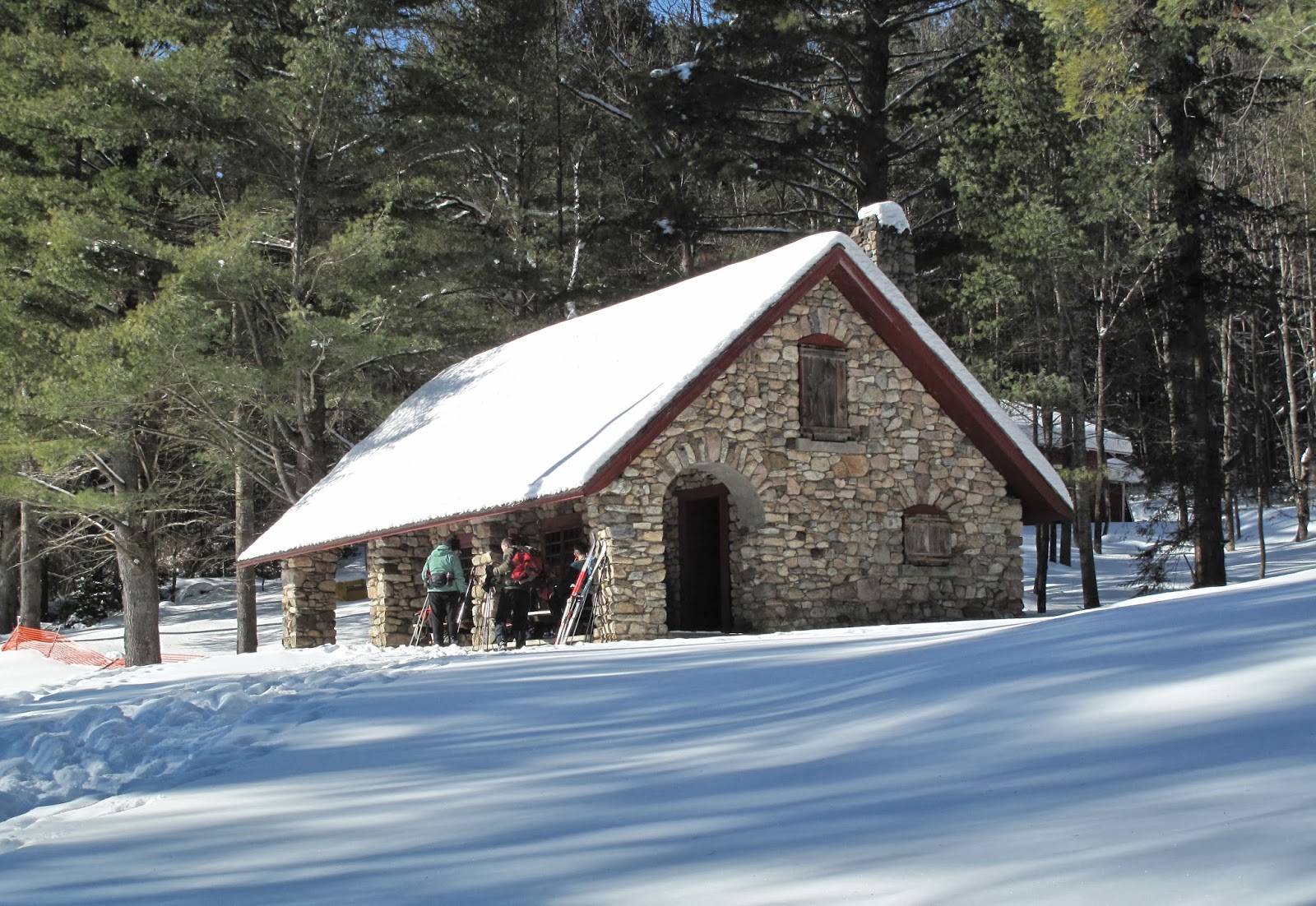
(Gateway Lodge)
Easily thirty years had passed since I had skied into Camp Santanoni in Newcomb with Bill and my father, and I was itching to go back.  The Adirondack Mountain Club (ADK) listed the trip regularly, but I never could fit it into my schedule.  This year, John Antonio, a leader of many mid-level ADK trips, offered the trip on a day that worked for me. My friend, Karen, and I signed up.

The week had been bitter cold and this mid-February day was no exception.  We arrived at the trailhead for the 4.7 mile ski to the main camp in -5 degrees with fluffy powder snow conditions, the promise of some warmth from the sun, and a clear blue sky. If any sport can beat back a chill, it is cross-country skiing. Not only that, for the first time ever, I had brought hand warmers that would fit comfortably into my mittens!


(The Creamery, part of the largest farm operation ever associated with a family estate in the Adirondacks)


"Start out as soon as you're ready," John said, "It's too cold to stand around."  I snapped my boots into my skis, opened the hand warmer package and inserted them into my mittens. I pushed off with my poles.  Everything was in our favor; deep tracks had been made by previous skiers and the quality of the snow could not have been better. The gradual incline of the first half-mile warmed us up fast.

At The Creamery, we stopped and allowed everyone to catch up, and to take a few minutes to introduce ourselves to those we did not already know. Of the ten participants on this outing, I knew about half of them. A group trip like this is a great opportunity to meet people who enjoy playing outdoors.

 
(Karen and John ski on the carriage trail across a stone bridge.)


.

From the Creamery, we settled into a relaxing pace, our skis making barely a sound in the powder. With two tracks in the snow, side by side, conversation was easy.  I enjoyed moving ahead or behind to visit with different people.  I also liked hanging back to ski alone.  Since I stopped often to take pictures, I was often close to the back of the pack.

One woman and her son brought their canine buddies.  Often, dogs are unpredictable on the trail.  They may run into the woods, or trip up hikers and skiers.  Not these two.  They were trained to stay close to their masters, keeping a quick pace as they bounded through the snow.  And when we stopped, they got lots of attention.


We gathered again at this intersection below, making sure to have a drink of water.  Tucked into an outside pocket of my backpack, my water bottle was frosty, with a few ice chips already forming inside.  I took a few good gulps and felt refreshed.  It is easy to forget to drink water in the winter.


(ten friends, new and old, and two dogs, enjoy a perfect winter outing)


After a slow ascent for most of the trip, we began a gentle downhill glide for the final mile, heading to Newcomb Lake and the main camp.  Through the trees, we had glimpses of the high peaks beyond, cold and snowy in the distance.  I stopped often to capture Santanoni Peak, which Meredith and I had hiked a few summers ago.

The first time I took a picture, the peak was barely visible through the trees.  "You might get a better view farther on," John told me.  Another quarter-mile along, I stopped again and took another picture.  Stop and shoot, stop and shoot.  Every picture showed more of the peak than the last. Then, to my surprise, the view below appeared, clear as day, above Newcomb Lake. 

I remembered the day Meredith and I had been on Santanoni Peak's summit.  It was our second peak of three in the Santanoni range that day, and we had a good coating of Adirondack black mud on our legs.  We found a rocky overlook and took in the wide view across the Adirondacks while we ate our lunch.

Today, we would not have been able to stay on that summit long enough to have lunch. The temperature up there had to be well below zero.  After taking a final picture, I put my mittens back on.  My fingers had begun to chill, but I didn't care; my hand warmers would toast them back up in seconds!


(Santanoni Peak across Newcomb Lake)


We arrived at the camp right at noon.  Taking off our skis, we clomped across the wooden porch floors in our ski boots to a sunny spot and opened our packs.  At a balmy 10 degrees above zero, we could sit around for 20 minutes or so in comfort.  John called to me across the porch, "Virginia, did you get a picture of that last view of Santanoni Peak?  That was the best one!"


(lunch on the porch)


The Santanoni Preserve was established by Robert Pruyn, a prominent Albany banker and businessman. Originally encompassing 13,000 acres, the camp had a total of 45 buildings, included Newcomb Lake, and was considered the grandest of all Adirondack camps when it was completed around 1900.

It stayed in the Pruyn family until 1953, when it was sold to the Melvin family of Syracuse.  In 1971, tragedy struck when the Melvin's eight-year-old grandson became lost on the property.  For days, a search party combed the acreage.  I remember my father going up to Newcomb from our Saratoga home to help with the search.  No trace of the child was ever found, and the family decided to sell the property.

(Newcomb Lake at the Camp)
The Nature Conservancy bought Santanoni Preserve and then transferred to it to the State where it became part of the Forest Preserve.  For years, the buildings deteriorated with the expectation that they would be torn down, a requirement of the Forever Wild clause in the State Constitution. Eventually, in 2000, the buildings and 32 acres were reclassified from Wild Forest to Historic Area by the Adirondack Park Agency. 

(fresh paint and treated log siding are two of the many restored features)
Since 2000, restoration has been continuous.  Now, in the summers, there are tours of the buildings.  Getting to the camp is still a challenge.  Most people bike or hike in in the summer.  A horse-drawn wagon ride is available, but I've heard that it takes so long that there is little time left to enjoy the property.


Skiing to the camp is a great way to go, but no tour guide awaited us.  An unlocked padlock held the door to the great room closed.  John had been told that we were free to remove the padlock and explore the room, as long as we hooked it back over the latch when we left. 


Fifteen hundred spruce trees were used in the camp's construction. Birch bark walls and hand-hewn beams help make Camp Santanoni one of the best examples of rustic Adirondack Architecture.

It was so cold inside that I had difficulty imagining this room full of people.  Adirondack furniture with cozy upholstery and plaid wool blankets, woven carpets, and other appealing decor, seemed elusive. Still, I could appreciate the architecture and Adirondack craftsmanship.


The field stone fireplace looks like something out of a Medieval castle.  With hearths on both sides, it could house a big fire, much more than would have been necessary to ward off a late-summer evening chill.  Like many vacation homes today, a great camp such as this would not have been used in the winter.


(five buildings all connected under one roof resemble a phoenix in flight when seen from above)


Eventually, after having our lunch and exploring the buildings, we began to feel cold. It was time put our skis back on.  That mile-long descent we had had into the main camp area was a welcome uphill on the return, warming us in minutes. And later, heading back to the cars, we had some nice rolling downhills.

We stopped again at The Creamery, as we had when we first began. A thermometer registered 17 degrees, and the February sun made a few icicles drip. We snacked on whatever we had left in our packs, and visited with another skier who was on his way in to the Preserve.

(I loved this little dormer window nearly completely covered in snow)


Maybe I'll see if I can find a friend or two to bicycle in to Camp Santanoni in the summer.  We'll go on the tour and paddle one of the available canoes on the lake.  We might even find a sunny rock to sit on for lunch, under the watch of Santanoni Peak.  But for now, this crisp winter day had been perfect.


(Virginia on one of bridges crossing Newcomb Lake)

Friday, February 7, 2014

Groundhog Confusion

I have been confused about Groundhog Day for decades. I never quite get it until February 3, when I read Punxsutawney Phil's results in the Times Union. I know my newspaper will clear up many of life's mysteries--after all, my name is the same as the little girl's who learned in 1897 from the New York Sun that there really is a Santa Claus. Proof positive.

When I was little, living in Saratoga Springs, I knew that a man in a top hat holding a groundhog, or woodchuck as we called it, was really just a funny thing. And I understood that it certainly didn't tell us anything about spring, which we all knew would arrive around mid-April regardless what the woodchuck was supposed to be telling us, which I never really understood anyway.

I knew all about woodchucks, because my family spent a few fun early-summer Sunday afternoons a year woodchuckin' on farms in nearby Washington County. My father would knock on a farmhouse door and ask if the farmer would like him to hunt woodchucks in his fields. “Every farmer knows that a woodchuck hole can break a cow's leg. Farmers like to keep the woodchuck population down,” my father said, and we could see that that would definitely be true.

My mother, my sister, and I took off on cow paths up the hillsides, admiring the views and wildflowers, while my father went in another direction with his rifle. I loved running through the meadows. After a while, we would all meet back at the car and go home, refreshed from a woodchuckin' afternoon. I knew that we would never see a woodchuck in February.

The real confusion about woodchucks and their shadows came as I got a little older and learned that some people thought that spring might come in six weeks, mid-March, a very early date for spring to arrive, in my experience. And yet the story said that that would be a late spring. When I learned in school, that the weather-predicting woodchuck was Punxsutawney Phil who lived in Pennsylvania, I figured that seasons down there must just be different. End of story.

Then I read in The Saratogian, my own hometown newspaper, that the woodchuck predicted a winter ending in six weeks! I totally forgot about where Phil lived and what the significance of his shadow was; I was so surprised to think of spring coming to my neighborhood so soon...and then it didin't.  It arrived in mid-April as it always had.

From then on, I could never remember if the story told that six more weeks of winter meant an early or a late spring. Truth be told, I must have a total mental block because I still don't know from one year to the next.

Maybe it depends on what we call spring. The science of the Vernal Equinox aside, I have my own definition of what spring is. When I lift up the leaves on my garden around March 15 and see crocus shoots, that is a sign of spring, but it is not spring. Along about April 7, if I have my first blooming daffodil, that is spring. It's true, that we may have had warm days, the smell of damp mud, and even a sun burn by the end of March, but spring is when we're not likely to have much more snow. Even in these days of global warming, we sometimes get our biggest snowstorms around St. Patrick's Day.

Last Sunday, I saw on the television news that Phil had seen his shadow. That's cool, I thought, but wait, what does that mean? If it means that we have six more weeks of winter, does that make spring early or late? Didn't I figure this out last year, and the year before that? Am I, like, seriously, the only person who can't keep this straight? And should I be less concerned about woodchucks and more worried about my own cognitive inabilities?

On Monday, February 3, I opened the Times Union. My eye jumped right into the article about the groundhog story. Poor Phil “was roused from slumber at 7:28 a.m.” and “was sure of his weather forecast.”  There would be six more weeks of winter, but nothing was said about whether six weeks meant an early or late spring. Then I glanced back at the article's title which read: “Punxsutawney Phil predicts long winter.” Okay, I think I've got it...for now.

Don't even try to explain to me what happens to spring if Phil doesn't see his shadow.