Showing posts with label Santanoni Great Camp. Newcomb NY. Show all posts

Saturday, August 16, 2014

Biking Santanoni

(Karen and Janet rode up the carriage road )
Some of you will remember my post from this past winter entitled, "Santanoni Ski."  In subzero temperatures with deep fluffy snow, a group of us skied into the Santanoni Great Camp, a National Historic Landmark in Newcomb, once owned by the Pruyn family.  Ever since then, my friend, Karen, had been determined to ride our bikes in.  A couple of people we knew had done it, and visiting the Great Camp in the summer would offer a different interest and beauty from winter.
(Summer air comes through the main lodge's windows; a big change from when we were here before!)
On a cool damp July day, our mutual friend, Janet, joined Karen and me for the outing.  A five-mile ride on a bike is not a big challenge, but patches of soft dirt, that could make us spin out on our hybrid bikes, forced us to be extra cautious. Still, the old carriage road was a comfortable ride on a gradual uphill through a rich green forest.

At the farm site, we could see the remains of the big barn, burned down a decade ago. This farm produced large quantities of produce, despite farming in the Adirondacks being notoriously difficult. Today the fields are mostly forested, but we could still discern boulders poking through the shallow grass, and stones throughout the landscape. While I love the deep woods that have reclaimed the land, I wondered what it had been like to see across open farm fields to myriad majestic Adirondack peaks. 

(Beautiful woodwork was made from trees on the property)
In just about an hour, we arrived at the camp. Only the great room had been open for us to view in winter; now we had access to every room in every building. As Great Camps go, this one is rustic, a place to enjoy nature and summer sports. The Pruyns of the late 19th century and early 20th century came here to have fun with a few select friends and family, away from work in Albany.

(Hailey restores and  reglazes windows)


Besides the summer openness of the grounds, Santanoni advertises tours.  In fact, Hailey, an intern majoring in historic preservation, did not give us a tour, but talked to us on the porch, telling us the history of the property, and encouraged us to take a self-guided tour through the buildings.

With rain in the forecast, and the sky a heavy gray, we decided to save perusing the buildings for later, and, instead, chose to go out for a boat ride before the rain set in.  Just downhill from the lodge, the boat house, where the Pruyn family had kept canoes, guideboats, and rowboats for their own use on Newcomb Lake, sits on the water's edge. The public is encouraged to use the boats currently stored there and explore the lake, its islands and coves, and to view the Great Camp from the water.

(Karen paddled on Newcomb Lake using a kayak from the boat house)
Janet, Karen and I were excited to find three canoes and a kayak in the boat house.  Without deliberation, we decided that Karen should have the kayak, and Janet and I would take a canoe.  Then we looked closer.  One canoe had a sign on it that read "this boat leaks."  We eliminated that one. Of the remaining two canoes, one was very large, so we chose the other as less cumbersome.

Karen was already in the water. Janet and I carried our canoe down the ramp. Next, she climbed into the bow and sat down.  From behind her, I could see the metal seat sag and the sides of the boat draw in.  "Janet!" I called out.  "Aluminum shouldn't do that! What if the sides crack while we're out on the lake?"  Janet and I carried the canoe back into the boathouse.  All that was left was the big canoe.  We couldn't lift this one, so we dragged it to the water.  It was definitely sea-worthy. 


(we were drawn to the lake on the other side of the bridge)


While the equipment proved to be a bit sketchy, paddling on this remote lake was a dream.  We headed towards the bridge that we had just ridden our bikes over.  Earlier, we had heard the call of a loon from the far side.  Hoping to see the loon now, we went under the bridge and into the open water beyond. Leafy shrubs between gray rocks dipped into the water along a shoreline devoid of sign of man...or any sign of the loon.

We could have gone a long distance on this small lake, but, afraid that a storm might come up quickly, we decided to turn around.  Suddenly, the rhythmic sound of flapping wings made us look up. Just above, large and black, our loon went over our heads towards the other section of the lake!


(Janet enjoyed her solid seat in this canoe)

Paddling back under the bridge and closer to the camp, we were within a stone's throw of the boathouse if the weather changed.  We reveled in the peace and quiet as we meandered through this calm water, but we knew there was a time when conversation and laughter, combined with outdoor activity, made this a more active scene.


(the main lodge of Santanoni Great Camp is tucked into the woods)

For the Pruyns, amusement was the order of the day--plays, story telling, poetry writing, music, games, and outdoor sports filled the time they spent here. Bedrooms were not luxurious, with the idea that guests should get up and outdoors, not languish indoors on comfy mattresses. The lodge's wrap-around porch drew people out of the buildings.

(the artist's cottage would be a perfect cottage for me!)


Fishing, swimming, boating, hiking, or picnicking on an island in the lake, could all be done on a moment's notice. An artistic Pruyn son had his own artist studio, and a daughter enjoyed her nearby gazebo. Part way around the lake a small building housed towels for swimming, and changing rooms, at a time when modesty demanded that swimmers be on the fringe of visibility.


The sky grew darker and a few sprinkles fell...and then we saw the loon, a final touch of wildness on this lake within the mountains.  We paddled close to him and he slipped beneath the water, turning up a little farther away on our other side.  He seemed relaxed, looking around, and then stretched up, preening.  We were enthralled.  After a while he dove down and reappeared farther away.  By now, the rain came down harder and we paddled back toward shore, past the artist's cottage, past the great lodge, and into the boat house.


We were grateful for the big porch where we could sit at a picnic table with our lunch and look through scrap books and photo albums portraying the Great Camp's heyday. The photos showed women walking on logs like balance beams, men writing rhymes describing an evening's antics, children using child-sized canoes or making collections of moss and stones they had found in the woods.

Even the staff had more leisure time when they came north.  With functional decor, cleaning required less effort and upkeep than in the Pruyn's formal home. Seasonal meals with the day's catch, and fresh produce from the farm, made cooking simpler too. Just the same, while the whole lodge might only have 15 people staying at one time, 70 staff members were needed to run the place.


(the wide porch surrounds the lodge and sheltered us from the rain)

A family joined us on the porch at another table.  They had just arrived on their bikes.   After perusing the albums, we took a careful look inside all of the buildings, and we chatted with Hailey. Our decision to paddle on the lake first had worked out perfectly.

Before long, the rain turned to drizzle, and we decided to walk the path to the artist's cottage.  Inside, we saw the massive stone fireplace and the view of the lake out the large front window.  We didn't stay long, because it appeared that this building was currently being used as the interns' residence.  We imagined what it must be like to wake up amidst the wild splendor of Newcomb Lake and the shrill call of the loons.

Walking farther along the path, we came to a little sand bar and took off our shoes. Although the air was cool, the water felt warm.  Surely the Pruyns and their friends had waded here. 


(Ladies having fun in a line dance)

In the spirit of the fun-loving women visiting the Great Camp a hundred years ago, Karen and Janet kicked up their heels on the lake shore in the drizzle. Salut!


(Ladies having fun in a line dance--just like those in the other photo, right?)

Hours had passed since we left our bikes under a back porch roof at the main lodge.  In a light drizzle, we began the return ride along the dirt carriage road. Although we remembered that we had ridden on a gradual ascent on the way in, the speed of our descent took us by surprise. We pulled on our brakes the whole way, conscious that we might skid out more easily in the soft spots on the down grades.

Janet flew!  A very athletic and strong woman, Janet appeared fearless.  At a more level spot, she waited for Karen and me.  With near panic in her voice, her words tumbled out, "My brakes are hardly working!  I don't want to go so fast!"   At the farm area, we stopped again. The descent had leveled and Janet had more control. The rain had stopped, so we relaxed a moment before the last half-mile to our cars.


(the gatehouse made an elegant statement to guests entering the Santanoni Great Camp)


Near the parking lot, the property's gatehouse, with upstairs residence for the gate keeper of long ago, is impressive.  We entered a small gift shop that sold maps, books, and other items on trust.  I bought a booklet about the family and the property, leaving money in the cash box.

We were drawn to the creek alongside the building, which connects Lake Harris and Rich Lake, where we could see blue mountains in the distance.  Then we rode into the parking lot and loaded our bikes onto the cars.

(there is no end to beautiful scenery here)

We thought about other friends of ours who would enjoy this trip. Maybe we'll come again next year and bring them along.  We'll just be sure to check the boats carefully before we put one of them in the water!


Sunday, March 16, 2014

Santanoni Ski

(Gateway Lodge)
Easily thirty years had passed since I had skied into Camp Santanoni in Newcomb with Bill and my father, and I was itching to go back.  The Adirondack Mountain Club (ADK) listed the trip regularly, but I never could fit it into my schedule.  This year, John Antonio, a leader of many mid-level ADK trips, offered the trip on a day that worked for me. My friend, Karen, and I signed up.

The week had been bitter cold and this mid-February day was no exception.  We arrived at the trailhead for the 4.7 mile ski to the main camp in -5 degrees with fluffy powder snow conditions, the promise of some warmth from the sun, and a clear blue sky. If any sport can beat back a chill, it is cross-country skiing. Not only that, for the first time ever, I had brought hand warmers that would fit comfortably into my mittens!


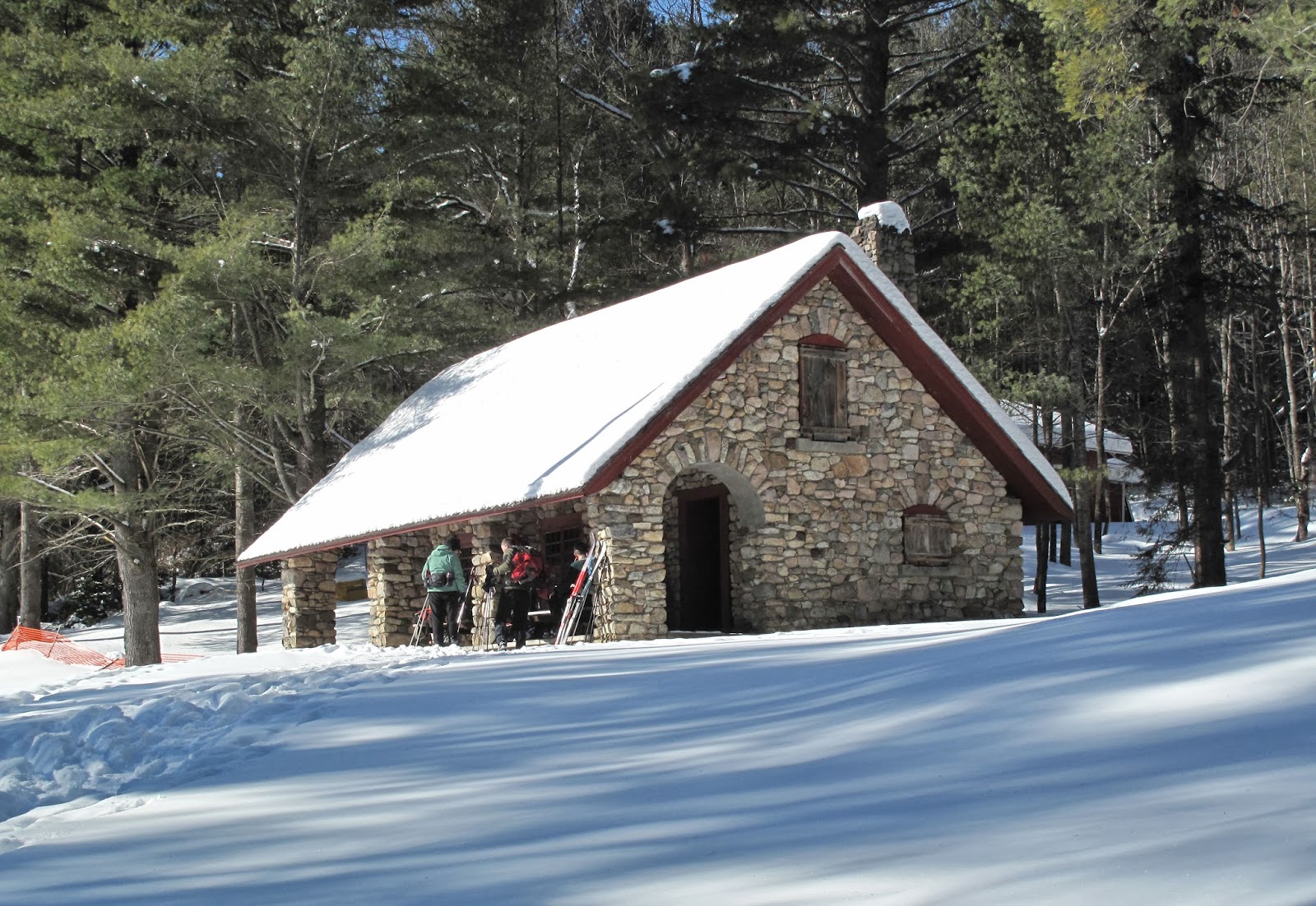
(The Creamery, part of the largest farm operation ever associated with a family estate in the Adirondacks)


"Start out as soon as you're ready," John said, "It's too cold to stand around."  I snapped my boots into my skis, opened the hand warmer package and inserted them into my mittens. I pushed off with my poles.  Everything was in our favor; deep tracks had been made by previous skiers and the quality of the snow could not have been better. The gradual incline of the first half-mile warmed us up fast.

At The Creamery, we stopped and allowed everyone to catch up, and to take a few minutes to introduce ourselves to those we did not already know. Of the ten participants on this outing, I knew about half of them. A group trip like this is a great opportunity to meet people who enjoy playing outdoors.

 
(Karen and John ski on the carriage trail across a stone bridge.)


.

From the Creamery, we settled into a relaxing pace, our skis making barely a sound in the powder. With two tracks in the snow, side by side, conversation was easy.  I enjoyed moving ahead or behind to visit with different people.  I also liked hanging back to ski alone.  Since I stopped often to take pictures, I was often close to the back of the pack.

One woman and her son brought their canine buddies.  Often, dogs are unpredictable on the trail.  They may run into the woods, or trip up hikers and skiers.  Not these two.  They were trained to stay close to their masters, keeping a quick pace as they bounded through the snow.  And when we stopped, they got lots of attention.


We gathered again at this intersection below, making sure to have a drink of water.  Tucked into an outside pocket of my backpack, my water bottle was frosty, with a few ice chips already forming inside.  I took a few good gulps and felt refreshed.  It is easy to forget to drink water in the winter.


(ten friends, new and old, and two dogs, enjoy a perfect winter outing)


After a slow ascent for most of the trip, we began a gentle downhill glide for the final mile, heading to Newcomb Lake and the main camp.  Through the trees, we had glimpses of the high peaks beyond, cold and snowy in the distance.  I stopped often to capture Santanoni Peak, which Meredith and I had hiked a few summers ago.

The first time I took a picture, the peak was barely visible through the trees.  "You might get a better view farther on," John told me.  Another quarter-mile along, I stopped again and took another picture.  Stop and shoot, stop and shoot.  Every picture showed more of the peak than the last. Then, to my surprise, the view below appeared, clear as day, above Newcomb Lake. 

I remembered the day Meredith and I had been on Santanoni Peak's summit.  It was our second peak of three in the Santanoni range that day, and we had a good coating of Adirondack black mud on our legs.  We found a rocky overlook and took in the wide view across the Adirondacks while we ate our lunch.

Today, we would not have been able to stay on that summit long enough to have lunch. The temperature up there had to be well below zero.  After taking a final picture, I put my mittens back on.  My fingers had begun to chill, but I didn't care; my hand warmers would toast them back up in seconds!


(Santanoni Peak across Newcomb Lake)


We arrived at the camp right at noon.  Taking off our skis, we clomped across the wooden porch floors in our ski boots to a sunny spot and opened our packs.  At a balmy 10 degrees above zero, we could sit around for 20 minutes or so in comfort.  John called to me across the porch, "Virginia, did you get a picture of that last view of Santanoni Peak?  That was the best one!"


(lunch on the porch)


The Santanoni Preserve was established by Robert Pruyn, a prominent Albany banker and businessman. Originally encompassing 13,000 acres, the camp had a total of 45 buildings, included Newcomb Lake, and was considered the grandest of all Adirondack camps when it was completed around 1900.

It stayed in the Pruyn family until 1953, when it was sold to the Melvin family of Syracuse.  In 1971, tragedy struck when the Melvin's eight-year-old grandson became lost on the property.  For days, a search party combed the acreage.  I remember my father going up to Newcomb from our Saratoga home to help with the search.  No trace of the child was ever found, and the family decided to sell the property.

(Newcomb Lake at the Camp)
The Nature Conservancy bought Santanoni Preserve and then transferred to it to the State where it became part of the Forest Preserve.  For years, the buildings deteriorated with the expectation that they would be torn down, a requirement of the Forever Wild clause in the State Constitution. Eventually, in 2000, the buildings and 32 acres were reclassified from Wild Forest to Historic Area by the Adirondack Park Agency. 

(fresh paint and treated log siding are two of the many restored features)
Since 2000, restoration has been continuous.  Now, in the summers, there are tours of the buildings.  Getting to the camp is still a challenge.  Most people bike or hike in in the summer.  A horse-drawn wagon ride is available, but I've heard that it takes so long that there is little time left to enjoy the property.


Skiing to the camp is a great way to go, but no tour guide awaited us.  An unlocked padlock held the door to the great room closed.  John had been told that we were free to remove the padlock and explore the room, as long as we hooked it back over the latch when we left. 


Fifteen hundred spruce trees were used in the camp's construction. Birch bark walls and hand-hewn beams help make Camp Santanoni one of the best examples of rustic Adirondack Architecture.

It was so cold inside that I had difficulty imagining this room full of people.  Adirondack furniture with cozy upholstery and plaid wool blankets, woven carpets, and other appealing decor, seemed elusive. Still, I could appreciate the architecture and Adirondack craftsmanship.


The field stone fireplace looks like something out of a Medieval castle.  With hearths on both sides, it could house a big fire, much more than would have been necessary to ward off a late-summer evening chill.  Like many vacation homes today, a great camp such as this would not have been used in the winter.


(five buildings all connected under one roof resemble a phoenix in flight when seen from above)


Eventually, after having our lunch and exploring the buildings, we began to feel cold. It was time put our skis back on.  That mile-long descent we had had into the main camp area was a welcome uphill on the return, warming us in minutes. And later, heading back to the cars, we had some nice rolling downhills.

We stopped again at The Creamery, as we had when we first began. A thermometer registered 17 degrees, and the February sun made a few icicles drip. We snacked on whatever we had left in our packs, and visited with another skier who was on his way in to the Preserve.

(I loved this little dormer window nearly completely covered in snow)


Maybe I'll see if I can find a friend or two to bicycle in to Camp Santanoni in the summer.  We'll go on the tour and paddle one of the available canoes on the lake.  We might even find a sunny rock to sit on for lunch, under the watch of Santanoni Peak.  But for now, this crisp winter day had been perfect.


(Virginia on one of bridges crossing Newcomb Lake)