Tuesday, March 20, 2012

Mountain Meditations

I love hiking with friends and family, but sometimes I just have to get out there alone.  When a free 60 degree sunny day presented itself, and Bill was away at a conference, I headed to one of my go-to places, Alander Mountain in the southern Berkshires.  Not only is Alander a great little mountain (5 mile hike round trip with 800 feet elevation gain), but the drive is pretty too. I know all the back roads.

A friend of mine once told me, "As soon as I get in the car to go somewhere nice, or on the train, I start finding solutions to my problems." I didn't have any problems that I was looking for solutions to, but my mind was a jumble of emails, telephone conversations, and in-person interactions.  Going to a quiet place in the woods seemed like the perfect getaway.

I had been on a Sierra Club state-wide Energy Committee conference call the night before, which addressed disturbing gas drilling and nuclear concerns. I had talked recently about current environmental topics with Jackie, a friend and environmental educator.  She had asked wistfully, "What can we do to stay optimistic?"  I stumbled on the question, but today, I knew what might work for me. 


Alander Mt. is in the Mount Washington State Forest, just over an hour from home in Western Massachusetts. The trail begins across a meadow with a pond in the distance on the left and a Cape Cod style house behind stone walls on the right--a fitting New England scene.  In minutes the trail descends to a lively brook.  There had been a bridge here before Hurricane Irene, but I did a little rock-hopping and got across easily. 


From here the trail rises gradually on an old farm road, the woods riddled with tumble-down stone walls.

I thought of the emails and personal interactions I had had over the past few days.  Some had accomplished tasks, or been pleasant conversations, others had seemed less than satisfactory.  An internal dialogue of "what I should have said," went through my mind.

Small streams with tiny waterfalls ran on either side of the hill as the trail climbed.  This early in March not a leaf was on the trees, and a few patches of ice remained on the ground. Sunshine beamed unbroken by foliage.

I walked slowly.  I had no reason to hurry. The air had the humidity of a warm Spring day; there was no sense in raising a sweat. I took time to soak in the aromas of pine and hemlock, and the sounds of babbling streams.  As the trail rose, mountain laurel edged the path, its leaves dark green all winter.  In a couple of months, laurel blossoms would brighten the woods with pink and white.

Just below the summit, I stopped by the cabin built here for hikers to use.  Damp and unappealing, it never looked preferable to me to camping in a tent. 

 Still, I went inside and looked around.  Someone had been here very recently, even leaving a few graham crackers that mice had not yet found. 

(a few leftovers for the next campers)

 Maybe a wood fire would make the cabin cozier than I gave it credit for.


The trail took a turn for the last 1/4 mile to the summit, through blueberry bushes that offer a boon harvest in July.  Reaching the open ridge, I admired views to the south and west towards Connecticut and more of the Berkshires.


(view towards Connecticut)

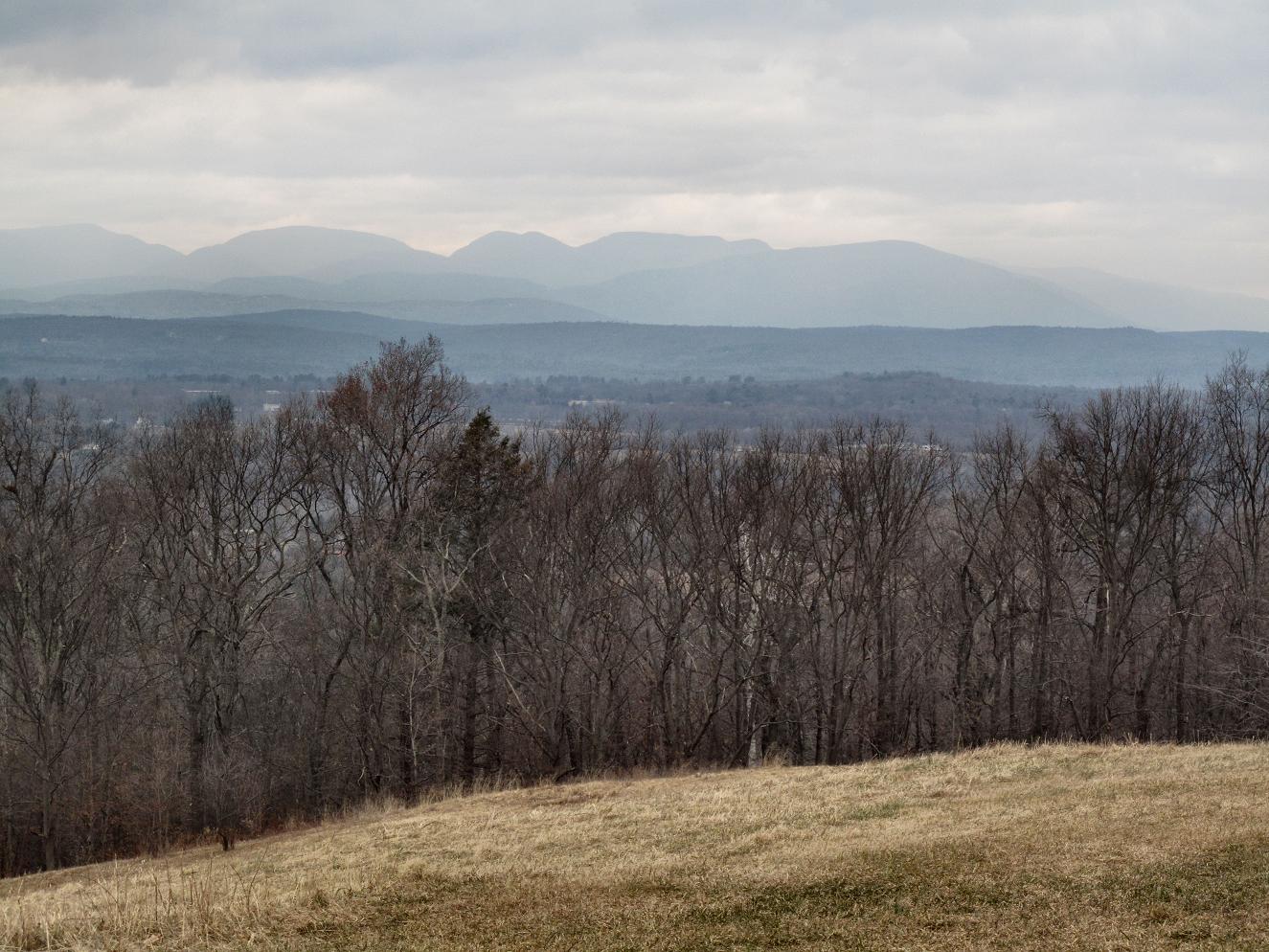
Opposite, behind a row of bushes, another view opens to the town of Copake below and to the Catskills beyond the Hudson Valley.  I like both sides, but I chose to have my lunch on the Catskill side.  A thick haze made the mountains barely visible, but I knew they were there and that they were still snow-covered.


Looking down on the village of Copake with my binoculars, I could see a cluster of houses and a church along the main street.  A truck went by on the road far below.  How many generations had seen this view almost the same as I was seeing it today?  My environmental mind thought of the old Iroquois premise that we should look seven generations ahead whenever we make decisions.  This land where I was sitting had been saved by forethinking preservationists.
(Catskills barely visible in the distance)

I lingered at the summit with the warmth of the sun on my head, the wind at my back, and the earth beneath my feet. Standing on exposed rock, I closed my eyes and soaked in these natural energies.

A hiker came from the other direction, the first person I had seen all day.  He walked quickly with ear buds on.  As he passed me, we remarked on the beautiful day.  I stayed a few minutes longer and then headed back down the path.


It was still early in the day and I had put all of my earlier mental conversations behind me.  Now, I looked for animal tracks, listened for birds or running water, and searched the woods for moss-covered stone walls, as the sun created deep shadows across the trail. 

Often I hum or whistle on the trail.  I do this at home, too.  I am rarely completely quiet, but today I thought of a Co-op friend whose husband was spending three weeks on a silent retreat.  A few of us had said, "He can't talk for three weeks!"  Our friend responded, "he gets to not talk for three weeks," making us understand that his weeks of silence were a privilege rather than a chore.  Right now, on this trail, I felt privileged to make only the sounds of my footsteps on stones and leaves.

Eventually, I was again low enough on the mountain that I could hear the trickle of little streams.  I sat down by one of them and listened to its gentle voice.  My elderly next-door neighbor had once bought a small bowl of rocks for inside the house that made this sound when it was plugged in and a continuous gurgle of water tumbled over the stones.  An electrified stream wouldn't work for me; I would have to be content with carrying this in my memory.

I remembered myths where gods, goddesses, fairies, saints, or ancestors, came out of the earth through hillside springs like this. No wonder the musical sounds of water almost seemed to speak from beyond. I sat in the dappled sunlight and listened. 

One time my friend, Maggie, said to me, "But you can't always be in antiquity. You have to apply those universal thoughts to today." I supposed she was right, but I liked hanging out with the early Native Americans and ancient Celts here in the woods.

I passed a strong lively stream.  The little ones had gathered up and made a more significant brook and a more urgent sound.  Once more I sat down in the leaves and listened.  This time, I thought of John Muir and John Burroughs, naturalists of nearly a century ago who changed the country's views on conservation and preservation.  They sat in places like this and wrote poetry or essays. And I couldn't forget Thoreau.  He walked all over these mountains absorbing nature and applying it to his life.

And coming up to almost the present day, my mind wandered to my favorite Adirondack author, Anne LaBastille.  She soaked in the water, mountains, and forests just a few decades ago and declared that we all needed to look for the spirit of Thoreau amidst the spectres of the modern age.
 
Finally, I decided to walk on out of the woods.  A Buddhist prayer popped into my mind and I winged it out in generic fashion to all the people who had been passing through my mind: May they be happy; may they be peaceful; may they be free from suffering.  I certainly was relaxed, peaceful, and full of early Spring.


 The car was hot.  I took off my boots and socks and put on my Birkenstocks.  Tossing my long sleeved shirt on the back seat, I opened the car windows, got in, and drove away.  I turned on a CD and Mendelssohn's festive 5th Symphony accompanied me on my drive back through the countryside.


Thursday, March 1, 2012

Winter Reading: Anne Morrow Lindbergh

I had not intended to become an Anne Morrow Lindbergh scholar.  It all began innocently enough last September when I was packing for a few days in Maine.  I should have gone to the library, I thought.  I browsed my bookshelves and said to myself, what could be more appropriate than re-reading Gift from the Sea while at the ocean?
I had read the book a few times, finding something new in it with each reading, but it had been at least seven or eight years since my last reading.  In Gift from the Sea, Anne studies relationships and compares them to shells she finds on the beach.  The pictures she paints as she describes the shells and her insights into marriage and other relationships are thoughtful and compelling.

While still in Maine, I googled her and decided that I wanted to know more about her life.  When I got home, I took out the biography, Anne Morrow Lindbergh by Susan Hertog, from the library. Raised as a daughter of the American Ambassador to Mexico, Anne grew up in a wealthy and privileged family with frequent travels to Europe and South America, eventually graduating from Smith College.  While in Mexico visiting her parents over a Christmas vacation, Charles Lindbergh joined the family as a guest of the Mexican government.  Anne developed an immediate crush, later claiming that life for her began when Charles came on the scene. 

I had seen Charles Lindbergh's "Spirit of St. Louis" hanging in the Smithsonian in Washington D.C., but I was not aware of what a celebrity he had been in his day.  Papparazzi followed him everywhere. The public was totally charmed and he walked comfortably amidst the throngs.  Anne knew that if she wanted to be part of Charles's life, she would not be able to maintain the privacy and solitude that she craved. 

But she loved to fly.  After her first ride with her sisters in Charles's airplane, Anne found an instructor back in her college town and began flying lessons.  The next year when Charles again came to Mexico, he let her fly his plane.  Imagine what flying was like in those days.  Just Anne and Charles in an open two-seater cockpit, cruising up the sides of mountains in Mexico and dashing down the next.  Anne sensed a huge freedom, had no fear in the plane, and relished time alone with Charles.  Flying gave them the opportunity to land on isolated beaches and meadows, far from the press.  

Marriage brought a new perspective on duty.  Devoted to duty and God, her parents had instilled in Anne the need to be of service to her community and family.  As Anne flew with Charles to different parts of the world, she shared her vision with an adoring public through books and articles.  I was surprised to learn that Anne Morrow Lindbergh had been a huge best-selling author in the 1930s and 40s. 

The tragic kidnapping of their first child, Charlie Jr., dramatically changed Anne's and Charles's lives. After a frantic three-month search for the baby with Charles convinced he would eventually bring Charlie home alive to Anne, the baby's body was found a mile from their home, killed within the first day or two of the kidnapping.  Anne responded by blaming herself--the baby was stolen right out of his bedroom while she was in the house.  Previously convinced of the basic goodness of man, she now had to confront evil, a major crisis of faith.  Charles blamed the press and a chaotic democratic society.

I was interested to learn that kidnappings were more common during the Great Depression of the 1930s than at any other time in history.  Perpetrators thought they could make big money quickly.  The kidnapper of Charlie Jr. apparently intended to hold the him for ransom, but was so terrified by the hoards of policeman and press, who descended on the area in droves, that he killed the baby and hid the body.  A year went by before the kidnapper was caught. From hereon, Anne and Charles saw the press as a threat to their existence.

More than ever, Anne wished for a peaceful life away from the public eye.  In time she and Charles had five more children, but the media attention persisted.  To escape, they lived in ten different parts of the world over a fifteen year period.  At the same time, Charles became more adamant than ever that Anne should accompany him on his flying missions.  While she loved flying and writing about these adventures, she was torn between the duty she felt towards Charles and her love and duty to her children.  During this period Charles came to value Anne's writing; he became her most intuitive reader and editor.

As I read the biography, I couldn't help sharing some of it with friends.  While at the Co-op one day, I mentioned my reading.  A few people said, "I love Anne Morrow Lindbergh!"  My friend, Lynn, said, "I've read a few of her books. They have meant a lot to me."  Another woman told me, "For years, my husband and I gave Gift From The Sea as a part of our wedding gifts to each of our friends."  Lynn became interested in reading the biography; we even held a book club meeting at the Old Chatham Country Store! 

Since much of the biography focused on Anne's writing, I decided that I should read two of her best-selling books, one, Listen!The Wind, about flying with Charles, and the other, Dearly Beloved, her only work of fiction. 

Listen! The Wind describes ten days out her six-month journey across the North and South Atlantic with Charles.  They had been commissioned to map routes and winds for possible future commercial air travel.  How incredibly exotic this book must have seemed to her readers.  Landing on islands with native people, gauging the winds--first too much, then too little--and Anne's complete fearlessness in the air over thousands of miles of ocean.

Anne didn't just write while traveling.  She also had work to do.  By hanging an antenna out of a hole in the bottom of their tiny plane, Anne was responsible for reading and sending coded messages to and from land.  She enjoyed the camaraderie with people on the ground who connected to her in the air.  Once she made radio contact with a ship on the ocean.  Charles dove down close to the ship, waved to the sailors, and then flew steeply back up to the clouds.  Anne's other job was to fly the plane for periods while Charles monitored readings and maps. As I thought about flying in 1933, I could understand the public's fascination with Anne's books.  Nothing as surreal as flying across oceans had been done before.  In addition, Anne and Charles were an attractive couple that made them darlings of this new frontier.


Since I had now read three books by and about Anne, I knew her novel, Dearly Beloved, would be a change of pace. The story is a spin-off of Anne's startling discovery that Charles no longer belonged on the pedestal where she had held him for fifteen years.

Charles's fascination with Nazi Germany, when he was invited to inspect the Luftwaffe, did not seem problematic.  He was justifiably awed by the German engineering and precision of their air force. What upset Anne and the American public was his position in the America First campaign, a white supremacist group with Nazi leanings. Scholars claim that his anti-democratic sentiment came from his reaction to the kidnapping of Charlie Jr.  He held overt American freedoms responsible for allowing heinous crimes.  As his anti-semitic speeches grew louder, Anne faced a dilemma.  At first she stuck by her wifely duty and wrote articles politically similar to Charles's speeches, despite her convictions that he was wrong.  Eventually she had to break away to keep her voice and sense of truth. During this tumultuous period, she and Charles both had affairs.

Anne retreated to a house in Connecticut and began writing about her own marriage and marriage in general. What came out was Dearly Beloved, a story in which a young couple stands at the front of the church to get married. The narrator describes the thoughts of the different friends and family who are watching the ceremony, each character viewing the wedding vows from his own life experience.  Anne's fictional exploration resolves into a positive endorsement of communication, oneness, and endurance through marriage.

I thought I had finished my study of the Lindberghs and reported this back at the Co-op.  Lynn said, "Did you read Bring Me a Unicorn?  That was my favorite.  I give it as a gift regularly."  Should I bypass Lynn's favorite book?  I requested it from the library.

 Bring Me A Unicorn brought me full circle back to the young shy introverted woman with a fierce need to express herself through writing. My picture of Charles came full circle, too, from the confident young aviator to an older reflective man, who would visit the Smithsonian just to watch the tourists' expressions as they gazed at his planes hanging there.  Bring Me A Unicorn, a compilation of Anne's letters and journal entries completed my Lindbergh study.

As she grew older, Anne found time for solitude, a love of nature, and more time to nurture her writing.  She and Charles continued to live in the Connecticut house where they had regular visits from family.  Anne Morrow Lindbergh outlived Charles by 27 years and died in 2001 at age 94.


Saturday, February 11, 2012

Are Squirrels People Too?

I admit that, in the 29 years we have lived in our Albany home, I have often been unhappy sharing my yard with gray squirrels.  The fact that, at any one time, we might have eight in the yard at once has definitely influenced my feelings about them.  Despite their fluffy tails and sometimes cute antics, I have found them to be annoying and pesky.

For one, I learned early on not to plant tulips.  In Albany, tulips are a staple of our city's Dutch heritage, but not in my yard.  When we first moved here, I planted tulip bulbs. Just as those red and yellow buds got fat and ready to open, squirrels nipped them off.  If the squirrels had been hungry and wanted them for a feast, I would have had some sympathy, but no, they dropped the buds and left. From then on, I planted daffodils instead.

I don't even attempt traditional tomatoes.  My neighbors often had large almost-ripe tomatoes hanging from the vine, but who would come along and take the first bite?  Squirrels.  Those nice juicy fruits had teeth marks all over them.  I do grow grape tomatoes.  I lose some but can still retrieve a few pints in the course of a summer.


We managed to "out-fox" the squirrels at the bird feeder.  They used to swing from maple branches and land on the roof of the feeder, then hang by their back toes, ready for a feast.  Although amazed at the squirrels' gymnastics, we cut the tree branch and got a feeder that closes when too much weight is on the rim.  A baffle on the pole helps too.

The most expensive damage came when a squirrel fell down the chimney and chewed the firebox inside our oil burner.  We had to pay for a few hefty repairs after that escapade; we also put a screen over the top of the chimney.  "Rats with fluffy tails," one neighbor used to say.

Okay, sometimes they can be cute.  After the holidays we put the Christmas tree out in the yard, still covered with the popcorn and cranberry chain I string each year.  I like watching the squirrels clamber over the tree carrying off lengths of the chain across the yard and up our Norway maple tree.  Against the snow on cold days, they can look soft and picturesque with their fur puffed out for warmth, as they try to keep a grip on the popcorn string.

In the yard behind us, a huge silver maple houses a squirrel apartment complex.  Two large holes provide entrances.  Who knows how many squirrels live in the trunk and in the largest branch.  From our porch, we have been entertained watching them go in and out.  Our cat keeps track of the squirrels too.  She chatters and her tail flips hard even though she can only be a spectator from the window.

And in the fall, they run from the oak tree across the street laden with acorns heading for the silver maple condo complex.  We wake up to the sound of acorns pinging the roofs of cars while the squirrels tackle the branches and load up for winter.

Still, I have never considered these gray rodents more than occasionally cute nuisances, until last week.  I was cruising down our street on my bike when I saw a freshly hit squirrel in the road.  It lay on its side, obviously dead, but appeared almost unharmed, as if it has just been given a stunning blow.  Next to it, a puffed up gray squirrel stood guard.  On the grass, two other squirrels appeared, watching.

For a while after I got home, I took an occasional glance out the window.  Each time a car went by, the squirrels scattered, then returned, the one taking particular care to stay nearby.  Could they be grieving?  What was the relationship of the guard to the deceased?  Were the two others family members?  We know that cats and dogs are capable of feeling loss, but squirrels? When three crows came, thinking a fresh meal might be available, the guard squirrel kept his position and the crows remained at bay. 

By the time Bill came home, the dead squirrel was beginning to look like road kill, the guard squirrel had moved farther away, and crows were showing greater interest.  Bill carried the carcass on a shovel to the field at the end of the street where it would decompose as nature saw fit.

We were both amazed that we had never seen this kind of behavior in all the years we have lived here. Had I underestimated the squirrels? Was there sadness in the silver maple condo? I may need to give these gray neighbors more credit.


Sunday, January 15, 2012

Bonticou Crag

I looked down into the garden from inside the kitchen.  My Scottish heather was blooming...at New Year's!  Its delicate splash of pink amidst the dead leaves was pretty but would it bloom in the Spring or was this it?  Had our warm winter fooled the garden? As an environmentalist, I have some anxiety about weird weather patterns.  And as a snow lover, I have been missing the traditional beauty of winter, and the fun of snowshoeing and skiing.

On Sunday, Thomas called, "Marlie and I thought we would go skiing this week since we're taking some time off, but without any snow, we were wondering about a hike."  He asked me if I was free on Tuesday and we brainstormed some ideas. I could tell that he had Bonticou Crag in New Paltz in mind. He ended the conversation, saying, "Well, just thought I'd put a bug in your ear."  Putting a bug in my ear is a risky thing.  My mental wheels were turning.  Here was the option of a positive spin on this warm snowless season.

Next he sent me an email, "Do you want to meet us at 11 a.m. in New Paltz?"

I already had my hiking boots out. New Paltz is exactly equidistant between my house in Albany and theirs in Jersey City, an hour and twenty minutes for each of us.  The town has funky shops, a variety of restaurants, considerable early American history, and just over the hill are great hikes in the Shawangunks.  

In fact, Meredith had been the one to introduce all of us to New Paltz when she went to college there in the mid-2000s. We discovered stunning quartz cliffs, soft woodland trails and carriage paths, waterfalls, rolling rural views, and fascinating history. Recently, New Paltz had become a place that attracted Thomas.  Like many people in the metro-New York area, he and Marlie found the 'Gunks and the Hudson Valley an easy drive to charming rural getaways.  

As arranged, we met just off the thruway and headed in my car to the Mohonk Preserve.  Mohonk charges a pretty steep $12 per person to hike on its trails.  While I support land preservation and have paid the fees before, we were glad that on this early January day, no one was in the booth at the Spring Farm parking area. For three of us, the two-hour 3-mile round-trip walk to Bonticou Crag would have cost $36.  
We put on our hiking boots, hats, and gloves, just as the sun disappeared behind a thickening cloud cover. Following a map I had brought from home, we began on a winding carriage path. Damp leaves smelled of Fall and we thought we heard the hoot of an owl.  A noon whistle blew in a nearby town.

The carriage path changed to a smooth hiking trail, ending at the base of the Crag, a conglomerate quartz cliff typical of the Shawangunks.  More adventurous climbers scramble up the rubble of rocks and rock-climb the wall.  Fortunately for us, there is an alternate route up the side of the ridge.

We continued following the base of the cliff but became disconcerted by the path's descent.  "We must have missed the turn-off to the ridge trail," I said. Since Thomas and I had been here before, Marlie was at our mercy as we all hiked back up, still didn't find the trail, decided we hadn't gone far enough, and hiked back down again.  "It should have a sign," Thomas said. 

I agreed but remembered that the previous time we were here, a large boulder had been covered by small cairns marking the intersection.  We kept going and there it was. The boulder seemed obvious to us now, covered with a disheveled collection of stones.  We turned onto the narrow twisty trail between fallen rock that led to the ridge and summit.

Thomas and Marlie hiked sure and fast, and I enjoyed the workout.  I shed my hat, gloves, and jacket.  Rocky outcroppings offered views along the way, but an ever-stronger breeze as we rose higher made me question whether I should have stripped down.


At the top of the Crag, the wind picked up and I put all of my gear back on.  We peered over the edge of the jagged white rock.  Far below we could see the hiking trails we had been on winding through the leafless forest. Two turkey vultures soared nearby. This day, that had seemed warm moments before, took on a sudden chill and we started down. 
 (Marlie and Thomas with the faint outine of the Catskills behind them)
I had brought brownies for a summit snack and now they were burning a hole in my pack, demanding to be eaten. We found a rock to sit on just below the ridge and fortified ourselves with chocolate. 
From there, Thomas and Marlie chose a different route for our return from the one we had taken on the way up.  The easy terrain gave us plenty of opportunity to visit.  We had seen each other just two weeks before at Christmas, but we had no trouble keeping up a running conversation. 
And then there were the quiet moments as we admired odd tree shapes, the pine needle carpet on the trail, or just soaked in a few moments alone in the woods.  We had only seen one other person in the preserve.


Our trail ended at a farm field with a beautiful view of the Catskills. We walked the dirt road back to the Spring Farm parking lot, suddenly aware of hunger pangs. All those great eateries in New Paltz were just minutes away.We chose to go to Bacchus, a restaurant with New American cuisine and a choice of over 400 beers.

By 3 p.m. we each went our separate way: Thomas and Marlie headed south to Jersey City, and I went north to Albany.


Sure, Thomas and Marlie would have liked to get in a ski day on their vacation, and more seasonable weather would be my preference, but being able to hike on this day had not been about turning lemons into lemonade.  It was much more than that.  I had been invited to share in the kids' vacation.  What could be better than spending a day in a beautiful place with two of my favorite people?
--------------------------------------
Addendum: A reader informed me that the fee at Mohonk Preserve applies every day regardless of whether someone is in the booth.  I was not aware of this and suspect that you would need to go to the Visitor's Center and pay the fee.

Tuesday, November 22, 2011

Jersey Crumb Cake

I sat at my parents' kitchen table in their Saratoga home one morning enjoying a piece of Entenmann's crumb coffee cake.  Long ago, after years of trying any crumb cake that came on the market, my mother had declared Entenmann's closest to her memory of the fabled cake she had had in her 1920s and 30s Hackensack, New Jersey, childhood. 

On this particular morning, I asked my mother, "Do you remember the name of the bakery that made the crumb cake in Hackensack?" Without hesitation, she replied, "Weimer's Bakery. My grandfather went there every Sunday and bought a crumb cake for us girls and my father, and a pecan ring for Mother and himself.  We liked the crumb cake best." 


My mother's tales of the Jersey cake's delectable sweet topping and base had reached mythic status in our family.  In the 1960s, my mother had attempted to recreate the recipe herself, combining different measurements of sugar, butter, and flour, until she was reasonably satisfied that she had come close to her recollection.  Back then, taste-testing these experiments was a task my sister and I had been more than willing to take on.

When I got home, I googled Weimer's Bakery.  It popped right up under the name Boehringer and Weimer (Boehringer was added in 1946) as the home of the best crumb cake in New Jersey! Still using the age-old recipe, B and W remains a thriving institution on Main Street in Hackensack. 

In early November, I visited Thomas and Marlie in Jersey City.  For the day's activity, Thomas suggested, "We should go check out that bakery."  He and Marlie had made a hobby of going to famous bakeries in Manhattan and New Jersey, so this was right up their alley, and throwing in a bit of family history made it all the more intriguing.

Meredith arrived from Manhattan, and, by noon, Thomas drove Marlie, Meredith, and me on a pilgrimage to B and W, Home of the Famous Heavy Crumb Cake in Hackensack, New Jersey.


With his BlackBerry as a guide, Thomas had little difficulty locating the bakery and its small parking lot.  Inside, a cluster of customers gathered and we studied the shelves.  Pecan rings overlapped in rows, but we saw no crumb cake.  We were waiting only a few minutes when a server brought out a huge pan of thick crumb cake and laid it on a counter.  She divided it into six-portion sections.  The crumb cake vanished so quickly that it didn't have time to linger on a shelf. Baked fresh all day from early morning until 5 p.m., B and W ensures that every customer gets a fresh piece at the reasonable price of $6.95 a section.  I purchased two--one for us to have that day, and one for me to take home.

Having secured our cakes, I called my mother from the car.  She was as excited as I was that we were discovering landmarks from 80 years before. Across from the bakery, a street sign read "Poplar Avenue."  A few blocks later, we parked in front of her childhood home.  "It's right up from the bakery!" I exclaimed on the phone.  "Oh yes," my mother said.

In this middle-class neighborhood, my grandfather had made his two daughters fantastic Christmas gifts that later became prototypes for the many wooden toys he created for FAO Schwarz from 1936 until 1970. My grandmother had cooked simple American foods, like meat loaf, baked beans, baked apples, and wholesome daily breakfasts of oatmeal or cream of wheat. My mother and her sister, in play dresses my grandmother had made, laced their brown buckle shoes into roller skates and skated on the sidewalk, laughing with friends after school.  And here, my great-grandfather brought waiting children a sugary treat every Sunday.


Back in Jersey City, at Thomas and Marlie's apartment, I laid our crumb cake on a cutting board. Three-quarters of an inch of sugary crumbs topped about a half-inch of cake.  I cut the cake into pieces for each of us.  Marlie made tea and we settled in for the taste test.


Meredith, Marlie, and Thomas are astute judges of baked goods; they know good goodies when they taste them.  I waited for their response.  Thomas said, in a less-than-enthusiastic tone, "It's good."  Meredith agreed.  Marlie studied the cake.  "It's not really cake," she determined.  "It has a rich yeast-bread base."
I looked closely.  No wonder my mother had had difficulty recreating this.  Jersey crumb cake was no ordinary combination of flour and baking powder! I pulled a piece of the base from the topping.  It was rich, moist, and sweet.  In contrast, the topping was a drier and chunky mix of brown sugar and butter. We decided that, while we liked the cake, it probably wouldn't be our first choice of breakfast treat given all the options at our disposal nowadays, both as bakers ourselves and from myriad nearby bakeries.

I packaged up the other cake and carried it back to Albany.  It was still only hours old when Bill had a piece around 9:30 p.m.  "This is really good!" he exclaimed.  I told him of our earlier somewhat subdued response and he repeated, "It seems pretty good to me."  Still, I knew the real judge was in Saratoga.  I froze a large section (against the recommendation of the bakery, of course) until I could take it to my parents.
 
 
In the meantime, I called my mother and we talked about Hackensack.  I found 1930 and present-day population statistics online and information on architectural and historical details.  I also found a recipe for a yeast-based New Jersey crumb cake! My mother reminisced about school, her friends, days when her father worked in New Jersey but her grandfather commuted by train to New York where he owned a men's millinery shop, and when Hackensack was a rising suburb separated by woods from the next town.

The following week, I was again at my parents' kitchen table. I hadn't told my mother that I had brought a crumb cake from Boehringer and Weimer's.  My mother's eyes opened wide when I took it out of the bag. "I can't believe you carried this all the way from New Jersey!" she exclaimed. My father was equally impressed.

When she saw the proportion of sugary topping to cake, my mother said, "No wonder we girls loved this!"  I waited for the verdict and she did not disappoint, "Boy, that's good!"  The rich yeast-cake base and the thick layer of crumbs were sources of admiration and brought up memories of a time when bakery treats like this were just that, treats. I showed my parents the photographs I had taken, and I was thrilled that the whole experience had been a fun vicarious journey for my mother.
When I visited my parents' home on Thanksgiving, I was surprised to hear my mother tell Bill that she and my father hadn't liked the crumb cake.  "What?!" I exclaimed. "You said it was really good!"   "Well, yes, but we decided that it was an awful lot of sugar, more sugar than cake, actually."  Ahh, I knew what had happened--my mother's adult perspective had kicked in. The day I had brought that New Jersey crumb cake straight from Hackensack, her gleeful response had been that of her 1930's inner child.

Sunday, October 30, 2011

Biking Philadelphia

When Bill said that October's Educause Annual Conference would be in Philadelphia, it took me about five seconds to decide to join him.  I have been to Philadelphia a couple of times and knew how I would entertain myself while Bill was in meetings. Biking in Fairmount Park, the largest landscaped park in the world at 9200 acres, topped the list. I emailed Breakaway Bikes, a shop that I had seen online as being closest to the park, to be sure I could still rent a bike this late in the season. 

Bill and I began the day fortified by a Belgian waffle from the Bonte Cafe along with a glass of fresh squeezed orange juice.  Full of rich butter, with European sugar caramelized on the outside, authentic waffles have to be cooked in an imported-only, super hot waffle maker. Crispy on the outside, and creamy on the inside, they tasted to us like the most delicious waffles west of Belgium.

From there, Bill headed to the convention center and I walked over to Breakaway Bikes. In minutes a nice young man set me up with a hybrid Fuji bike for the day, with helmet and kryptonite lock, and told me how to get to the bike path, about a half-mile away, and the park a mile beyond that.  

The Schuylkill River (pronounced "skoogle") cuts the park into East and West. The Waterworks, built in 1815, dominates the entrance to the East side.  Disease had already made people aware of the need for a reservoir of clean water and a system to send it to the city.  The complex became a Sunday afternoon destination for picnicking, skating, and walking. It is now open for tours.
Above the Waterworks, The Philadelphia Museum of Art houses a huge art collection, and was built as part of the 1876 centennial celebration.  The museums's 72 stone steps were made famous by Sylvester Stallone in the 1980 Rocky III movie.

I could have spent hours in the museum, but today I intended to explore the 40-plus miles of trails in this park.  I thought I would ride along the 20-mile loop on both sides of the river, and methodically take in the Colonial houses on the adjacent bluffs.  The first house I cruised by, Lemon Hill, made me realize that to ride the river trail and see the houses, I would be doing a lot of up and down.  The houses were built to take full advantage of river views below.  Up, down, and all around, became the motto of my day. 

My Fuji felt comfortable and smooth as I cruised along the riverside. At times, I shared the road with runners, but, in some areas, they had their lane to the left, I had the center, and cars were off to the right.  This is a biker's dream. 

Pedestrian and bike traffic were light on this Thursday morning, although my travels were occasionally impeded by Canadian geese. I could stop often to take pictures without becoming a road hazard. A cool autumn breeze kept me company as I rolled along.

I had printed off a park map while still at home.  Although it had limited detail, it gave me some idea of where the trails went and how I could get to different houses and high points.  I was pretty impressed when I crossed the river on this bridge!  Wouldn't bikers and pedestrians like this kind of accomodation in Albany? 

When I thought about life in the mid-1700s, it seemed almost unbelievable that the city had become so populated and foul that wealthy residents were already seeking country homes here, a fair distance in those days of about four miles from the center city. Eight colonial homes are scattered throughout Fairmount Park, all originally having significant acreage for farming, and overlooking the Schuylkill River.  Some are open to the public.  I knew I wouldn't be able to take time from my bike ride to tour the homes today because I was determined to cruise by every one of them.  If I get the chance to go back again, I now know which of the eight I would want to go inside.


Mt. Pleasant, above, built in 1762, with its unusual architecture for that period, and additional buildings for the servants and smokehouse, was originally the home of a Scottish sea captain.  I would choose to tour this house because so many of our founding fathers visited it.  I liked picturing George and Martha Washington getting out of a carriage here for a dinner visit. John Adams proclaimed Mt. Pleasant the finest house in Pennsylvania.  And, before becoming a traitor, Benedict Arnold bought the property for his wife.


Cedar Grove, above, was built way back in 1748 by a wealthy widow.  What was it like out here for a woman alone (with her staff, of course!) at that time?  Wilderness surely must have been within sight of these rural escapes. This stone house boasts a "must-see" kitchen.  I liked the look of Cedar Grove with its stone construction, numerous chimneys, and beautiful windows.

Fairmount Park has a huge amount of land for recreational use with tennis courts, a riding stable, and ball fields.  I came across a track meet here at the Belmont Plateau.  I had to put my bike in the lowest gear to get to the plateau's summit, but was rewarded by benches under large oak trees that made a restful spot to enjoy this spectacular view of Philadelphia.  I sat down and ate the apple I had bought from an Amish vendor the day before at Philadelphia's Reading Terminal Market.

The bike path supposedly continues as far as Valley Forge.  I exited the park for a short distance, but came across construction and detours almost immediately. I circled back, seeing no reason to leave the park's beautiful designated bike trails, and returned to the city along the river. 

After leaving my bike at Breakaway Bikes, I managed to beat Bill back to the hotel with some time remaining to freshen up.  He had an hour and a half dinner break which he intended to spend at the famous Monk's Belgian Cafe and Beer Emporium, not far from the hotel. A pub dinner with Bill and the evening vegging out at the hotel alone seemed like the perfect end to my biking and sightseeing day.

Thursday, October 13, 2011

Blueberry Hill

As soon as I open the car door, I smell dry autumn leaves, goldenrod and grasses--the aromas of a meadow. This is my backyard, a 5 1/2 mile distance from my urban home, merely a stone's throw, a short drive, or even at times a bike ride. It isn't my first choice of escape. I prefer woods and mountains, but I can still feel alone in nature here not far from home.


For four years, I was a docent at the Albany Pine Bush Discovery Center. This past summer, I made the change to "preserve steward." Now it is my responsibility to walk my trails in the Blueberry Hill section of the Pine Bush once every two weeks. I hope to become intimate with this piece of land just inches away from urban development and the city land fill.


Today I came fresh from re-reading Anne Morrow Lindbergh's Gift from the Sea. The three ideas that Anne gleaned from her time at the beach were the need for simplicity, solitude, and an understanding of the intermittency of nature and relationships.


I had the solitude and simplicity--just me and my hiking boots. At times I could see office buildings beyond the tree line, and the outlines of houses on neighboring streets, but I did not see any other person.


I began my walk along the lane surrounded by typical pine bush scrub oak and pitch pines on my way into the meadow. Besides a low hum of distant traffic sounds, I heard birds in constant conversation. I was pleased to see a pair of bluebirds, lots of sparrow varieties, tree swallows, chickadees, and turkey vultures circling overhead. It was a treat to be out early on this Indian Summer day.


Albany's Pine Bush Preserve encompasses 3100 acres of inland pine barrens. While coastal pine barrens are common, our Pine Bush is one of only 20 inland areas remaining in the world. It gets considerable notoriety as a home of the endangered Karner Blue butterfly, but, in fact, over 50 species "of special concern" live here also. It is an ecosystem worth protecting.


I walk at a relaxed pace soaking up the autumn sun, the bird sounds, and aromas of this morning.


Still, I am a woodland person, and I am glad when my path enters the trees, even though the trail runs under power lines and I can now hear children's voices from nearby neighborhoods.


My task for today is to pick up sticks and small branches on the new trails that are being built on the periphery of this part of the Pine Bush. By having fewer trails criss-crossing the acreage, the ecosystem will be more whole and will foster a more secure place for the animal and plant life that is native to this area. Old trails will be cordoned off.


I start picking up sticks. There are lots of them. I can tell right away that I'm not going to get the trail cleaned up in one morning. Now I begin to think about the time and plan how much of my morning I can spend here.


And then I hit the first bog. Okay, it's been an incredibly wet past few months, but this wet area is huge. I have to go way around it into the trees and off the trail. I don't like to go off-trail at the Pine Bush because there are lots of deer ticks.


Deer ticks carrying lyme disease are everywhere in the Northeast nowadays and I have found them on my clothes here and on other hikes, which is why I wear the fashionable Pine Bush style of tucking my pants into my socks. While it's fun to see deer and fawns, today I just see their tracks.


I finally get around the bog, pick up more sticks, and find a few beer cans and pieces of broken plastic. I regret that I didn't bring a trash bag with me.


Besides the bog, the ticks, and the trash, I'm getting hot and mosquitos are attacking me like crazy. As usual, I forgot the great new bug lotion I bought last summer for camping.... I check my watch. There are other things I need to do today than to be here whacking at mosquitos.


My serene mood has vanished. Sure, I'm still solitary out here with my hiking boots, but any spiritual aspects of the morning are long gone. I just want to get out of the woods. But there are two more bogs. I go around them, pushing twigs and branches out of my way.


Finally, I'm back in the meadow. What was that intermittency idea that Anne Lindbergh talked about? Oh yeah, moments of perfection come and go in nature, in relationships and in mood; it is best to recognize the fluidity of the ebb and flow.


The landscape reminds me of coastal pine barrens that I have walked on Cape Cod. Perhaps the drone of continous sound is not traffic, but the distant rolling of waves on the shore. I'm good at these kinds of imaginings and let my mind recreate this scene in another place.


I'm definitely overdressed, and I could use a little of that ocean breeze. It's supposed to go up to 80 degrees on this October day and the sun is rising. I take the shady side of the meadow and find a few lingering raspberries.


Birds still sing and flit from branch to branch. Even though I forgot the bug dope, I have my binoculars and try to get some good bird sightings. A couple of flickers cross my path, bees taste the last remaining pollen of goldenrod in the sun, and a chipmunk scrambles through dry leaves as it dashes into the wooded edge of the trail. Hey, there's even a seagull. Maybe I really am near the ocean! (I can't see the landfill that attracts them and pretend it's not there.)


While bright colors are rare in a pine barrens environment, this token maple stands out between the oaks. My mood is improving so I keep walking. I don't remember what else it is that I have to do this morning but I'm sure I have a list somewhere.


But what do I smell now? Something that is not dry leaves and meadow. Grilled cheese?? I look around. I'm at least a quarter of a mile from the nearest building and even farther now from the houses. And there are no fast food restaurants in this area. It smells really good. I even wonder if there might be a controlled burn happening in the Pine Bush that I was unaware of. No, this is definitely the gooey aroma of toasty cheese in a fry pan.


I realize that I'm kind of hungry. Morning is on the wane. A grilled cheese sandwich would taste really good, but I know I don't have any Swiss, my favorite, in my refrigerator. Still, a cold glass of fresh apple cider, something I do have, would taste pretty refreshing. I'll put Swiss cheese on my next grocery list.


As I turn into the tree lined path where I began and head to my car, I am reminded of naturalist John Burroughs who admonished his readers a century ago to "make the most of the near at hand." I will be back in a couple of weeks to scout out any changes and to pick up more sticks on "my" trails in the Blueberry Hill section of the Albany Pine Bush Preserve.