Saturday, August 19, 2017

Bennett Hill: Summer

(the trail is narrow with surrounding foliage)

The last of our guests have gone, and it is still only 10:30 on Sunday morning.  We had perfect weather for our family picnic the previous day and lots of quality visiting.  Now it is time to get out of the kitchen, and go for a walk.  I remember my plan to go to nearby Bennett Hill in every season of 2017, and summer is in full swing.


(leaves frame the farm scene)

Temperatures in the 70s and low humidity beckon.  I say to Bill, "I'm going to go to Bennett Hill.  You're welcome to join me."  Bill can be a reluctant hiking companion, so it's helpful if I put the idea out there without any pressure. 


(the corn looks good from here, although it may not be high as an elephant's eye)

I hear Bill upstairs in his sock drawer, as I go up to get my own hiking socks, but when I arrive his whole drawer has fallen onto the floor and dumped its contents.  Not the best start.  Still, a few minutes later, he comes up the cellar stairs with his hiking boots in hand, socks from upstairs in the other.  I know he is on board with my plan.  Sometimes we operate like this -- say little and watch.


(a new bridge since Spring)

In fact, this is the perfect day for Bill to go along.  He is a very leisurely hiker, but, if I have camera in hand to take pictures for a blog post, I become the one lagging behind and his pace is just fine.


(jewelweed, poison ivy's companion)


 As we approach the trail's beginning and I see how this year's rains have made all the growth huge and lush, I realize that I have never before been to Bennett Hill in the height of summer.


(all the rain we've had and not a drop in the tub?!)


As always, I take time to look through the trees at the farms along the way.  They never disappoint -- always a few heifers in the field, and a pastoral view to the hills beyond.  I think of my mother who, remembering that I get my milk from our food co-op, has asked me,  "Do the cows that produce your milk go outside?"  It bothers her to see cows in barns all day, never walking the hills.  My milk comes from here at Meadowbrook Farm, and I answer, "yes."  Nevertheless, I always only see heifers outdoors on this hike. Maybe I should confirm that the milkers actually do go outside.


(Was there an open farm field here when this tree was young and spread its branches far and wide?)


As the trail enters the woods, evidence of our very rainy spring and summer shows in the abundance of fungi.  I have mushrooms in my own backyard, so I should not be surprised that there are lots of them in the woods.  I scan the ground as we walk.


(lots of tiny orange mushrooms)


I don't know anything about fungi. There are lots of things that I don't know about in the woods.  When Thomas was 13 and went to Merck Forest for a week of camping, counselors taught the kids all about edible woodland plants.  Later, he pointed them out to me there. If any of these fungi are edible, I wouldn't know.


(such a pretty smooth white against the purslane)


(and this one all notched as if in petals)


I raise my eyes as we approach the summit plateau.  The flat top of Bennett Hill is my favorite part of this hike.  I love the winding trail along the plateau's edge, through ground covers, scrub pine, and the occasional white birch.


(the summit plateau trail offers variety and views)


In two locations the trees open to a view to Clarksville below.  But where has the town's defining road gone?  Have the lush greens of summer hardwood trees arched over signs of man so much that the road and most of the buildings are invisible from above?  Such a green season! 


(the view of Clarksville is almost obscured by foliage)


Along with the birch tree hugging the edge the of the hill, I am attracted to the young oak in the foreground.  Then I notice the bright yellow of goldenrod.  Goldenrod is beautiful, with numerous tiny flowers on arching stems.  It gets a bad rap because people confuse it with highly allergenic rag weed, and because it signifies that August is on the summer horizon.


(a splash of yellow goldenrod peeks from behind a young oak tree)
Still on the plateau, I come upon this dense blueberry patch.  Earlier in July, it would have been laden with wild berries.  Somebody, either wild or domestic, must have eaten every one.


(wild blueberry plants)

I had to email my friend and naturalist, Jackie Donnelly (saratogawoodswaters.blogspot.com), about the berries hanging in a loose cluster in the photo below.  I was not surprised when she answered me right away, "That pale aqua color leads me to think they couldn't be anything but deerberries."  Jackie has made a life-long study of nature's flora.  Once I knew the name, I looked online for more information.  As it turns out humans can eat these berries, but they are most often left for the animals.


(deerberry)


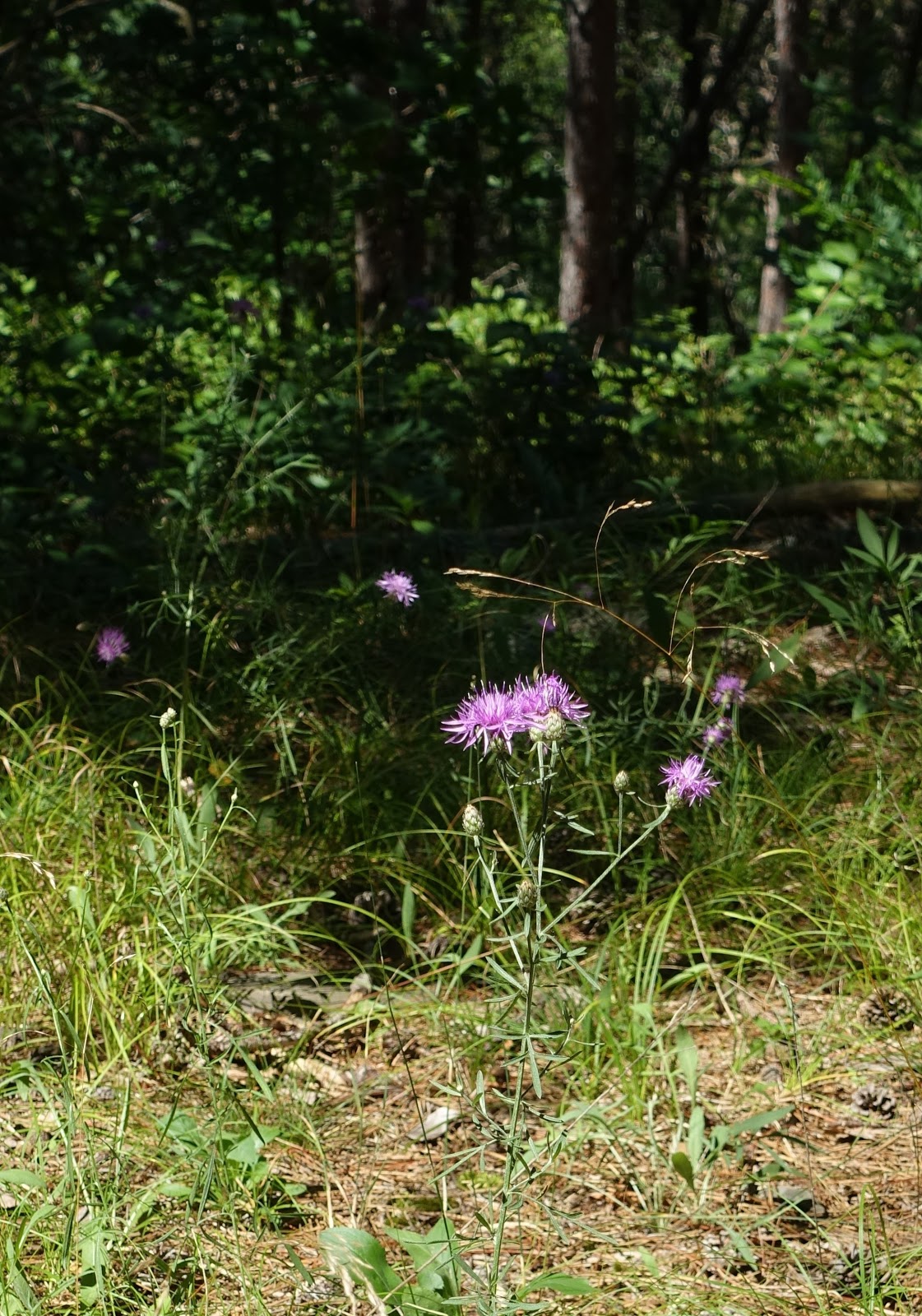
Eventually, the trail leaves the openness of the plateau, and heads back into the woods. Long stems of purple break the pattern of greens; knapweed's name does not give even a hint of how delicate a flower it is.


(knapweed makes a show of pastel lavender)

Bill waits for me by the rock pile that I pictured in my spring post.  From there, we walk together back down the hill through the forest, past the heifers in the field, and to the car. We both feel relaxed after our woodland walk with all of its gentle beauty and quiet.  Before long, I will return to record the autumn changes at Bennett Hill.


(purple flowering raspberry)


Sunday, July 23, 2017

Woodswoman Then and Now

(My collection of Anne La Bastille books)


My friend, Karen, and I had plans to camp in mid-July, when I saw that the Adirondack Museum (now the Adirondack Experience) planned a day of events to celebrate the life of Anne La Bastille, the author of Woodswoman and many other books.  As fans of Anne's books and her lifestyle, Karen and I made a quick change to begin our trip one day earlier in order to go to the museum.

In preparation, I began to re-read Woodswoman, in which Anne begins a new life in her own log cabin on remote Twitchell Lake, far from roads, electricity, and running water, while she also creates a career in wildlife ecology.  I estimate that I read Woodswoman eight times in the 1980s and 90s, but had not read it in 15 or 20 years.


(My father with a heavy load going up a peak in, 1978)


With this current reading, I was initially surprised and disappointed in my sense that the book had aged along with me.  Published in 1976, Woodswoman was contemporary when I first read it.  My father and I were having many of the same experiences in the woods that Anne had.  We backpacked heavy loads over the peaks, camping on or near the summits, cooking over campfires, and drinking water from every stream, trusting its purity.  We knew that we would not see bald eagles or moose, or an abundance of alpine plants, which had been absent from the Adirondacks for many decades.

(My father drinks from a collapsible cup near Avalanche Lake, 1976)


Few people backpack over the tops of the mountains today, most doing day trips or camping at the trail's base.  Camping on high peaks' summits is illegal, as are campfires. Now, we fear giardia and purify any water we drink.  Bald eagles are common, and moose number in the hundreds.  Alpine flowers and vegetation have made the high summits even more beautiful. 

I realized that I had read the book so many times in my 20s, because I was in the Adirondacks so much less than I had been while growing up.  As a young mother, I went with Anne vicariously. I wished to see snow falling softly out of a cabin window, to swim at night under the stars, to see northern lights pulsate over an Adirondack lake, and to pitch my tent where other people were miles away.  In ensuing years, I have done all of those things, but I did not know then that I would have the opportunity later.  Did the decades since I had read Woodswoman indicate that I no longer needed Anne's words and had outgrown her landmark book?

I was half-way through my current re-reading, when Karen and I arrived at the museum before 11 a.m., the time of the first presentation on Anne's life.  Leslie Surprenant, the speaker, told us that, no matter how well we thought we knew Anne, we would learn something, and we did.


(Leslie Surprenant talks about Anne's ancestry)

Anne gives only brief mention of her parents in any of her books. Leslie told about her family over the generations and how different members contributed to who Anne became -- what she gained from them as well as what she chose to leave behind.  As a longtime friend of Anne, Leslie shared stories of Anne's devotion to breaking barriers for women in science, her eccentricities such as always wearing pink lipstick and pink toenail polish even while hiking Adirondack trails barefoot , her passion for the environment, and her love for her friends and her dogs.

The next presentation on the moving of Anne's cabin equally fascinated us.  One of the reasons for this day's celebration was the opening of a large new building at the museum, which included Anne's cabin. An Adirondack Experience spokesperson described how the cabin had been taken apart and moved piece by piece, with sleds and snowmobiles across Twitchell Lake's thick ice in subzero weather.

(The cabin now at the Adirondack Experience museum)


Photographs of the cabin, before the move, showed a place that seemed foreign to the picture I had in my mind of Anne's idyllic abode. Over the decades, Anne had added bits and pieces to the original structure to the extent that small metal roofs and sheds stuck out in every direction.  What had happened to the charming home she had originally built?  For the most part, time and a demanding career had made more space necessary, and Anne had hurriedly constructed new additions without concern for aesthetics.  As part of the presentation, we watched a video showing how the de-construction revealed the original 12x12 cabin that had been the focus of Anne's life in the woods.


(Anne's 12x12 space)

After the second presentation, Karen and I walked across the museum campus to see the cabin in its new home.  It was just as we imagined, with Anne's colorful rugs brought back from her consulting work in Guatemala, her writing desk in front of the window and rocking chair before the woodstove, her guitar,  the wooden bars she had nailed up the wall of bark-covered logs to reach her sleeping loft, and more.  We made sure to absorb the scene and to incorporate it into the visions we had carried from Anne's books over the years.

Karen and I perused other buildings and exhibits at the Adirondack Experience, and then went to nearby Lake Durant to set up our campsite and have dinner, returning to the museum for the evening presentation.


We were captivated by the information shared with us by a panel of experts, again including Leslie Surprenant, friend and executrix of Anne's estate, and also a woman from the Adirondack Park Agency, another from the Adirondack Center for Writing, someone from the Adirondack Experience museum, and a man representing the Department of Environmental Conservation.  The hour-long program explained important aspects of Anne's will and estate planning.  Panelists discussed decisions that had been made to best preserve the essence of Anne's intentions.

Anne donated a large portion of her estate to Cornell University, from which she had received her bachelor's and doctoral degrees.  In addition, Anne wanted her cabin and 32 acres to become a writer's retreat.  In her first year as executrix, Leslie tried to distill a plan for how to do this.  Restoring the cabin would be expensive, and what modern writer would want to live without electricity, running water, road access, or internet?

(The Adirondack Experience is a beautiful and interesting museum)

In a perfect-timing scenario, the Twitchell Lake Inn offered space for rent, a first in  its more than 100 year history. The Inn is a beautifully restored lodge on Twitchell Lake across from Anne's property.  The Adirondack Center for Writing secured the location for the Anne La Bastille Residency Program, in which six carefully selected writers would spend two weeks writing and sharing in creative camaraderie.

Leslie and others felt that this residency fulfilled Anne's desire to offer writers a retreat during which they would have the opportunity to focus on honing their craft. The dilemma of how to satisfy Anne's desire to protect her cabin and land remained.  The Adirondack Museum asked to have the cabin, beginning the process of disassembly.  It was determined that Anne's 32 acres should be donated to the adjacent New York State Forest Preserve.

While this all sounds cut-and-dry, establishing how to fulfill Anne's will was far from it. Each of the panelists gave us an understanding of the huge 6-year project Leslie has had to deal with.  Although a close friend of Anne's, Leslie never expected to have this task.  Now, almost completed, the results show her conscientious care over a myriad of minute details and complexity, which have created a legacy Anne would be proud of.

(Cedar River Flow)


Karen and I spent the next day paddling the Cedar River Flow and thinking about our time at the museum.  The Flow and the Cedar River are wild and beautiful, with mountains rising from every side.  We reveled in the solitude and quiet.  We thought of Anne in her canoe, as we watched a bald eagle, loons, herons, and osprey. 

In the evening, I continued my reading of Woodswoman.  I came to the chapter "Animal Visitors," and was struck by its timelessness, as Anne described the call of loons, hearing an owl from her sleeping loft, being harassed by a nesting goshawk and kept awake by mice.  Perhaps I had been premature in thinking that Woodswoman showed its age.

(Karen, the only person I see on the Flow)

I was fascinated when I re-read her conversation with a ranger who spoke about overuse and erosion of trails in the Adirondack high peaks and the need for a permit system -- in 1972!  Their conversation could occur today.  Anne worried about motor boats disturbing the nests of loons, and we fight for non-motorized ponds in 2017.  Her battles against acid rain in the Adirondacks continue and were a prelude to the changes occurring from climate change right now.

Finishing my re-reading of Woodswoman, I looked back with affection at the details I had considered historical rather than timely.  As with Anne's will, all of the specifics could no longer apply as Anne envisioned them, but the essence is loud and clear.  Woodswoman remains an important and wonderful part of Anne La Bastille's ongoing inspiration and legacy.

(Anne La Bastille, Guilderland Library, 1993)


Saturday, July 1, 2017

Lyme escape -- Mount Van Hoevenberg!

(Virginia on the summit of Mount Van Hoevenberg)
I knew that I was fortunate, having a clear-cut, rather than a vague, case of lyme disease.  I had the obvious bull's-eye rash, fever, headache, stiff neck -- no question that antibiotics would come my way.  I had one bad week, lingering fatigue, and not much else.


(The trail began through tall pines and low fern)

Still, I think it's okay to wallow in self-pity for a brief period, and I was very disappointed to have had to cancel all my hiking plans.  Meredith and I had four days scheduled to hike in New Hampshire, a new adventure for us, and I had been excited about another year of time together on the trail.  In addition, I had offered a women's backpacking trip into the high peaks, through the Adirondack Mountain Club.  I emailed my participants telling them that I would not be able to muster the high level of energy necessary for a backpack trip into demanding terrain.

(a wilderness pond made by a beaver dam, with Mt. Van Hoevenberg in the background)


As I felt better each day, I hatched a plan.  I would head north after my weekly trip to see my parents in Saratoga Springs, stay at the Keene Valley Hostel, and hike a very do-able hike the following day, returning to Albany before dinner.  I hung onto this idea and intended to make it happen rain or shine.  My environmental side felt a pang of guilt about driving a long distance with just one person, me, in the car, but I threw this off.  Getting to the mountains seemed a necessary part of my recovery.


(If all these berry bushes had had berries on them, I might have had some ursine companions!)

I love the Keene Valley Hostel.  It's well-kept, a hiker's retreat, and cheap.  I cooked my spaghetti dinner in the hostel's kitchen and went for a walk in the rain. In the 13-person bunk room, I chose the only top bunk.  The top offers privacy, and the light there was better for reading. Despite my fondness for the hostel, I don't sleep well. The room was nearly full and there were a couple of light snorers.


( Had I really thought I might not have classic Adirondack black mud on this hike?)

I was up and dressed by 6:15, and the sun shone.  A couple of other people were already having their breakfast when I arrived in the kitchen. 


(the trail begins its ascent)


I chose to hike Mount Van Hoevenberg, reported to have fabulous views of the peaks from a rocky summit.  For my first outdoor getaway in weeks, I thought the 4.4 miles round-trip with 750 feet of elevation gain, would provide a modest adventure that I felt up to at this point.


(This panorama greeted me as I arrived at the rocky summit)


I parked on the South Meadow Road, with no other cars in sight.  I knew that just 3/10ths of a mile away, the Adirondak Loj parking lot would be overflowing.  Not here.

The forecast predicted that sunny hours would only last until early afternoon, when rain would return.  I hit the trail by 8 a.m., and felt like an escapee.  I reveled in the solitude, woodsy aromas, and bird song.


(Mount Colden above the marshy South Meadow)


The first half-mile was fairly flat in woods edged by ferns between towering pines.  The mud hit as I arrived at an old beaver pond, and the ascent began.


(I watched the clouds lift off Mount Marcy, to the left)

With the temperature hovering around 60 degrees, I knew I had lucked out with the morning's weather on this day.

I began to think that the summit was near when the trail suddenly opened from a forested needle-covered path to open rock and an astounding view. A panorama of peaks from Gothics, across the Great Range, and to the ski jumps in Lake Placid, surpassed the descriptions I had read.


(Aren't these fir trees fascinating with their thin blue cones standing upright?)


Many people who hike the 46 Adirondack High Peaks, as Meredith and I had, leave the lesser mountains "for another time."  Today was one of those "other times."  Even at my relaxed pace, the hike had taken only an hour and 15 minutes.


(Gothics Mountain with its forbidding slides.)


Two overlooks offered variations on the same scene.  I chose one and spent the next hour there.  I took pictures, had a snack, compared my map to the mountains I could see in front of me, reminisced about being on the summits, and just sat, soaking it all in.


(I love summits that have white birches, weathered by wind and storms)


I was picking up my gear to leave, when the first people I had seen all day arrived.  A young couple from Chicago, trying to snatch a quick hike before leaving the area, joined me in expounding on the weather, the view, and the day. Then they were gone.


As I headed back towards the wooded trail, I turned around to remember how I had first seen the panorama when the trail opened from the forest.  I stood for a moment, and then walked back to the overlook, once again taking in the view of these mountains, that I loved and knew so well, for a final time before leaving.


(A last look before beginning the descent)


The hour-long descent went quickly.  I thought about when I would hike this trail again.  Maybe friends would snowshoe here with me.  I imagined the view of all those peaks in deep winter.

Five people passed me, as clouds began to roll in.  I arrived at my car and a few sprinkles fell.  I took my time heading home, stopping at other favorite spots along the way.  And I was home by dinnertime.


(the return on this serene path)

Saturday, May 13, 2017

People's Climate March, April 29, 2017


With four buses sponsored by the Sierra Club and booked for the trip from Albany to the People's Climate March in Washington, DC, I knew I would be asked to co-captain one of them.  Emails flew in the days before the march, with the final roster of riders on "my" bus sent at 6:30 p.m. the night of the ride.  Every possible complication had been thought of, or so it seemed.


In fact, leaving Albany was the most difficult part of the next 24 hours.  Arriving at the meeting location 11:30 p.m. to check my passengers with my co-captain, Sierra Club colleague and friend, Pete Sheehan, I knew immediately that loading up was not going to go smoothly.

In short, people arrived who were not on any list but had tickets in hand; one bus had an accident before boarding; a replacement bus came with 13 fewer seats than the original one; and my bus driver arrived ready to go and immovable about keeping to the schedule.


(I was charmed by a little girl who took this picture of me.)

Phone calls with other captains, pleading looks from double-booked passengers, and the bus driver in the wings demanding Pete's attention, left me strung out by 1 a.m. We eventually left Albany, with most, but not all, issues resolved.


( World War II memorial with fountains running)
The bus dropped us off near the Lincoln Memorial at 8 a.m., where temperatures were already in the 70s and the air thick.  The forecast predicted 92 degrees and high humidity. Despite having given my passengers a refresher on the events of the day, and having strongly encouraged them to have a buddy at all times, I struck out on my own, and Pete left to meet up with his niece.

(the Lincoln Memorial to the west brings history into focus behind the WWII Memorial)

I reveled in this time alone, as I walked slowly past monuments and memorials in the quiet morning.  The first person I met was a charming eight-year-old girl who asked to read my sign.  She spent a few minutes studying it. Given her interest and the fact that her parents kept a watchful eye nearby, I asked her to take my picture. 

She worked on the composition of the photo, saying, "Your backpack is in the picture.  Don't you think it would be better moved out of the way?"  I shoved it aside.  She checked again.  "Your sign is crooked.  Do you want it that way?"  I straightened my sign.  This child was a budding portrait photographer!  What a refreshing start to the wonderful interactions I would have with people all day long.


(a line of port-a-potties to the left, barrels of drinking water to the right)

High on my list was catching the World War II memorial with the fountains working. I had seen this memorial before, but in winter, when the fountain was not running.  From there, I continued towards the corner  of Jefferson and Third Streets, our designated Sierra Club meeting place.

More and more marchers arrived. At one point, I texted with a friend, and we tried to meet, but moving through the crowd was no longer easy.  Often, people passed me, read my sign, and gave me a thumbs-up.  Some said, "Sierra Club, yay!"  One young man stopped for a conversation with me about the Trump administration's anti-environmental policies.  My sign brought positive attention.  And, between these moments, I walked slowly in the rising heat and humidity, by myself, taking in my surroundings.


(young men carry a pipeline to protest drilling and the use of fossil fuels)
I reached our corner an hour early, figuring I would hail my Albany people as they arrived, and sat under a tree in the warm breeze, keeping a lookout.

A few nicely dressed people stood near me.  One woman asked why such a large group was gathering here. I explained about the march and the environmental issues that concerned us.  Then I asked her why she was here.  It turned out that she was one of a few Jehovah's Witnesses that met on this corner every Saturday morning to proselytize. 


(Marchers cluster under huge trees waiting for the march to begin)

Thankfully, instead of preaching to me, she joined me in admiring the mature trees in this park near the Capitol. She said, "You know, if you have time and really enjoy flowers and trees, the botanical garden is just across the street."  What a great surprise!  I headed over to see the garden.


(the US Botanic Garden dates from 1816)

Washington, DC, is famous for its springtime beauty.  I was enthralled by the array of roses in full bloom at the botanic garden.  And I wasn't the only person there carrying an environmental sign.  Taking a moment as a tourist in this quiet oasis was a bonus!


Since I had removed myself from the crowd, I used the opportunity to walk by the Capitol and the reflecting pool.  Here, tourists mixed with marchers.


(Crowds gather across from the Capitol)

When I returned to Third Street, the crowds had grown and the street filled.  I found some of our Albany folks comfortably sitting on the grass waiting for the march to begin.


(I figured a salty pretzel would be a hedge again the heat ☺)

All day long, I was pleased and surprised by how many people spoke to me.  Some took pictures of my sign, with or without me in the photo.  I liked the sign Pete and his wife, Margie, had made for me, but I was astonished at the attention that it drew.  It brought me conversation and camaraderie. Invariably, those who approached me were Sierra Club members.  We compared notes on where we came from and what issues especially concerned our Chapters.  I spoke with Sierrans from all over the country.


(the March begins!)
The temperature rose, and I got my usual heat-headache.  I had supplies in my backpack, however, and got rid of it before it took too great a hold. 


(the Capitol is a fitting backdrop)
Everyone let out a cheer when the march began.  The street was packed.  Those of us, under the trees, waited for an opportunity to grab places in the street and soon became part of the crowd.

I had been assigned the job of taking pictures for our Sierra Club Group, to accompany an article that Pete would write for our spring newsletter.  I made an effort to step to the side so that I could get the Capitol in the background of some of my photos.  After all, wasn't our point to let our legislators know how strongly we felt about environmental policy? 


(Native Americans have had a hard time in the West)

Given that there have been so many rallies and marches in Washington since Trump's inauguration, many people have been concerned that the marches have become an amalgamation of every issue anyone cares about.  I did not see this here.  Climate change, green jobs, and environmental justice were the themes.  I happened to be near Native Americans, who are hard-hit these days, as they fight to save their sacred lands from gas drilling and pipelines.


Over 200,000 people attended this march which went from the Capitol to the White House, a distance of two miles.  We passed museums, federal office buildings, and Trump International Tower.  A shout of "Boooo" went up as we passed the tower.

We had been warned about hecklers, Trump supporters who might try to aggravate us.  The only Trump supporter I saw was a man who held a sign that read, "Trump knows more about science than you do."  Definitely a very weak argument.


(the Newseum recognizes the freedom of the press, a right much maligned by the Trump administration)

The usual chants rose and fell, "This is what democracy looks like," being the most-voiced.  I especially liked the yell that rose like a wave, at one end of the crowd, many blocks from me, and carried through to the following end.  I could hear it coming, added to it, and then heard it pass.  Later, another shout started from the opposite end and passed again like a wave.  The effect made us feel united and powerful.
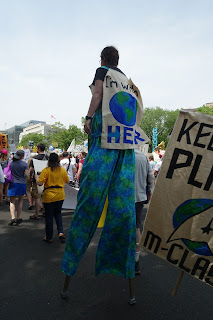


("I'm with her" used to indicate a Hillary Clinton supporter, now it is a support for Mother Earth)

Encircling the White House, symbolically counting every day of the 100 days that Trump had been in office, was the final destination for this march.  I followed the crowd, thinking I was headed in the right direction.  When I saw the Washington Monument, I thought, what happened to the White House?  It turned out that I, like a lemming going to the sea, had followed a section of the crowd that skipped the White House! 


(How did I miss this?)

I turned to go back against the tide, but the event was over.  More people already headed my way.  Later, online, I saw that many many marchers had followed the "right" crowd.  I wished I hadn't missed this part of the march.


(a runaway world)

As I walked back towards the monument, I saw a globe rolling across the grass.  A man ran for it.  At first the scene appeared comical, but quickly became metaphorical.  Despite our unity and our environmental passion, our world was running away, and we would be lucky if we could catch it.


Like me, many people found some shade under the trees.  Loud music played from the stage, where speakers would eventually rally the people once again.  I have heard many of our current great environmentalists speak, but I had never heard Al Gore, and hoped to this time.  The musicians continued to play, and time was passing.  I knew Gore would not be the first speaker, and I would need to board the bus in a while.  I looked at the long reflecting pool between me and the Lincoln Memorial and decided to begin making my way in that direction.


People walked and biked through the allee, enjoying their national park on a warm Saturday.  Tourists outnumbered climate marchers at this end of the Mall; no one stopped to talk to me about my sign, environmental issues, or the Sierra Club.  When I saw an ice cream stand, I knew an ice cream sandwich was just what I needed.


I had enough time to join the tourists sitting on the steps of the Lincoln Memorial watching the people.  I was glad that I could take these moments to reflect on my place in this iconic landscape, on these steps where major events had taken place in American history. 


(View from the steps of the Lincoln Memorial)


The comfortable breeze returned, and I felt my eyes closing. With a jolt, I realized that I might doze off and somersault down the marble steps!  It would be much safer to go to the park on the Potomac where we would gather for the bus. I meandered the way I had come hours before. A few of our people had already arrived, and we discussed our day's experience.  Before long, all of the riders on my bus were accounted for. 


(We gathered in this park along the Potomac, waiting for our bus.)

Once on the road, I thanked my passengers for a great day.  Then, I expressed my hope that we had made a difference. A loud cheer arose.