Tuesday, March 22, 2016

Weekend in Washington, DC


My friend, Rosemary, said, "Everyone will want to come visit us during cherry blossom season."

"We won't," I said.  "We'll come in the winter."

Our friend, Herb, has a two-year appointment to the National Science Foundation in Arlington, Virginia.  Normally, Rosemary and Herb live in Madison, Wisconsin.  With Washington closer to our Albany home, their invitation perked immediate interest.

Just after the holidays, we began to plan our visit.  Bill and I would take the train to DC, and the subway over to Arlington on a Friday in late February, returning on a Monday. We would have two full days to visit and sight-see.

(one residential tower after the next)

Upon arrival, our first view was of Rosemary and Herb's lovely apartment in one of the high-rise complexes of Arlington.  Just 12 minutes by metro into the District, this is a bedroom community populated almost entirely by millennials. The four of us could be taken for parents of any of the people we saw on the street or in the elevators.

Rosemary and Herb are still baffled by their neighborhood.  Shops consist of dry cleaners and nail salons.  A few restaurants are sprinkled throughout, but the nearest supermarket is a mile and a half away.

"There isn't even an ice cream shop here," Rosemary lamented.

Clearly, everyone gets what they need on their way home from work.  On the plus side, Herb has only a three-block walk to his office.


(babbling Rock Creek)


Before the trip, Rosemary sent me lists of possible places to go, asked my opinion, and requested ideas from us.  Making decisions was not easy! In the end, we picked a few destinations for each of the two days.

Our first outing on Saturday morning was to Rock Creek National Park.  "If there's a national park near you, we definitely want to see it!" I had emailed Rosemary.  I hadn't known that any park in the District is a national park, since the District of Columbia is under national jurisdiction.

"Everything we want to do today is fairly close together," Herb said, "so we'll drive."  We retrieved the car from its garage, four stories below their apartment building, and set out.

Walking woodland trails along the creek and over rolling hills gave us the perfect opportunity to visit, enjoy the fresh air, and see a beautiful and historic park


(Boulder Bridge where TR lost his ring)

I was fascinated by Boulder Bridge, with its underlayer of rocks hanging vertically.  This style of bridge construction is called "parkitecture," architecture designed to blend in with the natural landscape.  Theodore Roosevelt loved hiking in this park, and lost a ring here over 100 years ago.  The brochure we picked up encouraged today's hikers to try their luck at finding the ring!


(comfortable paths make nice loops in the park)


Our second activity was to tour the National Cathedral.  Despite all of us having been to DC a few times in the past, only Rosemary had previously visited the Cathedral, and even that was decades ago.  We were glad that some of our choices of activity were places that Herb and Rosemary had not yet thoroughly explored during their residence in the metro area.


(Washington National Cathedral)


We were surprised to learn that the cathedral had suffered a considerable amount of damage from a 5.8 magnitude earthquake in 2011.  We remembered hearing on the news about the Washington monument being closed for repairs and extensive work, but we did not remember hearing about the cathedral.  What an eye opener it was to see how entire turrets had shifted on their bases, turning clockwise so that they no longer lined up, but sat in precarious fashion, ready to drop heavy fragments at any moment.  Expert stone masons are carefully restoring the cathedral inside and out, at a projected cost of over $32 million.


(some victims of the earthquake)


Although an Episcopal church,  the cathedral, begun in 1907 and completed in 1990, is considered "the spiritual home of our nation."  It is an interesting mix of religious and national themes.

(State flags hang high)


Using a brochure, we began our self-guided tour.  The traditional Gothic architecture immediately raises the eye to majestic heights, and the cross shape with its numerous bays along the sides offers artistic fascination.  We started out together, but soon each of us wandered his own way.
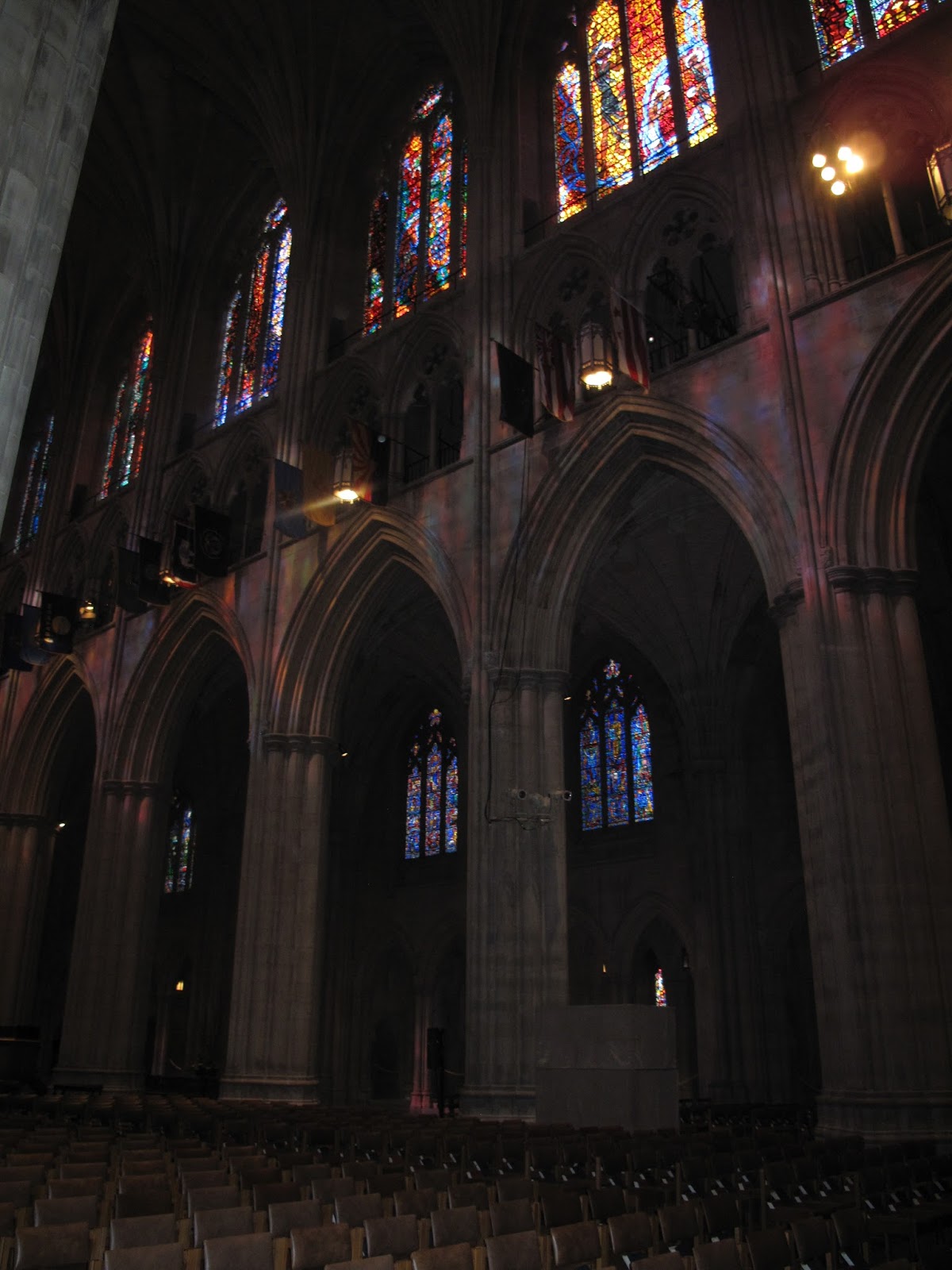

(brilliant windows glow above the dark stone)


I was struck by the abstract and brilliantly colored stained-glass windows.  Although parts of the building house traditional religious-themed stained glass, this window, below, of red and orange flames, is on the wall behind a statue of Abraham Lincoln and depicts the Agony of Civil War.


In the opposite bay, George Washington stands statuesque. The window behind him, in lovely swirls of blue, reflects the search for freedom in the founding of our nation.


Besides the glass, there was a series of dove paintings by illustrator N.C.Wyeth, a carving of Martin Luther King, who preached here regularly, and myriad more works of art.


Eventually, we all gathered outdoors where the carillon played high above.  We were hungry after our walk at Rock Creek and our wanderings through the cathedral.  Fortunately, the baptistery is now an Open City cafe, and fit our needs perfectly.

(I had Monk Tea, and how about those camel cookies!)


This February day's temperature reached a comfortable 60 degrees.  With delicious sandwiches on hearty homemade bread, pots of tea, a table in the outdoor seating area, and music from the carillon wafting down, we couldn't ask for more.


(The Baptistery made into an Open City Cafe)


Rejuvenated from a sit-down, and well-fed, we were ready to explore the 57-acre Cathedral Close, which comprises gardens and woods designed by Frederick Law Olmstead, best known for designing Central Park in Manhattan.  Olmstead wrote that the Close would "brush off the dust of the city...so that one is cleansed in mind and in spirit."


(restored 13th century Norman arch)


Both the garden plantings and the permanent structures originated from locations throughout the world.  In addition, close to 40 different flowers would bloom over a three-season period. Sheltered among the stone and greenery, a visitor could feel a timeless quiet.


(the Cathedral Close)

Our final exploration of the cathedral led us back inside, where we found the elevator which would take us up seven stories to an observation area.  From here, we could look out windows from every side, down to the ground, out to the city, and back to the cathedral's roof and architectural detail.


(we followed this hallway past windows to the outside)

What a treat! Whether it's in the mountains or in the city, I always love to get up high. The first windows we came to looked down on where we had just been, the cafe and the gardens. 


(the Baptistery with its cafe, and the Cathedral Close)


I was thrilled to see the flying buttresses with their ornate pinnacles up close.


In the interior space of the observation area, a museum displayed photographs depicting the history of the cathedral, including the recent earthquake damage and repairs.  We found so much to see and learn here.


(a pinnacle just beyond the glass)


We left the calm of the cathedral area and drove into a more hectic section of the city to see Malcolm X Park, our next stop. Bill had found this listed as one of the Top 10 things to see in Washington, according to Time Magazine.


(beautiful stonework stairways and paths)


With the aid of the GPS and his expert driving skills, Herb found the park and a safe spot for the car.  From the street, the park rose in a series of stone stairways up a steep incline, opening into a huge grassy area at the summit.

People played frisbee and lawn games, walked with strollers, rode bikes, jogged, and enjoyed the nice day.  The song, "Saturday in the Park," recorded by Chicago, came to mind.


(a young couple, a sunny day, a classic picnic basket, and a dog)


We saw one statue, Joan of Arc astride a horse, the only statue of a woman equestrian in the entire District.  While this was all wonderful, where was Malcolm X?


It became obvious that the real beauty of this park is its water features, even though they were dry now. In season, fountains, cascading falls, and pools dropped from one intricately designed stone level to another, with gardens alongside. I found it easy to imagine people watching the water, sitting on the stone walls and benches, perhaps with some impromptu music nearby, on a summer day. 


(water would cascade into a large fountain pool)

Despite all, we were a little confused. Why was this called Malcolm X Park, or was it?  We had seen no written name, statue, or indication that the advocate for black rights had ever been here.

Bill began to feel a little responsibility for suggesting that we come here.  I didn't mind; it was a fascinating park.  And Herb and Rosemary both said, "we love exploring places we have never been before."

Still, we were relieved when we came upon a plaque describing the park's history.  Built in the 1930s, it was home to concerts, events, and protests.  With the assassination of Martin Luther King, riots broke out and the area was devastated.  Since 1969, the park has been unofficially called Malcolm X Park, in recognition of racial protest, although its real name is Meridian Hill Park.  Since there is a memorial to President Buchanan in the park, the name cannot be changed to honor another person.

Now we had to seek out the statue of our 15th president. We found him, looking important but restful, on a regal marble pedestal under the boughs of a large tree.


(President James Buchanan sits proud)


We had had a full day and had learned a lot.  How relaxing it was to return to Herb and Rosemary's comfortable apartment and to eat a delicious meal, while we planned our next day's adventures.


We began Sunday by taking the metro to Foggy Bottom and walking the Mall, passing through or alongside the famous memorials.  While we had all seen most of them before, they are worth repeating over and over.


(The Museum of Natural History)


The weather wasn't quite as fine, so we had prudently planned some indoor activities for this day.  We debated which of the Smithsonian museums we should go in.  I was attracted to a photo exhibit of Iceland in the Museum of Natural History.  We enjoyed perusing the pictures of barren landscapes, and farms and villages, and of Iceland's hearty residents.  Then we discovered that the museum was showing the new IMAX movie celebrating the 100th anniversary of our National Park Service. We paid the minimal fee and got in line.

I had seen this movie advertised in the Sierra Club literature I receive.  In fact, I had researched how to bring the movie to our area.  Unfortunately, it was prohibitively expensive.  What a find to see it here!  The photography was exquisite, the music a perfect accompaniment, and Robert Redford's narration clear and interesting.  If we had any complaint, it was the "adventure" aspect of the film, which showed three people doing extreme sports throughout the terrain.  Some of their activities appeared unsafe, or detrimental to the landscape. Still, the movie was a wonderful tribute to the beauty and fragility of our National Parks.

We had lunch at Paul's Cafe.  With the sandwiches served on baguettes, and a case of exquisite pastries, this cafe is decidedly French. I couldn't resist a chocolate mini-croissant.  Along with the warm decor of natural woodwork, and large windows facing the Mall, Paul's made a cozy escape from the drizzle that had begun outdoors.  We were well-fortified for our afternoon activity.


(Uh-oh. Entrance to the Spy Museum)

Rosemary thought that Bill, especially, would enjoy the Spy Museum, a place, again, new to all of us.

Upon entering the museum, we were told to choose a personality from the ones offered, and to remember its characteristics.  Then we would see if we could successfully qualify to become a spy with our character.

We pressed buttons and answered questions.  After the second series, the screen told me to go to the Pub.  I was clearly a loser at spying!  Herb, however, went through several levels and got to the screen that said that he was the "most effective security threat."


(Herb and Rosemary see that he could qualify to be a spy!!)


Herb wasn't planning on a new career, so we followed the museum map through the pop culture section where we saw James Bond's car and Agent 99's phone.


(James Bond's Aston Martin)


From there we entered the history wing.  We learned how spying was used by the Greeks with the Trojan Horse, in Shakespeare's writing, by Queen Elizabeth I, and throughout the World Wars and into today.


(A model of the Trojan Horse began the museum's history wing)

Artifacts, writing, and recorded interviews fascinated us. We learned how the spies crafted their trade, what qualities they possessed that made them successful spies, how they influenced or deceived others, and were ultimately caught.  Equally interesting was the elaborate and complex intelligence the detectives used, coupled with their intuition and instincts. This museum has something for everyone.


(World War II intelligence and spy equipment)

We had had a packed weekend, and, yet, we had also had plenty of time to relax and visit, curled up in comfy chairs in the apartment.  It was fun to catch up with one another, and to better understand our friends' temporary home and lifestyle.

Monday morning, Bill and I left to catch the subway for our trip back to the train station and north to Albany. Our hours of travel time were spent going over our brochures and thinking about all of the places we had been, but we always returned to the many conversations we had shared.
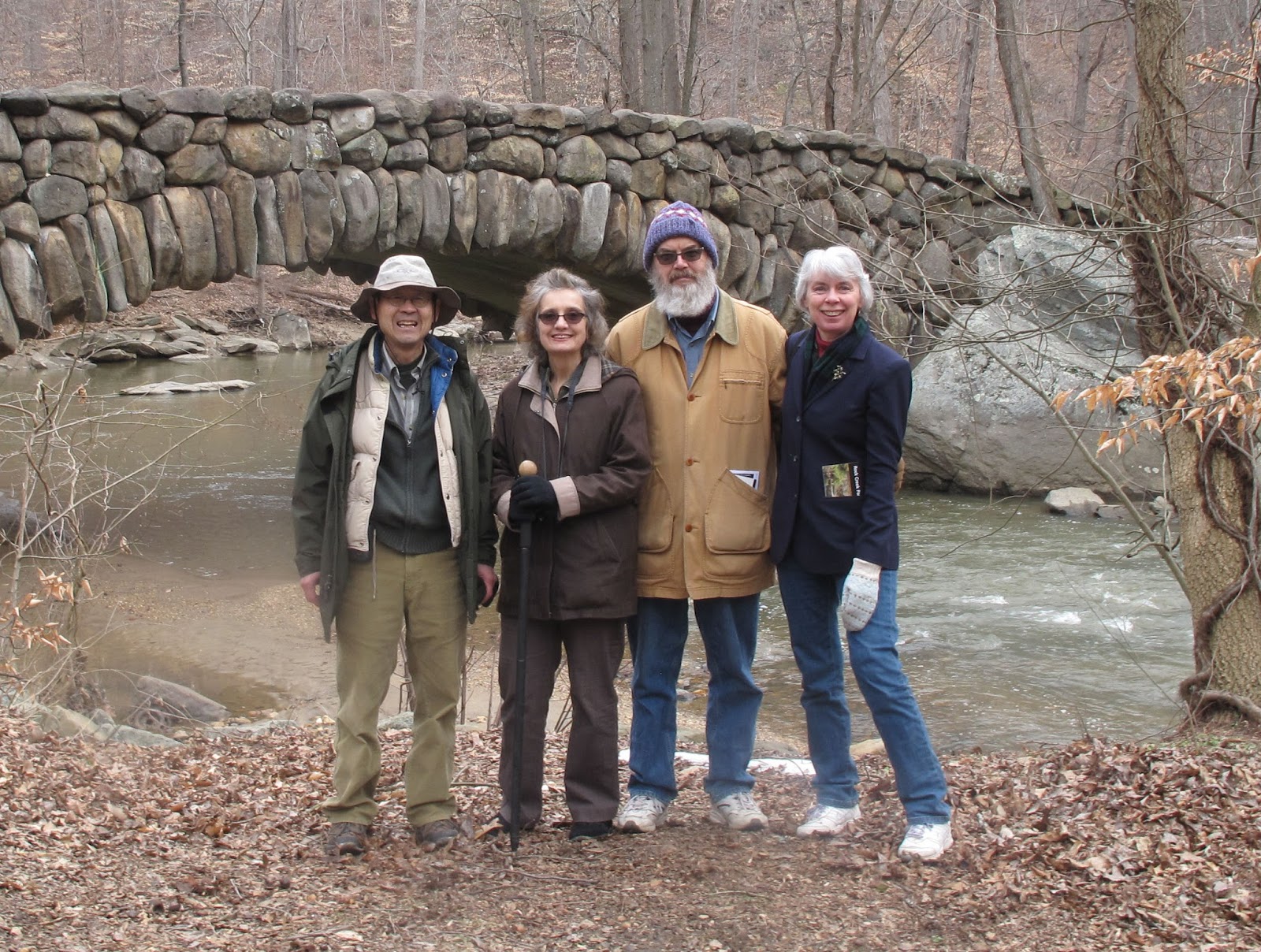

(Good friends since 1989)


Wednesday, February 17, 2016

Hot Dog Hike

(deviled eggs ready to take to the picnic)


The hikes that John Antonio leads for the Albany Chapter of the Adirondack Mountain Club are legendary, none more so than his annual "hot dog hike."   In recent years, I have gone on one of John's outings each winter.  As I read through this winter's listings, I instantly signed up for his hot dog outing.


(12 people, 4 cars, and lots of supplies)


I knew that everyone brought something, so I offered to make deviled eggs. To carry them safely, I needed a pack with a square-bottomed pocket for two egg cartons, each holding 12 halves of eggs.  Rummaging in my basement, I found my old Kelty pack, perfect with its angular frame. 

As we arrived at the trailhead, picnic supplies were divvied up: wood for a fire, charcoal for the grill, the grill itself, and more. Since I had lots of empty space in my pack, I took two small pieces of wood, and the bag of charcoal.

Then I saw Marie, who had a mystery package in her hand.  "It has to be held flat," she said.  She planned to carry her package for three and a half miles in her hand.  It fit perfectly in my pack on top of the charcoal. 


(See Marie's package on top? Newer packs have cylindrical bags.)


John has chosen a variety of locations for his hike over the years. This one particularly appealed to me -- a hike to two ponds in the Pharaoh Lake Wilderness. With a forecast for temperatures in the 30s, John had written in his email, "Layers, layers, layers is the way to go. Remember it takes a bit of time for the grill to heat up and you want to be warm when we actually start to chow down."

We started hiking at a good clip, our microspikes allowing us to grip the groundcover of light snow and ice with ease. Before long, everyone shed their heaviest layers of clothing. Lighter hats, mittens and jackets came out of packs, while others were rolled up and stashed away inside.


(John read about Ragged Mtn. from Barbara McMartin's guide book)

Rugged rock cliffs came into view on a hillside behind the trees.  John took out his old Barbara McMartin trail guide and read to us about Ragged Mountain.  Our trail would go around the base of the mountain rather than up and over its rock face. "Not to be climbed in winter," advised Barbara.  John's instincts as a retired teacher were put to good use for our benefit, not that any of us planned to climb rocks today.


(Ragged Mtn. through the trees)


Before long we reached Tubmill Marsh, where a mill once stood that made wooden shoe-nails.  It was hard to imagine the activity that once took place here.

(Serene Tubmill Pond)


A leanto at the marsh displayed carved writing from as far back as the 1930s.  Tom, a leader for Lean2Rescue, studied the condition of the structure.  "It needs a new roof," he said.  By summer, he would have a group of volunteers in here with him to repair this leanto for another few decades.


(No cracks for black flies to get through!)

We were interested in the structure that had lasted here for at least 80 years.  "This one was well-built," Tom said.  He put his hand up to the logs and added, "The logs should be so tight that a black fly can't get through."  These certainly looked very tight.  Then he laughed and said, "Of course the entire front of the leanto is open."  For sure! Blacks flies didn't have to worry about squeezing between logs to feast on campers!

If the weather had been bad, we might have stopped here for our picnic, but today was fine, and it was still early in the day so we continued on.


(Seriously, they know where they are going!)


When we came to a trail junction, John took out his map to show us our direction, and to point out the gradual elevation marked by topographical contour lines.  Our destination was Lilypad Pond.

Rock Pond Brook bisected our route. With this winter's warm temperatures, little ice had formed.  We debated whether our microspikes were a help or a hindrance, but we all kept them on and crossed safely, without accidentally slipping into frigid water. 


(Marie decides which rocks to hop)


We passed small Honey Pond, abundant with evidence of wildlife. Moose had left tracks in the snow, and beavers had been very busy working on these large trees.  What striking evidence of chewing! Eventually, these trees would fall, and the beaver would break off all of the smaller and mid-sized branches for their homes and dams.  This part of the forest would open into a sunlit meadow of berry bushes and shrubbery until trees once again filled the space.


(Beavers have worked hard here)

After a couple hours of hiking, we reached Lilypad Pond, its leanto and stone fire circle.  Let the festivities begin!

We emptied our packs of their provisions and treasures.  John pulled out his chair and the grill, took the charcoal I had carried, and started a cooking fire. In minutes he had the coals lit and heating.


(Happy cook, with his grill and camp chair)


A few people had brought wood from home for a warming fire.  This was not their first rodeo!  Although it was my first, John has offered the hot dog hike for eight years. Only one person had been on all of the trips. Most had participated a few times.  They regaled us with previous years' temperatures and adventures.  Last year, when we had lots of snow and cold weather, near zero temps had been only for the stalwart.  I was glad that this day was a comfortable 34 degrees.


(Tom works on the fire)


To tide us over while we waited for the real food, a spread of munchies, including my eggs, lay before us on the leanto floor.  Chips of all kinds, dips, and other snacks took the edge off our hunger.


(Everyone brought something to share)

Oh, and what was that?  beer? and wine?  Sure enough, Dale's Pale Ale made an appearance, as did small personal-sized boxes of chablis.  Shouts of enthusiasm arose!  Clearly, nothing had been forgotten.


(A toast to another year of the Hot Dog Hike!)


While we waited for the grill to reach cooking point, we walked down to Lilypad Pond.  It felt very remote.  A couple of us had considered carrying ice skates to use here.  In the end, we decided that, this year, ice was not trustworthy anywhere, even here, and had left our skates at home.  Water lapped the edge of the pond, and the ice had the murky white color of a softer surface, not hard, clear ... or safe.


(We checked out Lilypad Pond)


Just around noon, the sun came out.  What a treat!  It filtered through the trees, crossed the pond, and felt bright and warm, complementing the heat of the wood fire, as we returned to the leanto. The fire raged, and better yet, the grill was hot.


(What a beautiful place this would be for summer camping)

John laid the dogs on the grill in a circular formation.  These were premium products from Rolf's Pork Store on Lark Street in Albany.  "Don't let Rolf hear you call them hot dogs," John said.  "These are frankfurters."  And they sure appeared to be more than your average dog.


(Just a touch of toasty black!)

The first perfectly roasted hot dogs slipped into rolls in a hurry.  It didn't take long to devour them, while another batch roasted on the grill.  Louie, Karen's golden retriever, had not been tempted by the array of snacks, but he was definitely interested in food now.  "Poor Louie," someone said, as Louie watched each bite consumed by others. He didn't remain "poor" for long; plenty of tidbits came his way.

(Lori, Karen, and Barb enjoying their lunch, while Louie watched)


Louie is a great hiker.  I have a "no dog policy" when I lead a hike, but I make an exception for Louie.  He never leaves Karen's side.  Neither squirrels rustling in the leaves, nor the scent of other wildlife, takes him from his post. "Louie is really enjoying today, being out here with us on his own," Karen said, remembering the 8-month old puppy they had left at home.


Tom stepped away briefly, and Marie unwrapped the mystery package that I had carried for her.  "A birthday cake!" someone exclaimed.  Indeed, Marie had baked a white cake with lemon-butter frosting for Tom's 60th birthday ... and she had brought hats and blowers.  Upon Tom's return, we joined in a raucous rendition of "Happy Birthday," and blew the blowers.


(Marie sets the stage for a party)

It's never easy to light candles outdoors, but these held long enough. With John's hands to block the breeze, Tom had a quick moment to blow them out.


We began to feel a slight chill, and stood in a circle around the fire. The birthday cake, and Karen's chocolate chip cookies, made the perfect ending to our lunch.


(Do Virginia and Karen's husband, Jeff, look like "pixies?")

Karen and I both poised our cameras on a log, to take 10-second timed photos, so that all twelve of us could be pictured.  Marie said that we looked "pixie-ish" in our party hats. Silly might have been a more accurate word, but, so what, we all sported big smiles, evidence of a fun and festive afternoon.


(Hot Dog hikers 2016)


Then we packed up for the return hike.  We had spent an hour and a half here at the leanto on Lilypad Pond, eating, chatting, and enjoying this year's event. 


The food and camaraderie gave us renewed energy for the three-and-a-half-mile hike out.  John said, "I will keep doing hot dog hikes as long as I can.  If everything else goes, we'll still do this."  In fact, John's hikes throughout the rest of the year are pretty special too, and he would appear to have many more years of hiking ahead, but who could argue?  He was host for much more than hot dogs, and we were grateful.


(Energized for the hike out)


Monday, January 11, 2016

Hiking Mount Equinox


Some of you know that I have an aversion to hiking mountains that have roads up them.  There's something about sweating your way up a mountain to find a parking lot with people sitting on rocks all cool and comfy. 

For this reason, when my Adirondack Mountain Club friend and fellow leader, Karen, suggested a year or so ago that I lead a hike up Mount Equinox in Manchester,Vermont, I resisted.

Then, this past September, Karen led a trip to Equinox. I read the write-up she posted in our chapter outings schedule: "The trail rises through a very old forest directly to the imposing summit.  The property is owned by the Carthusian monks, who dedicate themselves to prayer and solitude.  The decaying old hotel at the top has been taken down, and the Carthusian order has built a beautiful open sunlit and green building for the public to enjoy the views and learn about their order, a place of repose and quiet."

That sold me.  I wasn't available the day of Karen's hike, so I put Equinox on my must-do list.  When I emailed Karen to tell her that I planned to hike Equinox, she wrote back, "You'll want to join the Carthusian order after going through their building."


(Not your typical trail head parking!)

Manchester is not far from Albany. On Election Day, this past November, my friend, Rachel, and I headed to Vermont for the hike. The day dawned clear, with unseasonably mild hiking temperatures.  We pulled into the parking lot behind the very old and luxurious Equinox Hotel and began the hike through the edge of town and into the woods.


(A very nicely made trail kiosk)

November can be a great time to hike.  With the leaves down, the woods are open, and views through the trees, otherwise not visible during the foliage seasons, make the hike interesting.  Dappled sunshine lit up the beech leaves still clinging to the trees and those at our feet.


The second highest mountain in Southern Vermont, Mount Equinox offers a trail with an elevation gain of nearly 3000 feet in just over three miles.   The first two miles are on an old mountain road, with a cobbly stone surface. Even though we set a steady moderate pace, the relentless upgrade occasionally left us panting.


(Although beautiful, this photo does not show how steep the incline is.)

We chatted the whole way.  Well, I chatted some and Rachel more.  She is much better at talking and breathing than I am!

Rachel is a stalwart  hiker, who has not only hiked the 46 Adirondack high peaks and the 111 Northeastern peaks, but she lived and worked at Yosemite National Park for three years.  She could ride on that reputation for the rest of her life, but, instead, regularly proves that she still has the stamina and natural ability to do just about anything.


(Those Vermonters know where to place a nice bench.)

We began to tire of the ongoing road. While beautiful, its sameness and steady incline began to feel relentless.  We were glad when we saw the sign for a turn-off onto a more rustic hiking trail, the final mile to the mountain summit.  Finding a bench at the junction seemed so "New England,"... a far cry from the typical Adirondack "sittin' stone."


(A relief from the road.)


This trail provided a nice change -- lined with mosses and young hemlocks, narrow and varied with twists and turns through the woods.  What a surprise and shock, then, as we emerged from the trees, to see first, not a view, but a parking lot.  Welcome to the paved summit!

Walking straight to the doors of the building, we tried every one.  Locked!  What!?  We wouldn't decide to be monks after all?  A sign on the door said that the Viewing Center would re-open in May.


(The Saint Bruno Viewing Center)


A cold wind whipped.  We dug into our packs for layers of clothing that we had shed early on.  Walking along the deck of the building, we found a place to sit on the cement floor out of the wind, feeling somewhat let down.

Two motorcyclists arrived.  They greeted us and then retreated to another sheltered location.  We smelled the pungent aroma of marijuana.


(The Visitor's Center has a deck all the way around.)


Once we felt revived from having lunch, were relaxed from a sit-down (even if it was on cement), and had dressed in all of our warm clothes, Rachel and I were ready to more thoroughly explore the summit.  First, we read the signs posted on the deck.  A map designated the names of the surrounding mountains.  We peeked in the Viewing Center's glass windows. The inside definitely appeared inviting. We would have to come back, so that we could appreciate the owners of this mountain, and the building they had built to commemorate their faith.


(Views from the deck are stunning.)

Views spread out in many directions. We realized, now, that the deck served the purpose of raising visitors just high enough to see for miles. We reveled in the beauty stretched out before us.  I had not expected southern Vermont to look so wild.  Rows and rows of blue ridges appeared infinite. We took pictures, and stood and stared, until the cold wind crept through our layers of clothing. We knew that we had to get moving.


(Could this be mistaken for the Blue Ridge Mountains down south, instead of our local Greens?)

We chose to vary our descent by taking an off-shoot to the Overlook Trail, promising us more views from rocky outcroppings.  Within a short distance we came upon this stone, constructed in memory of Mr. Barbo, the beloved dog of Dr. Davidson, who once owned the property.  Dr. Davidson was heart-broken when his dog was shot by a hunter in 1955. We were sure Barbo had lived a good life over his 12 years as the doctor's companion, despite his tragic end.  And Dr. Davidson goes down in history for having given the gift of these 7000 mountain acres to the Carthusian monks.


(Mr. Barbo, 1943-1955)


During World War I, having just completed his doctorate in chemistry, Dr. Davidson worked on the development of mustard gas.  During World War II, he worked in Oak Ridge, Tennessee, refining uranium for the future atomic bomb.  Although he felt strongly that the bomb had been a necessary evil, those who knew him wondered if his interest in helping the Carthusians was part of a need for atonement.

The Carthusians are a 900-year-old Roman Catholic monastic order devoted to silence, solitude, and contemplation.  Dr. Davidson's friendship with a Carthusian Brother gave his post-war land-conservation interest a greater purpose.


(Why did hikers in 1883 choose this particular rock in the woods for carving?)


Rachel and I continued along the comfortable needle-covered ridge path on its gradual descent. Half-buried in dirt and moss, a flat carved rock offered testament to hikers here over a century ago.  At that time, they might have been out for the day or been guests at the small Mountain House that existed here in the late-19th century.


(Rachel at one of the overlooks)

We liked this path.  It smelled of evergreens and opened to a couple of beautiful views.  On a day like this day, lunch at one of these view points would have been more comfortable than at the windy summit.  These spots might also be quieter on a summer day when tourists are more numerous.

Every view on this hike had been so different from the previous one. Here, we could see the town with its church spire in the Village of Manchester, and roads that spread beyond to farms and mountains. This view begged for binoculars.


(Manchester Center below)

We had to be careful hiking down the old road that we had ascended hours before, with its dense layer of leaves covering loose rocks.  Walking on "ball bearings," as Rachel called a stony down slope like this. 
 
When we reached the parking lot where our day had begun, we decided to go inside the Equinox Hotel, as suggested by the brochure at the kiosk.  The doorman did not question our attire, despite the contrast we made to the formal decor.  We poked in a few rooms, but were especially taken with the diningroom, which had views to the mountain.  Three women passed us with large rolling luggage, as we left the hotel through its elegant front entrance.


(Iconic Vermont as we reach the edge of town on our return.)
On the ride home, we discussed our day. I had an appreciation for the access that the Equinox toll road, the Skyline Drive, provided to others, but I continued to be surprised by the completely developed appearance of the summit. Other mountains that have scenic toll roads, such as Mt. Greylock in Massachusetts and Whiteface Mountain in the Adirondacks, retain some of their natural landscape, despite their motorized access.

With the addition of the Overlook Trail, our entire hike had been 7.8 miles. Having a significant elevation gain, the mountain had taken us 2.5 hours to hike up, and 1.75 to descend.  I would definitely come back and hike Equinox again when the Viewing Center was open, maybe with an eager crew of Adirondack Mountain Club participants. However, if you want to drive up the mountain, the toll road costs $15 for the car and driver, and an additional $5 for each passenger.

Regardless of how you get there, these views are worth the trip!


Monday, December 14, 2015

Boogie into Christmas!

My friend, Peggy, grabbed the arm of my chair and rolled her eyes.  I tried not to giggle.  This was the most unusual piano recital I had ever attended, but at least now I understood how she and I fit into this mixed-up group.


A few weeks before, Peggy and I were practicing Christmas violin duets to play for my parents, our third duet concert for them this year, when she said, with some hesitancy, "A friend of mine asked me if we could play our duets at her students' piano recital at the Beverwyck Senior Community."  Middle-aged women playing violin duets at a student piano recital?

"My friend, Shirley, is 99 years old," Peggy explained, "and she still teaches piano.  She thought we could add some variety to the program."  A 99 year old, still teaching?

I couldn't refuse.  If anything, I owed Peggy, since she is so generous, sharing music with my parents.  Still, I was baffled by what seemed like an incongruous concert.


We pared our Christmas repertoire of seven melodies down to four for the recital.  Our "interlude" was to last only 5 to 7 minutes.  We timed ourselves and would play "Silent Night" twice through, "Coventry Carol," "Simple Gifts," and "Jingle Bells Boogie," each once.

We both arrived appropriately early for the event, so Peggy pointed out various people to me. Shirley, who sat with her cane, held court.  Peggy went to speak to her, and I followed, thinking I would introduce myself.  I never got the chance. Shirley was surrounded.

Shirley's granddaughter, an attractive woman of about 40, seemed to be keeping track of the time and protocol.  Her young son, would play a violin piece at his great-grandmother's student concert.  Inclusion of a violin student, even with his family connection, was an additional clue that this was not a typical piano recital.


The recital began and piano students began to play.  All of their pieces were memorized, and they showed recital nerves, making occasional mistakes, but getting back on track a few measures later.  The audience, a mix of young parents, grandparents, and community residents, applauded for each student enthusiastically.

When the great-grandson stood up, violin in hand, a woman, who had been introduced earlier as hostess of the event as a resident of Beverwyck, sat down at the piano to accompany him.  The young boy played with confidence, but the accompanist could not stay with him.  She dropped out totally, coming back in at the wrong place, while the little violinist ran sixteenth notes up and down the violin's fingerboard.

When the piece ended, the accompanist apologized to the audience for not having had a chance to practice with the student.  She said that she hoped to do better on the second piece.  We hoped so too, but she did not.  It was worse.  By now, we wished the student were playing unaccompanied.  He plowed on. Peggy and I winced in pain.  I noticed that the student's parent had stopped recording the performance.

In the meantime, half a dozen adults and children opened the door quietly and came into the room.  They shuffled to the back near us, their feet inches from our open violin cases.  We both winced.  Chairs were brought in, even as students played.  We watched the feet of the newcomers and held our breath.


As the students played, I thought about our upcoming rendition of "Silent Night."  The song's real beauty, besides the melody and words, is its simplicity.  I began to think that this was not a good first piece for us.  I need a verse or two to relax when playing in front of people. "Silent Night" required a smooth gentle tone.  I worried that I might be a little shaky at first--too late to think about changing the order of our pieces now. They were printed right on the piano recital program.

And then the Beverwyck resident pianist returned.  She announced that she would play seven of the thirteen "Scenes from Childhood" written by Robert Schumann, and that she would describe each piece as she went along.  This is when Peggy gripped my chair. Whose recital was this anyway?  Everyone's, apparently!  The pieces and commentary dragged on.  Despite all, I suspected that the pianist may have been a very good soloist n her prime.

At long last, it was our turn.  I set up our stand and chairs, while Peggy gave a brief history of how we came to play together, having known one another most of our lives.

"Silent Night" went okay, not stellar, but passable.  "Simple gifts" was fun and lively. At "Coventry Carol," I confirmed with Peggy quietly, "Just once through?" She nodded yes, and we began.

The piece sounded good, in tune, but not quite right. We had determined weeks before that we would take turns playing melody or harmony and "Coventry Carol" required harmony from me. I forgot to drop down to the harmony, and we were both playing in a pure melodic unison, giving the piece a sort of angelic sound, but not what we had rehearsed.  When I eventually added the harmony, the music sounded so much more beautiful, that I wished we could play the piece twice.

Our final piece, "Jingle Bells Boogie," is pure fun.  Beginning with a swing harmony rhythm, the melody comes in with double stops, loud and lively, me playing melody this time.  To my surprise, Peggy began the opening rhythm twice as fast as we had previously practiced it. Fast is fun, and the piece is easy.  If she could keep the pace, I could too.

That horse raced with the open sleigh, zipping over the fields, and it was fun "to laugh and sing!"  At the end, we got a good round of applause.  One man called out, "Thanks, ladies!"  This concert had needed a bit of comic relief.

One student played after us, and then it was over.  I looked at my watch.  It had been a long concert.  What!?  We had only been here an hour?  Peggy spoke to a few people as she headed for the door.  This gave me just enough time to down two chocolate chip cookies from the refreshment table.

When we were in the parking lot, I laughed and said, "I couldn't believe the tempo you took for 'Jingle Bells!'  We flew through it!"  She looked nonchalant. "Oh," she said, "I didn't really think about it." And then she added, with a slight smile, "Anyway, it was time to be done."  It was, definitely.

In a few days, we are scheduled to play a morning duet performance for my parents in their Saratoga home.   "Silent Night" will be smoother, "Coventry Carol" will have proper harmony, and the horse in "Jingle Bells Boogie" can run as fast as he likes.