Saturday, September 10, 2011

Apple Picking


Even though we are still enjoying the fruits of summer in early September, by Labor Day our thoughts turn to apples. We like early Macs and "early" really is the name of this game when the MacIntosh apples are the most crisp and tart.


Lindsey's Orchard on Sugar Hill Road in Clifton Park has been our apple picking spot of choice since 1980 when my sister recommended it to us. Over the years we have checked out other locations, but have stuck by Lindsey's for two reasons. First, while they suggest areas for picking, we are free to roam the orchard. Some orchards are far more rigid about where you pick, even roping off certain trees. Second, even though Lindsey's has a lovely country store and apple shop on Route 9, the orchard is very low key. Apples are weighed and a few items are available for purchase in the back of a small barn on the property.


For most of the past 30 years, we have picked apples at Lindsey's with our parents or sisters decades ago, babies and toddlers, and then teenagers. Although Clifton Park has changed dramatically in those years, this farm seems the same to us every time we go.


This year, Thomas and Marlie visited on the day we had in mind for picking. While they only planned to get a few apples to carry back with them to New Jersey, they were up for the activity.


Bill and I used to pick a full bushel, but now with just the two of us at home, a half bushel is plenty. With paper in hand, Bill scanned the orchard for the colored streamers of the varieties that we wanted to try.


On this Saturday, apples ripe for picking included Paula Reds, JonaMacs, MacIntosh, Rhode Island Greening, Gala, and Wolf River varieties. Plenty of options for the four of us!


I didn't remember Wolf River apples and wanted to taste test one of these. The apples were so huge that we decided they would only do for baking. Still, we needed to see what they were like, picked one, and each took bites from different sides. All of us determined that Wolf River apples were short on flavor.


We wandered to the Cortland trees, designated by long yellow streamers. These had good flavor, were comfortably large and skins a little tough--perfect for baking. I filled the bottom of my bag with Cortlands, visualizing apple pies and coffee cakes.


Finally, we wandered over to the Macs--perfect! Smaller and tart, with crisp skin, these are the apples to take for lunches or just to munch in the evening when we need a little snack.


I didn't have any difficulty finding plenty of apples at eye level, but Thomas went up the ladder to pick those that Marlie spotted up high, tossing them down carefully so as not to bruise any.


We weighed and purchased our apples while Marlie perused the local products that the Lindsey's has to offer. She ended up buying a jar of honey made at Stone Quarry Farm in nearby Halfmoon.


We decided to visit Riverview Orchards on Riverview Road in Rexford as well. Riverview has a shop with many products, activities for kids such as a hay maze, and a large window overlooking the cider doughnut making process.


Although Lindsey's also sells doughnuts, we had saved our appetites for Riverview. Fresh from the fryer, these still-warm doughnuts are just a little crispy on the outside and soft on the inside. Thomas declared them to be among the best cider doughnuts he had ever had.


While we had by-passed Bowman Orchards on Sugar Hill Road on our way from Lindsey's to Riverview, we were interested to find that the cider that Riverview sells is from Bowman's. Not only did I like this collaboration between neighboring farms, but I was pleased to be supporting another local farm with our purchases. (Don't miss Bowman's if you are in the mood for ice cream. They have a scoop shop of their own homemade, as well as pick-your-own apples and berries, and a nice store in the barn behind a lovely historic brick home.)
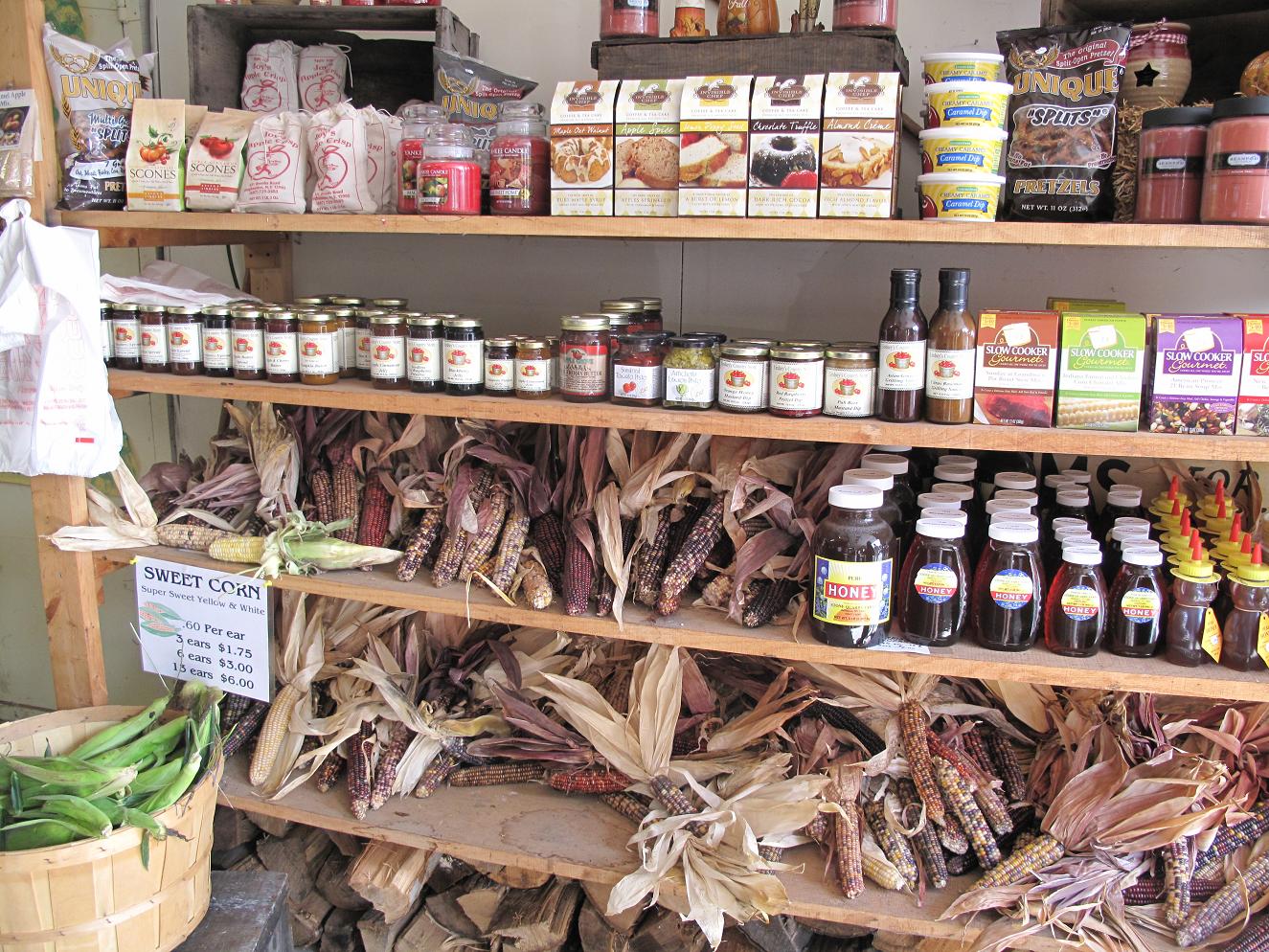


We spent a bit of time in Riverview's shop. Marlie studied the bee colony and found the queen bee, Bill perused the Palatine cheeses, and Thomas and I took a direct route to the doughnuts.


In the end Marlie bought a bottle of Arbor Hill Chocolate Cabernet Sauvignon Wine Sauce made in the Finger Lakes and a cut of Wisconsin Horseradish Gourmet Cheese. Thomas and I got cider and doughnuts, and I picked up my annual jar of Riverview Peach Preserves.


This weekend the orchards were seeing a steady business but were not overwhelmed with families. We were able to sit on the front porch at Riverview and have our snack while the doughnuts were still warm.


Next weekend (September 17/18) is the Clifton Park Farm Fest. Then every farm in the area will be hopping. If you have never attended Farm Fest, it's definitely a must-do. Check it out at http://www.cliftonparkfarms.org/ and click on Farm Fest 2011.


For now, we would head back to Albany, where I would juggle everything in my refrigerator to accomodate the half-bushel of apples we had just picked. We might be back in October to pick Northern Spy apples (the best for baking in my opinion), and maybe some Fujis for eating. And by then, I'd probably have a hankering for more doughnuts!

Sunday, July 31, 2011

My August Childhood

Early on every morning of my childhood between mid and late July, I awoke to the rhythm of horses' hooves coming from the Oklahoma training track across the street from our Fifth Avenue home in Saratoga Springs. I lay in my bed, eyes closed, listening. First one set of hooves, then another, faster, approaching and disappearing, or a group of them together. Sometimes conversation or the gentle crooning of "workout boys," as we called them then, joined the rhythm.

I would roll out of bed, and kneel on the floor, my elbows perched on the windowsill, my chin resting on my hands. I hoped to catch glimpses of the horses between the houses and trees that partially blocked my view. I was glad that my bedroom was in the front of the house where I could begin my summer mornings this way.


But by August, when racing traditionally began, I had moved my sleeping quarters to the basement where my older sister, Carolyn, and I would spend the month, because my parents rented the four upstairs bedrooms. In the final days of July, we emptied our closets, our desks and dressers, and made the rooms look ready for our "roomers." My parents slept in the livingroom for the month using the hide-a-bed (a fold-out sofa), opening it every night and closing it up every morning.

In the early years, my parents put a wooden sign on the lawn that read "ROOMS" in my mothers artistic lettering. Before long, we became part of the network of Saratogians who rented rooms or houses to August people, bringing in some additional household cash. When the husbands went to work for the day, housewives knew who to call. Lois might call my mother, "I have a man who needs a room and mine are full. Do you have anything?" My mother might call Marilyn, "I have two men, but can only take one more. Can I send the other to you?"


Our four bedrooms were always full, either from people who came year after year, or from someone who knew someone who recommended someone who needed a place. Most of the time our roomers were employed by the track. A few came to play the horses, but my parents preferred not to have flighty bettors who might not be depended upon to stay the entire four-week season.


Because our upstairs had only one bathroom, my parents almost always rented exclusively to men. "The men don't want to share the bathroom with women," my mother would say. Occasionally, a wife might be allowed to visit on the weekend.


We had Mr. Snow who loved "coming up to the country." He complimented my violin practice, and, when he returned to Queens, he sent me first-day-covers for my stamp collection. On Tuesdays, the track's dark day, Mr. Snow drove out to Washington County for Hand melons, and to Winslow's on route 9 for their turkey dinner.


Mr. Ludski did not have a car. Since our house was an easy walk to the flat track, this wasn't a problem, but in his free time he wanted to find unusual flowers. He would prowl the roadsides and nearby parks assuaging his botanical interest, walking many miles on a Tuesday. When he returned to New York, he would scatter seeds of wildflowers in Central Park.


We had a horse salesman from Ireland; the "boys," Charlie, and Marshall Cassidy, who were just beginning long careers with the New York Racing Association; the "three musketeers" who came back to the house in a slump if they had lost that day, and the "girls," who came only one season, adding drama and glamour, their sequined ball gowns hanging from the door jambs; and countless others.


In the mornings, Carolyn and I had a few chores. The men would leave by 6 a.m. My mother went into action instantly. I emptied the ash trays and waste baskets, and brought used sheets, towels, and water glasses to the kitchen. Waste baskets would be filled with pink sheets and The New York Times. How strange it seems to me now that the men smoked in the bedrooms! Further dating my experience to the 1960s and 70s, each man had a small fan to keep himself comfortable on the hot nights. Few people had, and no one expected, air conditioners.


Bedsheets were changed every third day. My mother had two long clotheslines across our large back yard. Sheets and towels went from end-to-end and side-to side. If rain persisted, she hung the laundry in the basement, but that would be a stressful week. Before any of the men might reappear, she would race up the stairs with cleaning supplies in hand. By 10 a.m., in her "work dress," as she called the A-line sleeveless shifts she made for summer, she was ready to sit for just a minute in the livingroom in front of one of our large oscillating fans, wiping her face with a kleenex.


Most of the men would return in the late morning and leave again before the 1:00 post-time. When we heard the track's bugle call from our house, we knew they would be gone until 6 p.m., around the time of the final race. Then they would go out for dinner, and be in by 8:00, ready to study the news for tomorrow's race day. Somewhere in-between times, Carolyn and I had to run upstairs to take our showers. Our first floor only had a half-bath. If we missed our chance for the day, we had to take a sponge bath in the basement set-tubs.


Carolyn and I liked sleeping in the basement. We had comfortable twin beds without bedspreads so they were easier to make each morning. The basement was cooler than our upstairs rooms, and sharing a room for a while was fun. In addition, our toys were in the basement, and we really weren't too worried about making that window of time for an upstairs bath. Some of this novelty wore off as we got to high school and college, but, for the two of us, the racing season always brought a sense of newness and curiosity.


For one week each August, my parents shipped us off to our grandparents who lived in a small rural home in the Berkshires of Massachusetts. We swam in the nearby river, sent sticks sailing in the brook, picked raspberries, helped our grandfather in his toy shop, climbed the apple trees, ate four meals a day, walked a half-mile to the tiny post office for the mail and a treat, and were doted upon but not spoiled (horrors!). If it sounds idyllic, that's because it was.

Some years, we also spent an August week at our aunt and uncle's in northern New Jersey. Then we might get a trip to the ocean where there were boardwalks and salt water taffy, an exotic outing for children who grew up with Adirondack lakes. At their suburban Victorian home, we ate gingersnaps from a box and made leaves burn using the sun and a magnifying glass.


But back in Saratoga, we found plenty to do. We could pick up the Spa bus on Circular Street and ride out to the Peerless Pools. Orthodox Jews who rented places on Phila Street also rode the bus, getting off at the Lincoln Baths. By the time I was ten, my best friend, Patti, and I could ride our bikes the four miles to the Spa pools or to play in Ferndell Spring.


For a few years, Patti and I made a checklist with the name of every state on a piece of paper. Riding our bikes, studying the license plates of the cars parked along the sidestreets, we tried to find a car for every state in the country. (Nooo, we did not have cars parked on the front yards. Our neighborhood of finely groomed grass never allowed such a thing!) Any state in the northeast was an easy find. More distant places like Illinois or Georgia intrigued us, but Alaska and Hawaii were the real trophies. Years could go by without finding one of those, although now and then a Rolls Royce with a British license plate crossed our path! This required adding a whole new line on our checklist.


And we were horse crazy. Patti and I drew horses, painted horse pictures, pretended to be horses, talked horses with our friends, read every girl-and-her-horse story we could find, and knew the different horse breeds from books. Even though my parents rarely went to the races and kids were not allowed to go, we made regular pilgrimages to the flat track early in the morning to watch the workout. We always had some knowledge of the year's star horses and jockeys and hoped to see them.


Then August would come to a close. Before the Henning Road entry, horse trailers rumbled up our street to the stables a few blocks away. We were ready for it all to end. My mother looked forward to taking down one of the two clotheslines and folding up that hide-a-bed until company came for Christmas. Carolyn and I had tired of our toys and the basement. We had nice bedrooms and were ready to reclaim them.


No sooner had the last roomer walked out the front door, than we began cleaning and moving our clothes back upstairs. Now horse trailers went by in the opposite direction with horses peering out from behind the small windows. Still, a few of them stayed a while and worked out across the street. In the misty cool late-summer mornings, the rhythm of hooves would wake me as I again slept in my bedroom. Now-and-then I would hear the soft singing of the workout boys whom I knew sat high in the saddle of the sleek thoroughbreds as they went around the Oklahoma Track.


By early September, the horses would all have gone, just leaving their flies behind. Cars no longer parked along the street, August's earnings went into the budget, and my mother went back to her part-time job at Skidmore College, while Carolyn and I headed to school.

After I graduated from college in 1978, my parents rented to just a few people for a couple of weeks during August for the Fasig-Tipton yearling sales. Before long, they stopped having roomers altogether. Still, until they sold the Fifth Avenue house in 2007, I made a point of staying overnight in my childhood bedroom once during the season and listening to the sound of horses' hooves going by.

I'll be heading to Saratoga tonight and will have my calendar in hand. My parents and I need to find a date to go early to the flat track and watch the morning workouts and admire the sleek thoroughbreds. Maybe I'll even see a car with a British license plate parked along the street.

Thursday, July 7, 2011

What's in Sharon Springs these days?

When my friend, Maggie, said that our outing this summer would be to the town of Sharon Springs, she added, "Bring your camera. This will be perfect for your blog!"


I was a bit skeptical. Bill and I had explored Sharon Springs ten or fifteen years ago when it was on an upswing, featured in the local and national newspapers. Since then, I'd heard nothing of it. And also, as a Saratoga native, I knew that this town had always been Saratoga's second cousin.


As I climbed in Maggie's car, joining her teenage granddaughter, Jorian, Maggie's first words to me were, "Did you do your homework?" Uh-oh, I hastily changed the subject!


I didn't have to worry because our first stop for the day was My Sisters' Place Cafe in the "upstreet" area of Sharon Springs. Tucked away, it presented a comfortable setting that would make anyone feel at home. Margi, the owner, offered us the day's selections. I chose a highly-recommended omelet made with goat cheese and pesto. Although, truth be told, I could have chosen anything she mentioned--the food here is fresh and local, just what I like. The omelet came with side salad of mixed greens.


Maggie, Jorian, and I had pleasant conversation and then we headed outdoors. "Be sure to walk the labyrinth," Margi told us, describing how neighbors had built it for her, and that Amish carpenters who lived nearby had built the Tea House.


I have been to labyrinths--circles where the path goes in ever smaller rounds--at Kripalu in Lenox, and in Jackson's Garden at Union College in Schenectady. I had tried to understand their meditative aspect and I had diligently walked them both, but walking in circles just didn't do it for me. This serpentine labyrinth was just my style. Large and meandering with the tea house at the far end, it wandered across the lawn. I could imagine getting lost in thought on this narrow gravel path. Already, I was starting to see the charm of Sharon Springs in the 21st century.


Sharon Springs is a town of 517 residents (2009), but in its heyday it boasted a summer crowd of 10,000 sharing its population of rich and famous with Saratoga Springs, just to the north. By the mid-20th century, Sharon Springs, always known as a particular favorite of New York City's Jewish population, attracted holocaust survivors who could take the therapeutic spa treatments as part of a medical reparations package.


Maggie insisted that I try the Eye Water Spring, noted to improve vision and focus. Jorian agreed and hurried over for her own treatment. Having Jorian along added credibility. Okay, Maggie is a friend of nearly 25 years, but I knew you couldn't get anything past a 14 year old. I rubbed some of the water into my eyes and tasted it, clean, sweet, and not sulphury. Below is my picture of the spring today, along with a historic photo from the mid-1900s. Note the women rubbing their eyes.


Unfortunately, the bathhouse, below, has fallen into extreme disrepair. I was surprised when Maggie told me that it had been a working therapeutic center just five years ago. Since then, a Korean-American company bought many of the old properties in 2004, but have been absentee owners. Much speculation revolves around their plans as local folks despair while the spa and several very large old famous hotels crumble.


Past the Bath House, we walked on Main Street, the "downstreet" area of town, where many charming businesses looked welcoming on this summer day.


The historical society had restored an old schoolhouse, while businesses, new just in the last decade, gave the street charm and vitality. And the most famous restoration project, the American Hotel, made a good case for staying overnight here.


(Historic plaques line both sides of the street. This town is justifiably proud of its past.)


(Restored shop buildings and even some "bottle" art reflect glory days as an internationally known Spa.)


(We were full from our lunch at My Sisters' Place, or we might have considered this pretty cafe.)


(This lovely home is now a massage therapy business.)


(The American Hotel, true to its name, sports the red, white, and blue.)


Still, there remain signs of long-ago prosperity and modern neglect. Besides the old hotels, boarded up with tall ever-encroaching weeds, homes and guest houses on the side streets are desperate for repair. I was particularly taken with this one, where columns go nowhere. How long would they continue to stand? Yet, this same building had gorgeous detail, such as the stained glass above every window.


I wondered what would happen to these buildings. They looked ripe for arsonists, the final note to other buildings in this town and such as happens in so many places. And, despite the rural beauty of the surrounding rolling hills and farmland, who would come here in this day and age when few people touted the benefits of mineral waters?


(Stone steps once led to a grand Victorian home entry and a lion-bracketed bench faces a former garden area.)


The residents of Sharon Springs hope to encourage artists and artisans, billing the town as a place off the beaten path for the post-911 crowd of city dwellers seeking the restorative quiet of an artist's community. As such, some homes have been lovingly brought back to life.


For now, go to the cafes, check out the shops, have a massage, and walk the paths of history. Oh, and if you're adventurous, trundle down a path next to the bath house and try clarifying your vision. I didn't notice a difference, but that was before I saw the photo of those ladies from the 1930s. Maybe I need to get a nice white handkerchief and dab gently at my eyes. Splashing the water camping-style didn't do the trick. Still, Jorian swears by it. Well, Maggie does too, but I'm sticking with the opinion of a history-loving, grandmother-accompanying, high schooler.


Wednesday, June 1, 2011

Catskill Ramblings

If, as existentialist Jean-Paul Sartre believed, life after death happens only when someone remembers the deceased, then my parents-in-law, Bob and Mary Ellen Traver, have been alive these past couple of weeks. Pictured here is the single flower from Mom Traver's peony, a plant that my sister-in-law, Mary Jo, and I dug up and split five years ago when the family home in Prattsville was sold. Mary Jo's plant also offers only one single bloom each Spring.


In mid-May, Mary Jo and I managed to get together for a trip to Thomas Cole's house, Cedar Grove, by luck on the first clear blue-sky day after weeks of torrential rain. In the car, heading south, we chatted about our kids, books, music, work, and events since we had seen each other last. In familiar territory, we had no trouble finding Cedar Grove.


Thomas Cole painted wild Catskill mountain vistas in the early 1800s, and is considered the founder of the Hudson River School of painting, a genre which gave credibility to American Art in the early decades of the United States. Once a farm of hundreds of acres reaching from the hills to the Hudson River, Cedar Grove now consists of only a few acres. Despite being tucked between a synagogue, a busy street, residential homes, and the Rip Van Winkle Bridge, the home and views from the wide porch drew us instantly into Cole's time and art.


A large window inside the house echoed this porch view. How often had Thomas Cole gazed upon the mountains at all times of day and season, studying the light for his next painting? Mary Jo and I were sure we could find inspiration of some kind if our livingrooms and porches faced such a scene.

Eventually Cole moved his work to a studio (below) on the property where he could focus on his work away from the hubbub of an active household. And when he wasn't in the house or studio, he would hike through the forests, playing his flute and carrying a sketch pad and pencils.


In the visitor's center, we were fascinated by an "Art Trail" pamphlet that showed many of the sites painted by Hudson River School painters. The locations were familiar to us. Mary Jo had even taken her parents on a short walk to one of the sites long ago. Over the years, Bill and I had been to almost all of them.


A bend in the Catskill Creek was listed as the Artist point closest to Cedar Grove. We had driven over the bridge past this viewpoint a hundred times, often to visit Mom T. at the nursing home in Catskill.


Mary Jo and I remembered the area as unimpressive, but, Thomas Cole's painting fresh in our minds, we decided to check out the spot anyway. We parked the car at a nondescript abandoned pub and crossed the bridge to see the view better. We were both shocked. Had it always been this beautiful? Why had we not paid more attention to this scene over the years? We both knew without saying it, that visits to an ailing parent had consumed our focus.


We decided to drive the short distance across the Hudson to Olana, also on the Art Trail and home to another Hudson River School painter and student of Thomas Cole, Frederic Church. From Olana's hill-top setting, the Hudson River curved below backed by clear blue mountains. No question, art imitated life for these artists.


On the way home, Mary Jo and I stopped at Stewart's for an ice cream cone. I went for a chocolate variety. Mary Jo ordered butter pecan, Dad Traver's favorite and a favorite of hers as well.

By now, I was pretty hooked on the Art Trail

and decided that Bill and I needed to go back to

some of the locations in the pamphlet that we had hiked before we were married.


The Sunday after Mary Jo and I had made the trip to Cedar Grove, Bill and I headed west into the Catskill Mountains on route 23A. Every stretch of this road brought back memories. Dad T. had driven a privately contracted U.S. Mail route stopping at post offices from Grand Gorge to Saugerties. Narrowly hugging the side of the mountain, the road was often treacherous. Still, its beauty was, and is still, unsurpassed.


I met Bill during our freshman year of college. The following fall, we went to Prattsville for a weekend and chose to accompany Dad T. on his Friday evening drive through Hunter and Tannersville. I was in awe of the fall foliage, the rock-bound narrow road, and rolling farmland. On the way back to Prattsville, we stopped to pick up a pizza for dinner in Tannersville, the closest pizza shop in the Northern Catskills.


By the following spring, again visiting from college, Bill and I fit in our first Catskill hike, a walk to the site of the Catskill Mountain House. I remembered a comfortable path through the woods, and a view looking down on North and South Lakes, with the Hudson far beyond. Not long after, Bill took me to Kaaterskill Falls.


Now, thirty-five years later, I wanted to see these places again, for old-times-sake, but also from the perspective of the Hudson River School painters. Our first short hike this day would be to Kaaterskill Falls. A kiosk at the trailhead showed both the pencil sketch and the final painting that Thomas Cole created from this location.


Today's weather was gray and damp. As we approached the falls, we heard the roar of water running fast from recent heavy rains. Bill and I talked about our trip here long ago when the water came down in a thinner stream and the trail went much higher alongside the falls. Our old hiking book encouraged walking on the narrow ledge that went underneath the falls for a more dramatic experience. At the time this was part of the thrill, but not today--the trail ends at the base with danger signs in bold yellow.


Back at the car, we continued on to the trailheads in the North-South Lake area, pulling into the DEC parking lot just before the state park entrance. Over the years, Bill and I had hiked in the Catskills regularly, but we had never been back to some of our early outings. It seemed amazing that we could return to these same landmarks after so many years and life-experience together. I re-emphasized to him that the Catskill Mountain House site had been our first hike.


Bill studied all the trail signs next to the parking area that listed the lakes and the sites of various hotels, now long gone, and said, "I don't think we hiked to the Catskill Mountain House that first time. I think we hiked to the Kaaterskill House."


Say-what??? "But it was always the Catskill Mountain House. I would have remembered if it was a different but similar word," I blurted out, stunned. I even had photographs with the name written on them.


"Oh well, I might have said Catskill, but, back then, I was into it being Kaaterskill with a 'K.'" Clearly, my teenage charm and beauty had overwhelmed Bill's ability to differentiate details!


He added, "Anyway, you're into the Hudson River School places today, so it doesn't really matter."


The fact was, I could tell right away that we had not hiked the trail to the Catskill Mountain House before, because most of the walk was on paved state park road. We looked at the trail for the Kaaterskill House and that seemed to fit our memories better. Apparently, I was not going to revisit our youth and a destination on the Art Trail at the same time.


"It may even have been the Laurel House," Bill said, now studying our maps. In my innocence, I had trusted this guy?


A heavy layer of fog descended on the mountain as we set off walking the two miles of park road to get to the half-mile trail to the Catskill Mountain House site. One of many huge Victorian hotels offering a view across the mountains, the Mountain House, and others like it, had enticed city dwellers to come by train for fresh air, relaxation, and renewed health. Most of these vacation spots for the wealthy had burned down in the first half of the twentieth century.


Today there would be no views. I could hardly even see Bill on the trail ahead of me. Now and then we stumbled upon a sign indicating that we were still going in the right direction.


When we reached the summit, a few people sat on the rocks having a picnic in the fog. Even though it was not actually raining, water dripped from our hair and eyebrows. We could only imagine the view across the valley.


In fact, we could imagine it well because it was basically the same view we had seen from many other places in the North-South Lake trail system. And who's to say those Hudson River School painters weren't also at those locations recapturing the beauty of the lakes and valley below on canvas?


Eventually, we drove back to Route 23A, again remembering Dad T. and the mail truck. For years he had driven the mid-day route to Saugerties with his Saint Bernard dog, Holly, in the passenger seat. Postmasters at each town along the way greeted them both; and just about lunch time, they hit the McDonald's in Saugerties, each getting a Big Mac.

Today, we went by the old house, now hardly recognizable since the new owners took down the pines, adding on and redesigning its shape. Over the Schoharie Creek and up the hill we climbed to the town cemetery where we found the family stone. Bill and I pulled away a few high grasses; I would be sure to tell Mary Jo that "2010" had been properly etched into the granite.


We took the back road home, over the ridge above the valley and the town of Windham. I had never tired of this ride in all the years we had driven it regularly. Today huge lilac bushes stood in full bloom at every farm house, and blossomed profusely in fields where farm houses must have once stood.


At home, I decided that we should have some butter pecan ice cream. I make it from the Ben & Jerry's Ice Cream Cookbook. Before even mixing the cream, the pecans are browned in a stick of real butter. Wouldn't Dad Traver have loved this? I made the mix, chilled it overnight, and then put it all in my ice cream machine the next day. Rich and creamy with sweet butter and nuts.


And yesterday, Mom Traver's peony bloomed.


Sunday, May 15, 2011

Walkway Over the Hudson

When the new Walkway Over the Hudson opened in 2009, I knew I wanted to check it out. A mile and a quarter in length, the walkway was built on an old railroad bridge, connecting the west side of the river at Highland to the city of Poughkeepsie on the east. I was sure that views would be fabulous from this high point above the river, but months went by, and I did not get there. It seemed like a long drive for a short outing, and never seemed to fit in with any of our trips along the thruway.


Finally, I decided that if I offered the new park as an Adirondack Mountain Club outing, other people who, like me, might have thought of going but just hadn't prioritized it, might join me. Getting it on the calendar was the first step.


I had a group of eight on a chilly gray Spring day. Only one participant had been to the walkway before. We drove down the west side of the river and parked in the lot for the nearby bike path, where parking is free. As a New York State Park, the Walkway parking costs $5. On this day, finding a parking spot was not difficult. A kiosk, with a nearby bathroom and picnic tables, provided us all with park brochures and maps.


The walkway is 24 feet wide and feels very stable. No one felt insecure above the trees and water. We took our time, looking in every direction. Clouds hung heavy, but high, and the wind blew strong and chilly. We were glad we had brought hooded sweatshirts and windbreakers.


The website had suggested a 3.6 mile loop which would take us across the bridge, south through a small portion of Poughkeepsie, back across the Mid-Hudson Bridge, and north to our parking lot. Below is a view to the south with the Mid-Hudson Bridge in the foreground, Hudson Highlands to the south, and a riverside park and tour boat on the lower left in Poughkeepsie.


On both sides of the Walkway, plaques are posted describing the history of the bridge, from its beginnings with the railroad to its current restoration for pedestrian use. The park also has a cell phone audio tour.


We stopped often to read the plaques and to talk about the views. It took us an hour and twenty minutes to walk the mile and a quarter. We studied the buildings along both sides of the river, the city of Poughkeepsie and its new train station, boats that sailed below, and mountains that tried to come out from under the clouds, as we wandered back and forth across the bridge in a zigzag line from west to east.


Finally, the sky opened up and the Catskills to the North came out in shades of blue. We watched as a mile-long freight train rounded the Western shore.


At the east side, the Walkway ends as it had begun on the west side, with a kiosk, picnic tables, a bathroom, and parking lot. With map in hand, we followed the streets into an Italian section of Poughkeepsie. Every street corner was well-marked (note the third sign down on the pole), directing our progress on the loop trail.


Just beyond the train station, we found many restaurants. Something to keep in mind if we come sometime without a picnic lunch. This area has changed considerably from ten or fifteen years ago when I used to come here to get the Metro-North train for New York City, a huge financial savings when we brought a full car with kids, and before Trailways and Megabus made travel to the City cheaper with fare wars.


From the Walkway, we had seen a rushing creek going through the city and tumbling into a large waterfall before reaching the Hudson. Now at ground level, we meandered alongside the rushing water by a stone wall in a residential neighborhood. We followed the Park Loop signs along a sidewalk where a few remaining cherry blossoms dropped petals to our feet.


In ADK tradition, we had our lunches in backpacks and were happy to find the waterfront park that we had seen from the Walkway. The sun came out in full and we soaked it up, visiting and enjoying a picnic with the Walkway Over The Hudson visible in the background.


Signs led us onto the Mid-Hudson Bridge. This bridge walk is narrow, with traffic nearby. We could feel the vibrations of the cars, but no one seemed unnerved by this, and, now with a clear sky, we could enjoy the views again.


At the foot of each tower, a speaker plays Bridge Music, percussive music performed by hitting various metal sections of the bridge with mallets and hammers. A panel lists the different pieces and we could push a button to choose a selection.


Eventually we reached the west side again, and an additional half-mile walk took us back to the park entry. We met two park rangers who offered to answer any questions we might have. Also, twice, we had seen park ATV's cross the bridge. This is a safe place with helpful staff.


We were happy to have experienced this park that we had read and heard about over the last year and a half. Since it is 80 miles from home, and only a 3.6 mile walk, I don't expect to come here often. If I lived closer, I could imagine taking an occasional stroll, especially in the summer when the breezes would be refreshing and many more boats would be on the water. Still, I recommend that anyone come here once. Check out this newest park in the New York State system.